
Chef Juliette
Various Almond Preparations
Five almond preparations, one discipline: remove the skins cleanly, dry every kernel through, then cut, toast, or cloak it in pale caramel without letting its fragrant oils escape.
A cooking platform built around craft, culture, and the stories behind what we eat.
Created by Chef Juliette
Based on No. 2570, Oranges à la Norvégienne, from Le Guide Culinaire (1907) by Auguste Escoffier
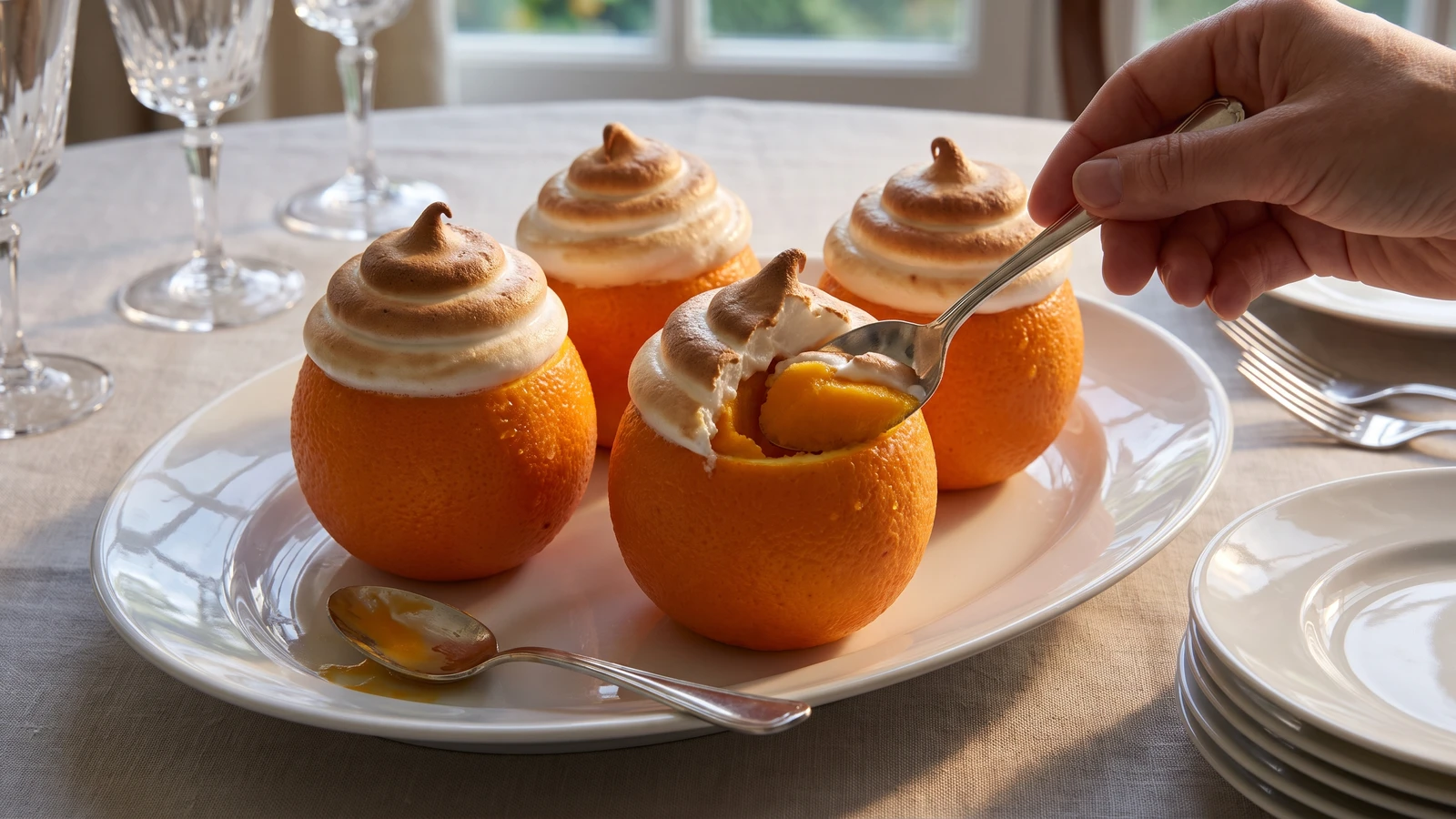
Four frozen orange shells beneath high meringue crowns, browned in seconds under the grill: a bright celebration dessert whose whole lesson is the discipline of hot against cold.
Oranges à la Norvégienne (orange shells filled with citrus ice and crowned with Italian meringue) teaches the cleanest hot-and-cold lesson in the dessert canon: the outside must colour before the inside has time to soften. That is the one true thing to know before touching a pan. Everything else prepares you for those few seconds beneath fierce heat.
The book assumed brigade quantities, orange ice and Meringue à l’Italienne (No. 2383) waiting as separate preparations, broken ice on command, and a salamander hot enough to colour on contact. A home kitchen offers a freezer, four fruit shells, a metal tray of crushed ice, and a broiler or grill turned fully high. We scale only the service, not the intent: two cups each of citrus ice and finished meringue, the filled shells frozen hard, then browned fast. One cook, one stove, one evening.
Making a great basin of meringue and holding a salamander are brigade scaffolding. Hollowing the fruit, filling it only three-parts, covering the cold centre completely, and colouring the meringue at speed are the dish and must stay. Freeze the filled shells until they feel stone-firm before you pipe. That firmness is your margin, and the quick colour is your victory.
Oranges à la Norvégienne belong to the Parisian grand-kitchen and banquet repertory, where cooks delighted in protecting frozen interiors beneath rapidly coloured meringue. Norvégienne does not claim Norwegian authorship; in classical French naming, Norway supplied an image of northern cold, much as the related omelette norvégienne concealed ice beneath its insulating cover. The orange-shell form carried that dramatic contrast into individual service, with the fruit serving as flavour, vessel, and a second layer of insulation.
Quantity
4 (about 2 1/2 lb / 1.1 kg total)
Quantity
2 cups (475 ml / about 400 g)
Quantity
2 cups (475 ml / about 180 g) Meringue à l’Italienne (No. 2383)
finished and at cool room temperature
Quantity
6 cups (1.4 L / about 900 g)
| Ingredient | Quantity |
|---|---|
| medium navel oranges | 4 (about 2 1/2 lb / 1.1 kg total) |
| orange ice or smooth water-based orange sorbet | 2 cups (475 ml / about 400 g) |
| Meringue à l’Italiennefinished and at cool room temperature | 2 cups (475 ml / about 180 g) Meringue à l’Italienne (No. 2383) |
| crushed ice | 6 cups (1.4 L / about 900 g) |
Wash and dry the oranges. Cut a neat slice about 1/2 inch (1.25 cm) thick from the top of each, then use a grapefruit spoon or small teaspoon to loosen and remove the flesh without piercing the peel. Scrape away loose membranes, but leave the white pith intact because it helps insulate the frozen centre. Reserve the fruit and juice for another use. If you make a small hole, press a patch cut from one of the removed lids against it from inside. Ça se rattrape. Stand the shells upright and freeze them for 30 minutes.
Let the orange ice or sorbet soften only until a spoon can pass through it, about 5 minutes. Pack it firmly into each frozen shell, pressing out air pockets, and stop when the shell is three-parts full. That empty upper quarter belongs to the meringue. Return the filled oranges to the freezer for at least 1 hour, until the centres are thoroughly hard. If the sorbet became soft while you worked, no harm is done; freeze by feel, not by the clock, and do not proceed until it is firm.
Set the oven rack 3 to 4 inches (8 to 10 cm) below the broiler or grill and heat it on its highest setting for a full 10 minutes. Spread the crushed ice about 1 inch (2.5 cm) deep across a rimmed metal sheet pan and make four snug nests. Transfer the frozen oranges to the ice and wipe their rims dry. Use metal here, not glass or ceramic, which can object violently to the meeting of ice and fierce heat.
Fit a piping bag with a large star tip and fill it with the Meringue à l’Italienne (No. 2383). Pipe a ring directly onto each dry rim to anchor the covering, then continue in overlapping spirals until the sorbet is completely sealed beneath a generous crown. Leave no gaps. If the meringue slides, the rim is damp or the mixture has slackened; wipe the peel dry and whisk the meringue briefly until it holds a ridge again. If it still refuses the piping bag, spoon it into a thick, smooth cap. Ça se rattrape. Coverage carries the technique, not the fluting.
Slide the ice-filled tray beneath the fully heated broiler and watch without turning away. Rotate the pan once if the heat is uneven, then remove it as soon as the ridges show hazelnut-brown tips while the hollows remain ivory, usually 20 to 45 seconds. The colouring must be swift. If the meringue remains pale after 45 seconds, return the oranges to the freezer, replace any melting ice, let the broiler recover fully, and try again with the rack slightly closer. Waiting beneath weak heat melts the centre before it colours.
Lift the oranges from the ice, wipe their bases, and set each one on a chilled dessert plate or in a shallow bowl that will hold it steady. Serve immediately, while the meringue tips are newly bronzed and the orange centre remains firm and vivid. Give everyone a spoon and let the warm crown collapse into the cold fruit. À table!
1 serving (about 145g)
Culinary guides, cultural storytelling, and the editorial depth that makes cooking meaningful.
Discover Culinary ExplorerChef Juliette
Five almond preparations, one discipline: remove the skins cleanly, dry every kernel through, then cut, toast, or cloak it in pale caramel without letting its fragrant oils escape.

Chef Juliette
A pastry pantry lesson in one tray: filberts warmed only until their red skins release, rubbed clean, cooled, and chopped into a fragrant mise-en-place for cakes, creams, pralines, and petits fours.

Chef Juliette
The smallest pâtisserie discipline decides whether a cake leaves its mould intact: clarified butter in every corner, followed by the lightest veil of dry flour or fécule.

Chef Juliette
Four whites, one spotless bowl, and a patient change of speed: whisk gently until loosened, then briskly to glossy stiffness, with powdered sugar waiting if the foam begins to granulate.