
Chef Juliette
Various Almond Preparations
Five almond preparations, one discipline: remove the skins cleanly, dry every kernel through, then cut, toast, or cloak it in pale caramel without letting its fragrant oils escape.
A cooking platform built around craft, culture, and the stories behind what we eat.
Created by Chef Juliette
Based on No. 2567, Cherries à la Valeria, from Le Guide Culinaire (1907) by Auguste Escoffier
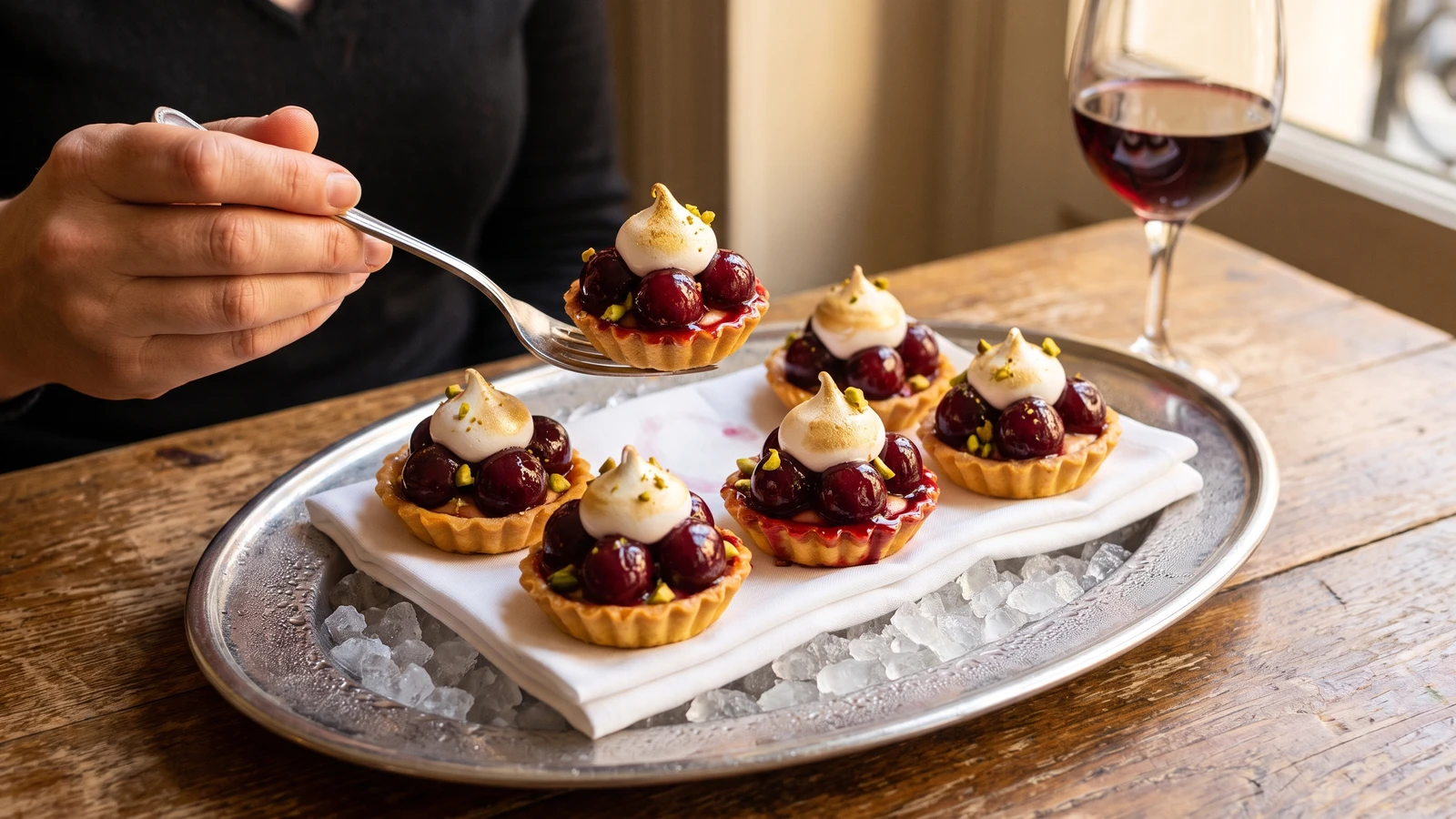
Cerises à la Valeria teaches temperature discipline: creamy red-currant ice in crisp tartlets, sheltered by vanilla meringue, then crowned with Bordeaux-poached cherries and a bright pistachio finish.
Cerises à la Valeria (Valeria cherry tartlets) teaches the discipline of temperature. The one true thing to know before touching a pan is that the red-currant ice must remain frozen while everything above it is finished with heat. Crisp pâte sucrée holds the ice, Meringue à l’Italienne (No. 2383), Italian meringue, protects it, and wine-dark cherries give the little tartlets their generous crown.
The original formula assumed pastry and frozen-dessert stations, its meringue waiting from a separate preparation, and enough hands to carry a platter over broken ice into oven heat without hesitation. At home, use a hard-frozen filling on a small metal tray nested over broken ice, then give the meringue seconds beneath a fierce broiler. The brigade's extra hands are scaffolding and can go. The frozen base, the cold cradle, the sequence of meringue, cherries, heat, and syrup must stay.
When they're right, the pastry is crisp, the currant layer tart and creamy, and the cherries gleam deep garnet under green pistachios. One cook, one stove, one evening, but begin early enough to freeze the filled shells solid. That final cold must be absolute before the broiler comes on.
Cerises à la Valeria belongs to the Parisian grand-kitchen repertory of named entremets, where pastry, fruit ice, poached fruit, and meringue were assembled at the last moment from preparations made by separate stations. Bordeaux in the poaching wine does not make the dessert Bordelais; the wine is one element in a composition drawn from the national classical canon. Its most surprising practice, sending a dish over broken ice into oven heat, used the ice as a thermal shield while the meringue dried.
Quantity
1 cup (240 ml / 125 g)
Quantity
⅓ cup (80 ml / 40 g)
Quantity
⅛ teaspoon (0.6 ml / 0.8 g)
Quantity
5 tablespoons (75 ml / 70 g)
cut into small cubes
Quantity
1
Quantity
1 teaspoon (5 ml / 5 g)
use only if needed
Quantity
3½ cups (840 ml / 400 g)
stemmed
Quantity
⅔ cup (160 ml / 135 g)
Quantity
½ cup (120 ml / 120 g)
Quantity
⅓ cup (80 ml / 80 g)
Quantity
2 cups (480 ml / 300 g)
stemmed and pitted while keeping them whole
Quantity
1½ cups (360 ml / 360 g)
Quantity
½ cup (120 ml / 100 g)
Quantity
1 cup (240 ml / 150 g) Meringue à l’Italienne (No. 2383)
prepared and cooled until thick but pipeable
Quantity
½ bean
seeds scraped
Quantity
2 tablespoons (30 ml / 18 g)
finely chopped
Quantity
6 cups (1.4 L / 1 kg)
| Ingredient | Quantity |
|---|---|
| all-purpose flour | 1 cup (240 ml / 125 g) |
| confectioners' sugar | ⅓ cup (80 ml / 40 g) |
| fine sea salt | ⅛ teaspoon (0.6 ml / 0.8 g) |
| cold unsalted buttercut into small cubes | 5 tablespoons (75 ml / 70 g) |
| large egg yolk | 1 |
| ice water (optional)use only if needed | 1 teaspoon (5 ml / 5 g) |
| fresh or frozen red currantsstemmed | 3½ cups (840 ml / 400 g) |
| granulated sugar for the red-currant base | ⅔ cup (160 ml / 135 g) |
| water | ½ cup (120 ml / 120 g) |
| cold heavy cream | ⅓ cup (80 ml / 80 g) |
| ripe red cherriesstemmed and pitted while keeping them whole | 2 cups (480 ml / 300 g) |
| dry red Bordeaux wine | 1½ cups (360 ml / 360 g) |
| granulated sugar for poaching | ½ cup (120 ml / 100 g) |
| Meringue à l’Italienneprepared and cooled until thick but pipeable | 1 cup (240 ml / 150 g) Meringue à l’Italienne (No. 2383) |
| vanilla beanseeds scraped | ½ bean |
| shelled unsalted pistachiosfinely chopped | 2 tablespoons (30 ml / 18 g) |
| broken ice | 6 cups (1.4 L / 1 kg) |
Combine the red currants, ⅔ cup sugar, and water in a small saucepan. Bring them to a gentle simmer, crushing the berries against the pan as they burst, and cook for 6 to 8 minutes until the liquid is brilliant red and the fruit has collapsed. Press everything through a fine sieve. Measure ⅓ cup (80 ml / about 90 g) of the strained liquid into the clean saucepan and simmer it down to ¼ cup (60 ml / about 70 g), just thick enough to coat a spoon. This is the red-currant syrup for finishing; chill it separately. Pour the remaining currant base into a shallow metal pan and cool it completely.
Whisk the flour, confectioners' sugar, and salt together. Rub in the cold butter with your fingertips until the mixture resembles fine crumbs, then add the egg yolk and press the dough together. If dry flour remains, add the ice water a few drops at a time. Stop as soon as the dough holds; kneading develops toughness. Flatten it into a disc, wrap it, and chill for 45 minutes.
Heat the oven to 350°F (175°C). Roll the chilled pâte sucrée between two sheets of parchment to about ⅛ inch (3 mm) thick. Line six 3-inch (8 cm) fluted metal tartlet tins, pressing the pastry into every corner without stretching it. Trim the rims and chill for 20 minutes. Line each shell with parchment and baking weights, then bake for 12 minutes. Remove the weights and bake for another 6 to 8 minutes, until evenly golden and dry at the base. Cool completely before unmolding.
Freeze the shallow pan of currant base until ice forms around the edges, about 45 minutes. Scrape it thoroughly with a fork, then repeat every 30 minutes until the whole mixture is finely crystalline and slushy. Whip the cold cream to soft peaks and fold it through the red-currant ice without crushing out all its lightness. Freeze until firm but still workable, about 1 hour. If it becomes solid before filling, leave it in the refrigerator for 10 minutes and beat it smooth with a sturdy spoon.
Bring the Bordeaux and ½ cup sugar to a gentle simmer in a saucepan just wide enough to hold the cherries. Stir until the sugar dissolves, add the pitted cherries, and keep the liquid at the faintest tremble for 3 to 5 minutes. The fruit should soften while remaining whole. Lift the cherries out with a slotted spoon and chill them in a single layer. If their skins begin splitting, remove them immediately; they will finish tenderizing as they cool. Reserve the poaching wine for another dessert or a glass of sparkling water.
Pack the creamy red-currant ice into the cold tartlet shells, filling each just to the pastry rim and smoothing the top. Set the tartlets on a small rimmed metal tray and freeze for at least 1 hour, until the filling is hard through the center. Don't continue while it is merely firm at the surface. This deep freeze is what buys you the seconds needed beneath the broiler.
Chill the serving platter. Pack the broken ice into a larger rimmed metal tray, keeping it below the rim so meltwater cannot slosh into the pastry. Nest the smaller tray of frozen tartlets securely over the ice. Use metal trays only; glass or ceramic can crack when carried directly from deep cold beneath fierce heat.
Fold the vanilla seeds gently through the prepared Meringue à l’Italienne (No. 2383). Transfer it to a piping bag fitted with a broad plain or star tip, then pipe a generous spiral over each frozen tartlet, covering the red-currant ice completely. Blot the chilled cherries very dry and press 4 or 5 into the meringue on each tartlet. The cherries belong in place before the heat, exactly as the composition requires.
Heat the broiler fully and place a rack about 6 inches (15 cm) below it. Carry the nested metal trays beneath the broiler for 15 to 20 seconds, rotate them, and repeat only until the meringue loses its wet shine and takes the faintest straw-gold color at its ridges. Work in seconds, not minutes. If the red-currant ice softens or the pastry begins sliding, stop and return the small tray to the freezer until hard, replace the broken ice, then continue. Ça se rattrape. A kitchen torch may be swept over the exposed meringue instead, always moving and avoiding the cherries.
Brush the cherries immediately with the cold red-currant syrup, letting it catch in their curves without flooding the meringue. If the syrup has jelled, loosen it drop by drop with cold water until it brushes cleanly. Sprinkle with the chopped pistachios. Arrange the tartlets on the chilled platter over a neatly folded white napkin, which steadies the shells and keeps them from direct contact with a warm plate. Serve at once. À table!
1 serving (about 300g)
Culinary guides, cultural storytelling, and the editorial depth that makes cooking meaningful.
Discover Culinary ExplorerChef Juliette
Five almond preparations, one discipline: remove the skins cleanly, dry every kernel through, then cut, toast, or cloak it in pale caramel without letting its fragrant oils escape.

Chef Juliette
A pastry pantry lesson in one tray: filberts warmed only until their red skins release, rubbed clean, cooled, and chopped into a fragrant mise-en-place for cakes, creams, pralines, and petits fours.

Chef Juliette
The smallest pâtisserie discipline decides whether a cake leaves its mould intact: clarified butter in every corner, followed by the lightest veil of dry flour or fécule.

Chef Juliette
Four whites, one spotless bowl, and a patient change of speed: whisk gently until loosened, then briskly to glossy stiffness, with powdered sugar waiting if the foam begins to granulate.