
Chef Juliette
Various Almond Preparations
Five almond preparations, one discipline: remove the skins cleanly, dry every kernel through, then cut, toast, or cloak it in pale caramel without letting its fragrant oils escape.
A cooking platform built around craft, culture, and the stories behind what we eat.
Created by Chef Juliette
Based on No. 2564, Bananas à la Norvégienne, from Le Guide Culinaire (1907) by Auguste Escoffier
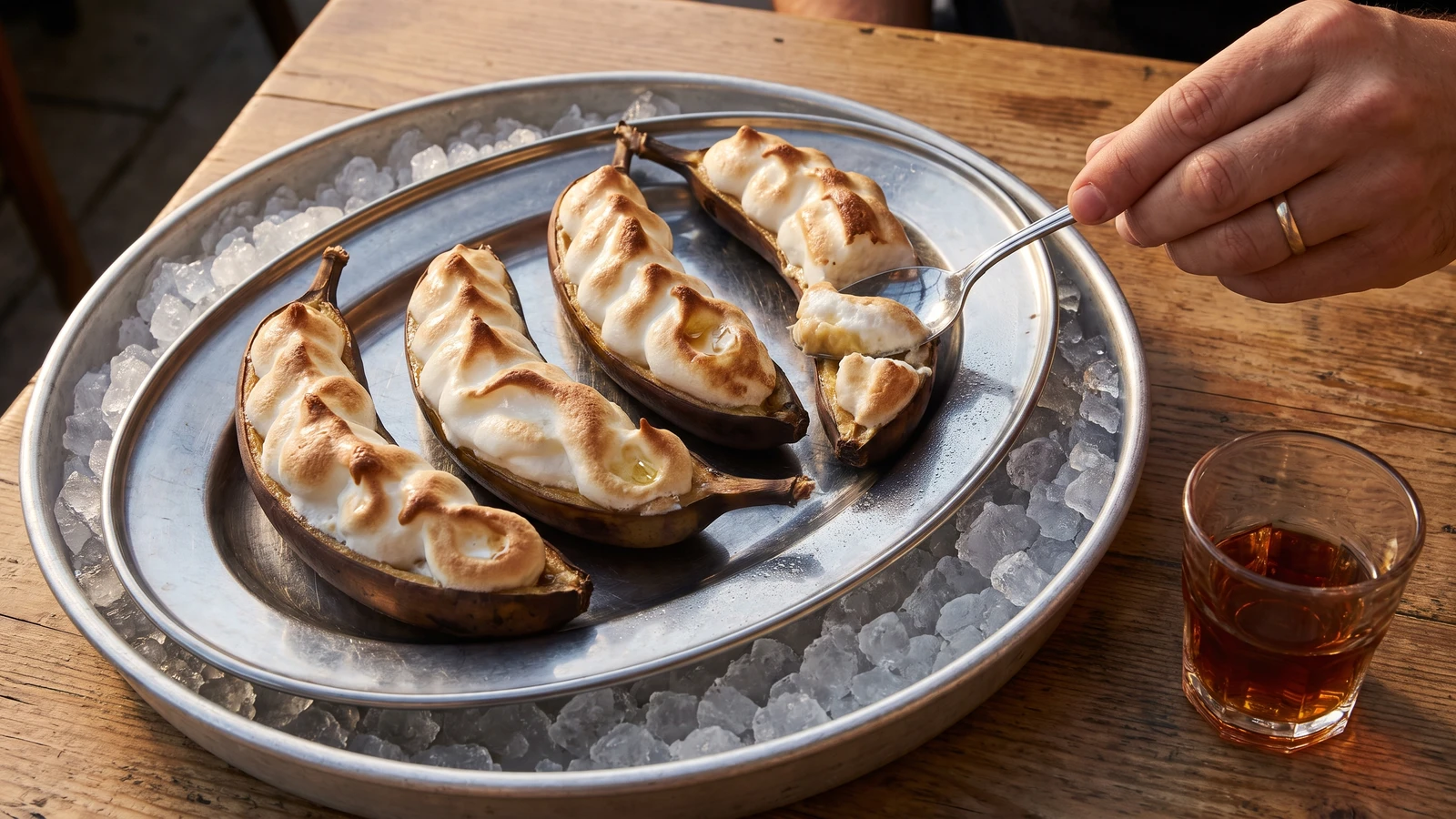
Banana skins cradle banana ice beneath a thick, grooved coat of rum-scented meringue, browned in a fierce flash while broken ice guards the frozen center. The insulation is the whole lesson.
Bananes à la Norvégienne (banana ice in its own skin beneath rum meringue) teaches one clean principle: insulation must be complete before heat arrives. The banana ice stays frozen not because the oven is gentle, but because a thick, unbroken coat of Meringue à l’Italienne (No. 2383), Italian meringue made stable with hot sugar, takes the blast and browns before the heat can travel inward. Leave one gap and the center begins to run.
The original entry assumed a pastry station with banana ice ready, a brigade-sized batch of meringue, hands that could pipe several portions at service speed, and a salamander fierce enough to color them in moments. Your honest equivalents are a fully heated broiler, a freezer-cold metal platter, and four bananas assembled one at a time. The oversized meringue yield is brigade scaffolding and has been scaled to 250 g; the three-quarter filling, rum flavor, grooved piping, broken-ice bed, and rapid browning are the dish, so they remain.
Before you cut a peel, have the ice, meringue, piping bag, and broiler ready. Once the banana ice enters the skin, speed matters, but coverage matters more. The one step that decides the dish is the seal: pipe thickly from peel edge to peel edge before the broiler sees it.
Bananes à la Norvégienne belongs to the Parisian grand-kitchen repertory of frozen entremets, not to Norway. The name borrows the snowy northern image of omelette norvégienne, in which a frozen center survives fierce heat because meringue slows the heat long enough for its surface to brown. This banana variation carries the same principle into an individual fruit shell, with rum giving the meringue its prescribed finish and broken ice buying the pastry cook a few more moments.
Quantity
4
well chilled
Quantity
1½ cups (355 ml / 340 g)
frozen firm but scoopable
Quantity
1 tablespoon (15 ml / 14 g)
Quantity
8 cups (1.9 L / 1.1 kg)
for the tray
| Ingredient | Quantity |
|---|---|
| medium just-ripe bananaswell chilled | 4 |
| prepared banana icefrozen firm but scoopable | 1½ cups (355 ml / 340 g) |
| Meringue à l’Italiennecooled fully | 3 cups (710 ml / 250 g) Meringue à l’Italienne (No. 2383) |
| dark rum | 1 tablespoon (15 ml / 14 g) |
| broken icefor the tray | 8 cups (1.9 L / 1.1 kg) |
Set an oven rack 10 to 12 cm (4 to 5 inches) below the broiler and heat it at its highest setting for at least 10 minutes. Put a small stainless-steel serving platter in the freezer while you work, and have the broken ice waiting beside a rimmed metal tray. Use metal throughout; glass and ceramic can crack when they meet the broiler and ice in the same service.
Lay each chilled banana on its natural curve. With a small sharp knife, cut away a long strip of peel about 2.5 cm (1 inch) wide from the upper side, stopping short of both ends so the shell keeps its strength. Ease out the pulp with a teaspoon, working in small pieces and taking care not to pierce the remaining peel. Arrange the emptied skins snugly on the cold metal platter and return it to the freezer while you prepare the meringue.
Fold the rum into the cooled Meringue à l’Italienne (No. 2383) with broad, deliberate strokes until evenly scented. Do not beat air out of it. Fit a piping bag with a small 6 mm (¼ inch) open-star tip, the home equivalent of the book's small grooved pipe, and fill the bag. If the rum loosens the meringue slightly, whisk it briefly by hand until a piped ridge holds again. Ça se rattrape.
Work with one banana at a time. Spoon banana ice into the hollow peel until it is three-quarters full, exactly as the original directs, then immediately pipe Meringue à l’Italienne (No. 2383) over the exposed ice in close grooved rows. Build a thick, continuous coat that touches the peel around the entire opening. Repeat with the remaining bananas. The seal is the technique: if even a pinhole of ice remains visible, patch it with reserved meringue before continuing.
Spread the broken ice about 4 cm (1½ inches) deep in the rimmed metal tray, then press the banana platter securely into it without letting meltwater rise over the platter's rim. Slide the entire arrangement under the fully heated broiler and watch without looking away. Brown for 45 to 90 seconds, rotating once if necessary, until the grooved peaks are deep hazelnut and the hollows remain ivory-gold. If color is slow after a minute, pull the tray out and let the broiler recover rather than leaving the frozen center under weak heat.
Wipe the outside and rim of the metal tray dry, set it on a heatproof board, and carry the bananas to the table still nested over broken ice. Serve immediately, one banana to each guest, while the meringue is bronzed outside and the banana ice remains firm within. À table!
1 serving (about 270g)
Culinary guides, cultural storytelling, and the editorial depth that makes cooking meaningful.
Discover Culinary ExplorerChef Juliette
Five almond preparations, one discipline: remove the skins cleanly, dry every kernel through, then cut, toast, or cloak it in pale caramel without letting its fragrant oils escape.

Chef Juliette
A pastry pantry lesson in one tray: filberts warmed only until their red skins release, rubbed clean, cooled, and chopped into a fragrant mise-en-place for cakes, creams, pralines, and petits fours.

Chef Juliette
The smallest pâtisserie discipline decides whether a cake leaves its mould intact: clarified butter in every corner, followed by the lightest veil of dry flour or fécule.

Chef Juliette
Four whites, one spotless bowl, and a patient change of speed: whisk gently until loosened, then briskly to glossy stiffness, with powdered sugar waiting if the foam begins to granulate.