
Chef Juliette
Various Almond Preparations
Five almond preparations, one discipline: remove the skins cleanly, dry every kernel through, then cut, toast, or cloak it in pale caramel without letting its fragrant oils escape.
A cooking platform built around craft, culture, and the stories behind what we eat.
Created by Chef Juliette
Based on No. 2547, Timbale à la Favart, from Le Guide Culinaire (1907) by Auguste Escoffier
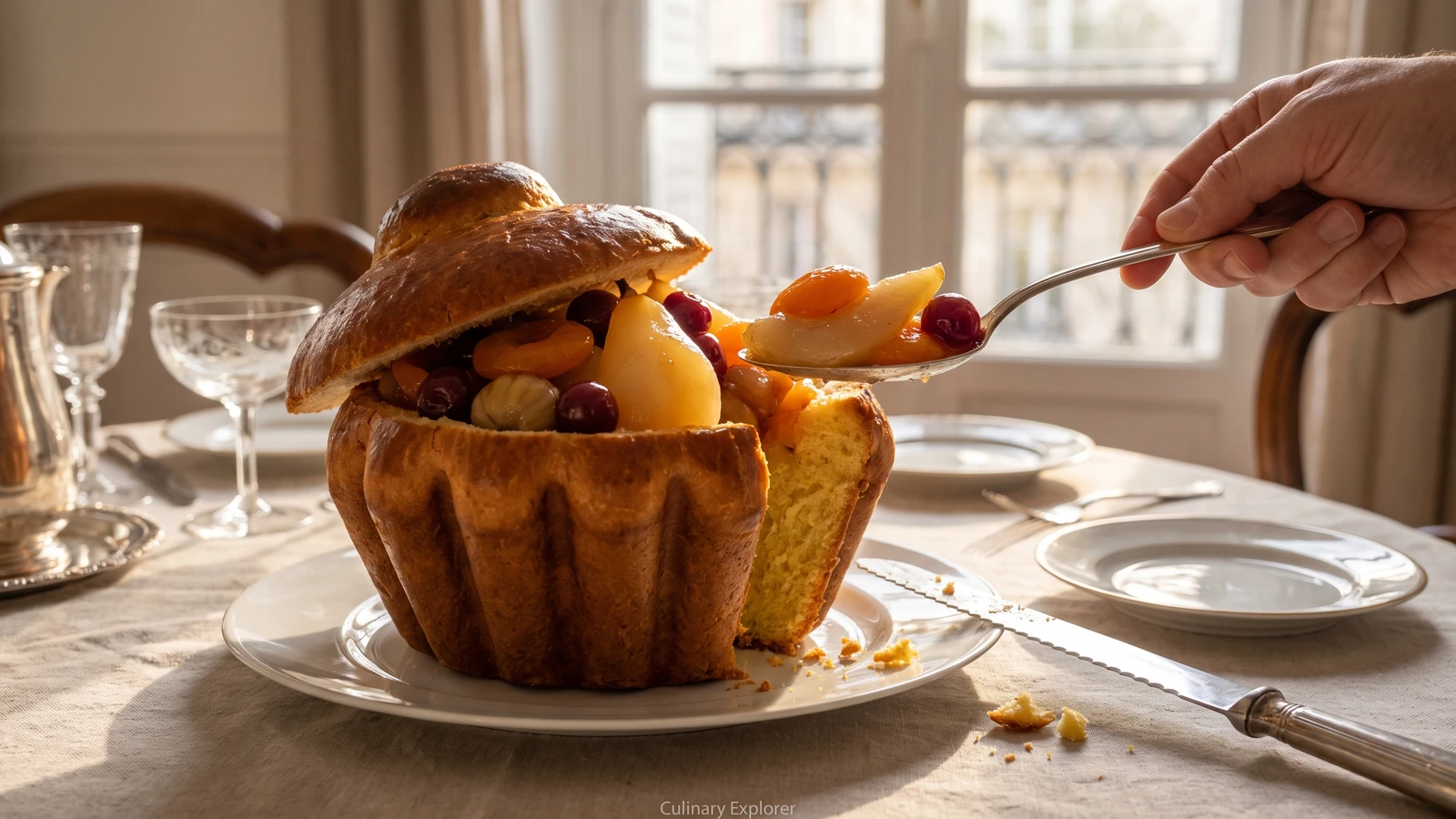
A burnished brioche shell filled at the last moment with whole fruit and vanilla chestnuts, held in a glossy apricot, kirsch, and chestnut binding that respects every shape.
Timbale à la Favart (a fruit-and-chestnut brioche timbale) teaches one decisive lesson: a bread shell and a syrupy filling may meet only at the last moment. Fill it early and the brioche drinks the syrup, loses its tender walls, and slumps. Filled at the table, it remains burnished outside and buttery within, holding glossy pears, apricots, cherries, and vanilla chestnuts as distinct pieces rather than a muddled compote.
The original assumed a pastry section, a Richelieu mould, separately prepared fruits, and enough chestnut purée for brigade service. Here a deep 18 cm fluted brioche or charlotte mould replaces the Richelieu mould, preserved fruit replaces several pans of poaching fruit, and strained apricot preserves become the waiting syrup. The original quart of chestnut purée is scaled to about three-quarters cup, enough to bind one home-sized timbale. The entry points backward for its decoration without supplying the pattern, so I won't invent one: the mould's fluting, a clear apricot sheen, and a few intact fruits at the opening give the shell its honest finish.
Separate poaching pans are brigade scaffolding and may go. The hollow brioche, whole or halved fruit, vanilla chestnuts, kirsch, and last-minute filling are the dish itself, and every one stays. One cook, one stove, one evening. Before you begin, remember the step that matters most: drain the fruit thoroughly and don't fill the timbale until everyone is ready to eat.
Timbale à la Favart belongs to the Parisian repertoire of named entremets, and Favart evokes the theatrical world of the Opéra-Comique and its Salle Favart rather than a chestnut-growing province. The dish carried brioche from the bakery basket into the grand pastry kitchen, where a shaped loaf became an edible mould for preserved fruit, vanilla chestnuts, and kirsch. Its whole-fruit rule is not mere ornament: distinct forms displayed a well-kept confectionery larder, while broken chestnuts gave the binding body without being wasted.
Quantity
2 cups (475 ml / 250 g)
Quantity
2 tablespoons (30 ml / 25 g)
Quantity
1½ teaspoons (7.5 ml / 5 g)
Quantity
1 teaspoon (5 ml / 5 g)
Quantity
3 (about 150 g out of shell)
at room temperature
Quantity
2 tablespoons (30 ml / 30 g)
lukewarm
Quantity
10 tablespoons (150 ml / 142 g)
softened but not greasy
Quantity
1 tablespoon (15 ml / 14 g)
Quantity
1 tablespoon (15 ml / 8 g)
Quantity
2⅔ cups (630 ml / 400 g)
select about 250 g intact and reserve 150 g broken pieces for the purée
Quantity
¾ cup (180 ml / 150 g)
Quantity
1 cup (240 ml / 240 g)
Quantity
1
split lengthwise
Quantity
4 halves (about 1¼ cups / 300 ml / 260 g drained)
drained, syrup reserved
Quantity
8 halves (about 1 cup / 240 ml / 200 g drained)
drained, syrup reserved
Quantity
1 cup (240 ml / 170 g)
drained, syrup reserved
Quantity
¾ cup (180 ml / 240 g)
Quantity
½ cup (120 ml / 120 g)
Quantity
3 tablespoons (45 ml / 43 g)
| Ingredient | Quantity |
|---|---|
| bread flour | 2 cups (475 ml / 250 g) |
| granulated sugar | 2 tablespoons (30 ml / 25 g) |
| instant yeast | 1½ teaspoons (7.5 ml / 5 g) |
| fine salt | 1 teaspoon (5 ml / 5 g) |
| large eggsat room temperature | 3 (about 150 g out of shell) |
| whole milklukewarm | 2 tablespoons (30 ml / 30 g) |
| unsalted buttersoftened but not greasy | 10 tablespoons (150 ml / 142 g) |
| unsalted butter for the mould | 1 tablespoon (15 ml / 14 g) |
| bread flour for the mould | 1 tablespoon (15 ml / 8 g) |
| cooked peeled chestnutsselect about 250 g intact and reserve 150 g broken pieces for the purée | 2⅔ cups (630 ml / 400 g) |
| granulated sugar for the vanilla syrup | ¾ cup (180 ml / 150 g) |
| water | 1 cup (240 ml / 240 g) |
| vanilla beansplit lengthwise | 1 |
| canned pear halves in light syrupdrained, syrup reserved | 4 halves (about 1¼ cups / 300 ml / 260 g drained) |
| canned apricot halves in light syrupdrained, syrup reserved | 8 halves (about 1 cup / 240 ml / 200 g drained) |
| whole pitted sour cherries in light syrupdrained, syrup reserved | 1 cup (240 ml / 170 g) |
| apricot preserves | ¾ cup (180 ml / 240 g) |
| reserved light fruit syrup | ½ cup (120 ml / 120 g) |
| dry kirsch | 3 tablespoons (45 ml / 43 g) |
Combine the bread flour, sugar, yeast, and salt in the bowl of a stand mixer. Add the eggs and lukewarm milk, then mix with the dough hook on low speed until no dry flour remains. Knead at medium-low speed for 8 minutes, scraping the bowl once or twice, until the dough becomes elastic and begins pulling cleanly from the sides. It will remain sticky. Don't bury it under extra flour, because that gives the timbale a dry, heavy shell.
Add the softened butter one tablespoon at a time, kneading until each addition disappears before adding the next. Continue kneading for 10 to 12 minutes, until the dough is glossy, supple, and thin enough to stretch into a translucent sheet without tearing. If it becomes greasy and slides around the bowl, the butter has grown too warm. Stop and chill the bowl for 10 minutes, then continue. Ça se rattrape. The finished dough should cling to itself, not leave a slick of butter behind.
Gather the dough into a ball and place it in a lightly buttered bowl. Cover and leave it at comfortable room temperature for 1 to 1½ hours, until visibly swollen but not necessarily doubled. Press out the accumulated gas, cover again, and chill for 1 hour. Chilling makes this butter-rich dough firm enough to shape and gives the baked shell a close, even crumb that can be hollowed without tearing.
While the dough chills, combine the sugar, water, vanilla bean, and its scraped seeds in a wide saucepan. Bring to a gentle simmer and stir only until the sugar dissolves. Slide in the chestnuts, keeping the intact ones in a single layer, and simmer at the barest tremble for 5 minutes. Cover, remove from the heat, and leave them in the syrup for 30 minutes. Lift out the intact chestnuts with a slotted spoon. Any that break have volunteered for the purée, which is precisely how the original kitchen used its chestnut remains.
Butter an 18 cm, 1.5 litre deep fluted brioche or charlotte mould generously, then dust it with the measured flour and knock out the excess. Shape the cold dough into a taut ball, set it seam-side down in the mould, and cover loosely. Leave it to proof for 1½ to 2 hours, until light, tremulous, and within about 2 cm of the rim. If a fingertip pressed gently into the surface springs back slowly and leaves a shallow mark, it is ready. A mark that vanishes immediately means it needs longer.
Heat the oven to 190°C (375°F). Bake the brioche for 35 to 40 minutes, turning the mould once for even colour, until the crust is deep butter-gold and the centre reaches 88 to 90°C (190 to 194°F). If the top darkens before the centre is ready, cover it loosely with foil. Rest the brioche in its mould for 10 minutes, turn it onto a rack, and cool completely for at least 1 hour. Hollowing warm brioche compresses the crumb into paste, so let it become entirely calm first.
Set the pear halves, apricot halves, and whole cherries on a rack over a tray for at least 45 minutes. Blot their undersides gently with a clean towel, keeping every piece whole or halved. Do not dice them. Their recognizable shape is the point of the Favart garnish, and proper draining keeps their packing syrup from loosening the chestnut binding.
Purée 150 g of the broken vanilla chestnuts with 3 to 5 tablespoons of their syrup, using only enough to make a perfectly smooth, thick purée measuring about ¾ cup. In a clean saucepan, combine the apricot preserves with the reserved fruit syrup and simmer for 5 to 7 minutes, until glossy and heavy enough to coat a spoon. Pass it through a fine sieve, reserve 3 tablespoons of the clear apricot syrup for glazing the shell, and let the remainder cool for 5 minutes. Stir in the kirsch, then fold in the chestnut purée. The binding should fall from the spoon in a broad ribbon. If it is stiff, loosen it with vanilla syrup one spoonful at a time; if it is loose, return it to gentle heat and reduce it before any fruit goes in.
Trim the base of the cooled brioche only if it rocks. Cut a lid about 2 cm thick from the top with a serrated knife, then pull out the inner crumb with your fingers, leaving walls and a base about 1½ cm thick. Work slowly around the flutes. If you make a small hole, press in a piece of reserved crumb brushed with apricot syrup; once glazed, the patch will hold. Brush the exterior lightly with the reserved clear apricot syrup and set the shell on its serving platter. Keep the lid beside it.
Just before serving, fold the drained pear halves, apricot halves, whole cherries, and intact vanilla chestnuts through the apricot-chestnut binding with a broad spoon. Turn the pieces rather than stirring them, so they remain themselves. If syrup collects at the bottom, lift out the fruit and reduce the binding alone for a minute, then cool it briefly and reunite them. Tip the glossy garnish gently into the brioche shell, set the lid at a jaunty angle, and bring it straight to the table. Cut the shell into wedges and spoon fruit beside each one. À table!
1 serving (about 260g)
Culinary guides, cultural storytelling, and the editorial depth that makes cooking meaningful.
Discover Culinary ExplorerChef Juliette
Five almond preparations, one discipline: remove the skins cleanly, dry every kernel through, then cut, toast, or cloak it in pale caramel without letting its fragrant oils escape.

Chef Juliette
A pastry pantry lesson in one tray: filberts warmed only until their red skins release, rubbed clean, cooled, and chopped into a fragrant mise-en-place for cakes, creams, pralines, and petits fours.

Chef Juliette
The smallest pâtisserie discipline decides whether a cake leaves its mould intact: clarified butter in every corner, followed by the lightest veil of dry flour or fécule.

Chef Juliette
Four whites, one spotless bowl, and a patient change of speed: whisk gently until loosened, then briskly to glossy stiffness, with powdered sugar waiting if the foam begins to granulate.