
Chef Juliette
Various Almond Preparations
Five almond preparations, one discipline: remove the skins cleanly, dry every kernel through, then cut, toast, or cloak it in pale caramel without letting its fragrant oils escape.
A cooking platform built around craft, culture, and the stories behind what we eat.
Created by Chef Juliette
Based on No. 2546, Timbale à la Parisienne, from Le Guide Culinaire (1907) by Auguste Escoffier
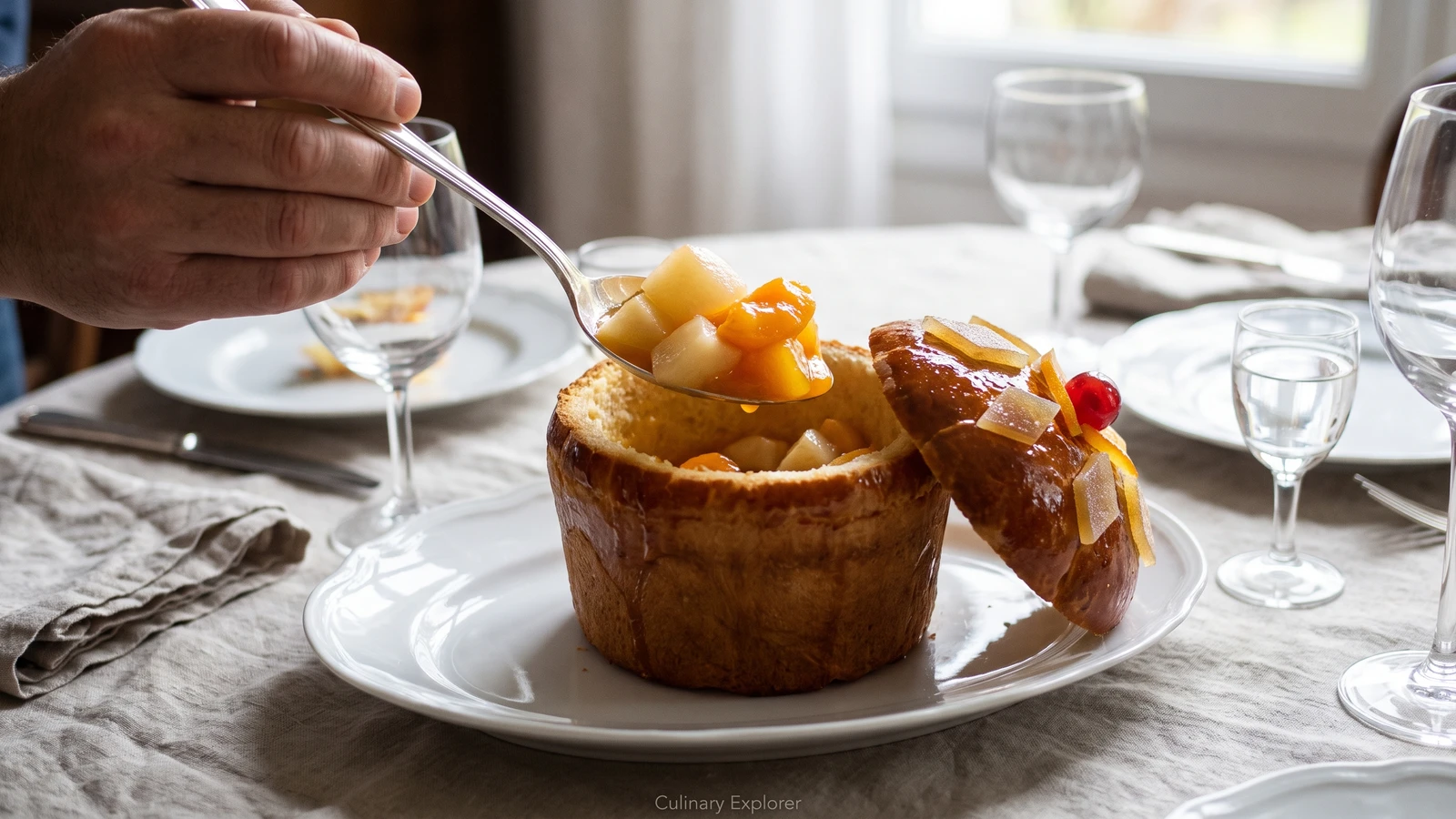
A glazed brioche shell arrives jewelled with candied fruit, then receives its warm filling at the table: firm orchard fruit, pineapple, almonds and raisins held in a bright, kirsch-scented apricot purée.
Timbale à la Parisienne (a Parisian brioche case filled with fruit) teaches restraint in the middle of abundance. Pear, apple, peach, apricot, pineapple, raisins, almonds and candied angelica all enter the same case, but the one true thing is simple: cook the fruit firm. If those clean quarters collapse, the timbale becomes compote in a handsome hat.
The source entry assumed a pâtissier with finished brioche, vanilla syrup, apricot purée and trays of prepared fruit waiting in separate corners of the kitchen. That separate labor is brigade scaffolding, so it goes. A 7-inch straight-sided cake tin stands honestly for the Charlotte mould, the fruit poaches in successive batches in one pan, and the brioche cools while its garnish is prepared. What stays is the dish itself: a hollow moulded brioche, an apricot glaze, firm fruit bound with Kirsch, and the filling poured in only when everyone is ready. One cook, one stove, one evening.
The finished timbale is butter-gold and glossy outside, bright with candied fruit, then opened to reveal warm orchard fruit shining under apricot purée. Watch the poaching more closely than the clock. The pear and apple need patience, while peach and apricot can surrender in a minute, and that difference decides the whole dessert.
Timbales belong to the formal Parisian repertoire, where a moulded edible case turned service itself into part of the dessert. The Parisienne title here signals the capital's grand table rather than a regional orchard: brioche, candied fruit, pineapple, almonds and Kirsch gather the wide pastry pantry into one abundant entremets. Its architecture has a practical purpose, since filling the case at the table keeps the brioche intact instead of letting the fruit syrup turn it into pudding.
Quantity
2 cups (480 ml / 250 g)
Quantity
3 tablespoons (45 ml / 38 g)
Quantity
1½ teaspoons (7.5 ml / 5 g)
Quantity
¾ teaspoon (3.75 ml / 4 g)
Quantity
3 tablespoons (45 ml / 45 g)
lukewarm
Quantity
3
at room temperature
Quantity
½ cup (120 ml / 113 g)
cool, pliable and cut into small cubes
Quantity
1 tablespoon (15 ml / 14 g)
softened
Quantity
1
beaten
Quantity
1 tablespoon (15 ml / 15 g)
Quantity
2 cups (480 ml / 480 g)
Quantity
1 cup (240 ml / 200 g)
Quantity
1
split lengthwise
Quantity
1 medium (about 6 ounces / 170 g)
peeled, cored and quartered
Quantity
1 medium (about 6 ounces / 170 g)
peeled, cored and quartered
Quantity
1 (about 5 ounces / 140 g)
peeled, pitted and quartered
Quantity
3 (about 4½ ounces / 125 g)
peeled, pitted and quartered
Quantity
¾ cup (180 ml / 125 g)
drained if canned and cut into large dice
Quantity
¼ cup (60 ml / 35 g)
cut into lozenges
Quantity
⅓ cup (80 ml / 45 g)
split lengthwise
Quantity
⅓ cup (80 ml / 50 g)
Quantity
1 cup (240 ml / 240 g)
Quantity
1 cup (240 ml / 320 g)
pressed through a fine sieve and divided
Quantity
2 tablespoons (30 ml / 28 g)
Quantity
⅓ cup (80 ml / 60 g)
cut into small decorative pieces
| Ingredient | Quantity |
|---|---|
| bread flour | 2 cups (480 ml / 250 g) |
| granulated sugar | 3 tablespoons (45 ml / 38 g) |
| instant yeast | 1½ teaspoons (7.5 ml / 5 g) |
| fine sea salt | ¾ teaspoon (3.75 ml / 4 g) |
| whole milklukewarm | 3 tablespoons (45 ml / 45 g) |
| large eggsat room temperature | 3 |
| unsalted buttercool, pliable and cut into small cubes | ½ cup (120 ml / 113 g) |
| unsalted butter for the mouldsoftened | 1 tablespoon (15 ml / 14 g) |
| large egg for egg washbeaten | 1 |
| water for egg wash | 1 tablespoon (15 ml / 15 g) |
| water for the vanilla syrup | 2 cups (480 ml / 480 g) |
| granulated sugar for the vanilla syrup | 1 cup (240 ml / 200 g) |
| vanilla beansplit lengthwise | 1 |
| firm-ripe pearpeeled, cored and quartered | 1 medium (about 6 ounces / 170 g) |
| firm applepeeled, cored and quartered | 1 medium (about 6 ounces / 170 g) |
| firm-ripe peachpeeled, pitted and quartered | 1 (about 5 ounces / 140 g) |
| firm-ripe apricotspeeled, pitted and quartered | 3 (about 4½ ounces / 125 g) |
| fresh or juice-packed pineappledrained if canned and cut into large dice | ¾ cup (180 ml / 125 g) |
| candied angelicacut into lozenges | ¼ cup (60 ml / 35 g) |
| blanched whole almondssplit lengthwise | ⅓ cup (80 ml / 45 g) |
| golden raisins | ⅓ cup (80 ml / 50 g) |
| tepid water for the raisins | 1 cup (240 ml / 240 g) |
| smooth apricot preservespressed through a fine sieve and divided | 1 cup (240 ml / 320 g) |
| Kirsch | 2 tablespoons (30 ml / 28 g) |
| mixed candied cherries and candied citrus peelcut into small decorative pieces | ⅓ cup (80 ml / 60 g) |
Combine the flour, sugar and yeast in the bowl of a stand mixer, then place the salt on the opposite side so it doesn't sit directly against the yeast. Add the milk and three eggs. Mix with the dough hook on low speed until no dry flour remains, then knead on medium for 6 to 8 minutes, until the pâte à brioche, the butter-rich yeast dough, begins to clear the bowl and stretch without tearing. Add the cubed butter gradually, waiting until each addition disappears before adding the next. Continue kneading until the dough is glossy, elastic and very soft. If it turns greasy or the butter smears around the bowl, stop and chill everything for 15 minutes before continuing. Ça se rattrape. The butter has simply become too warm.
Cover the bowl and leave the dough at comfortable room temperature for 60 to 75 minutes, until visibly swollen and airy but not necessarily doubled. Press out the large pockets of gas, fold the dough over itself several times, then flatten it into a thick disc. Cover and chill for 30 to 45 minutes. This short chill firms the butter and turns a sticky dough into something one pair of hands can shape cleanly.
Butter a 7-inch (18 cm) Charlotte mould or straight-sided cake tin generously, reaching into every corner. Shape the chilled dough into a tight round and place it seam-side down in the mould. Cover and let it rise for 60 to 75 minutes, until its crown approaches the rim and a light fingertip press springs back slowly. If the dough springs back at once, give it more time. If it begins to slump, gently deflate it, reshape it and proof it once more. Heat the oven to 375°F (190°C). Beat the remaining egg with the tablespoon of water and brush the exposed dough lightly, keeping the wash away from the sides of the mould.
Bake for 15 minutes, then lower the oven to 350°F (175°C) and continue for 20 to 25 minutes. The brioche should be deeply butter-gold, sound hollow when tapped and reach about 190°F (88°C) at its centre. If the crown colours before the centre is ready, cover it loosely with foil. Rest it in the mould for 10 minutes, turn it onto a rack and cool it completely, at least 90 minutes. Quite cold means quite cold here. A warm brioche compresses and tears when hollowed.
Cut a lid about ½ inch (1.25 cm) thick from the top of the cold brioche. With a small serrated knife and then your fingers, remove the crumb from the centre, leaving a wall and base about ¾ inch (2 cm) thick. Work slowly around the curve. If you nick the wall, press a little reserved crumb into the gap with a dab of apricot preserve; once glazed, the repair holds. Warm one-third of the sieved apricot preserves until fluid, then brush it over the outside of the case and lid. Press the candied cherries and citrus peel into the glaze in a simple band or scattered pattern, and set the timbale on its serving platter.
Cover the raisins with the tepid water and leave them for 15 minutes, until plump, then drain and dry them well. Split the blanched almonds lengthwise, cut the angelica into lozenges and dice the pineapple into substantial pieces. Keep these ingredients dry and separate while the orchard fruit cooks; excess water would thin the apricot purée and soak the brioche.
Bring the syrup water, sugar, vanilla bean and its scraped seeds to a boil, stirring only until the sugar dissolves. Lower the heat and simmer gently for 5 minutes. Poach each fruit separately because each softens at its own pace: pears for 5 to 8 minutes, apples for 3 to 5 minutes, peaches for 1½ to 3 minutes and apricots for 45 to 90 seconds. Lift each batch onto a wide tray with a slotted spoon as soon as a knife enters with slight resistance. The fruit must remain firm. If a batch softens faster than expected, lift every piece at once and spread it on a cool tray to stop the cooking. Ça se rattrape, but only if you move promptly. Strain ½ cup (120 ml) of the syrup into a small pan and reduce it to ¼ cup (60 ml).
Warm the remaining two-thirds of the apricot preserves with the reduced vanilla syrup, whisking until smooth and glossy. Remove the pan from the heat, let it cool for 5 minutes and stir in the Kirsch to make the purée d'abricots au kirsch, the kirsch-scented apricot purée. It should cling softly to a piece of fruit without setting like jam. If it runs freely, reduce it briefly before adding the Kirsch; if it is too tight, loosen it with a spoonful of reserved syrup. Fold in the pears, apples, peaches, apricots, pineapple, angelica, almonds and drained raisins with a wide spoon, preserving every clean edge.
Carry the decorated brioche case and the warm fruit garnish to the table separately. Spoon the fruit and its apricot purée into the timbale in front of your guests, letting the glossy filling rise generously above the rim, then rest the decorated lid at an angle. Filling at the last moment is not theater for its own sake; it keeps the brioche tender rather than sodden. Cut the case with a serrated knife and serve each wedge with plenty of fruit and purée. À table!
1 serving (about 230g)
Culinary guides, cultural storytelling, and the editorial depth that makes cooking meaningful.
Discover Culinary ExplorerChef Juliette
Five almond preparations, one discipline: remove the skins cleanly, dry every kernel through, then cut, toast, or cloak it in pale caramel without letting its fragrant oils escape.

Chef Juliette
A pastry pantry lesson in one tray: filberts warmed only until their red skins release, rubbed clean, cooled, and chopped into a fragrant mise-en-place for cakes, creams, pralines, and petits fours.

Chef Juliette
The smallest pâtisserie discipline decides whether a cake leaves its mould intact: clarified butter in every corner, followed by the lightest veil of dry flour or fécule.

Chef Juliette
Four whites, one spotless bowl, and a patient change of speed: whisk gently until loosened, then briskly to glossy stiffness, with powdered sugar waiting if the foam begins to granulate.