
Chef Juliette
Various Almond Preparations
Five almond preparations, one discipline: remove the skins cleanly, dry every kernel through, then cut, toast, or cloak it in pale caramel without letting its fragrant oils escape.
A cooking platform built around craft, culture, and the stories behind what we eat.
Created by Chef Juliette
Based on No. 2540, Violet Soufflé, from Le Guide Culinaire (1907) by Auguste Escoffier
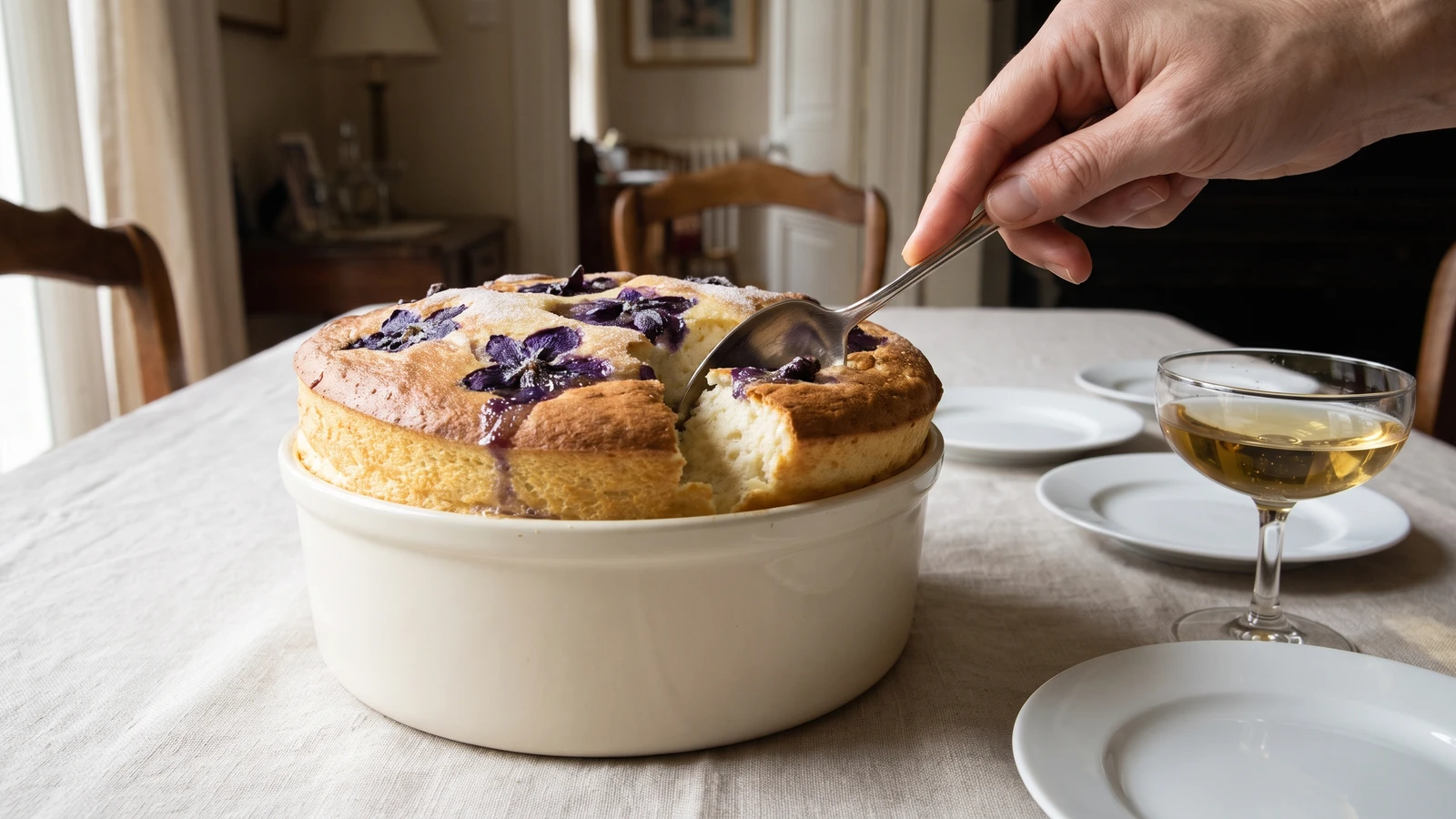
Soufflé aux violettes rises high from a vanilla panade and glossy whites, with crushed crystallised violets through its heart and a candied crown above: crush every shard fine, then trust the oven.
Soufflé aux violettes (violet soufflé) teaches the one true thing about every soufflé: the whites make the lift, but the base makes the walls that hold it. Here that base is scented with vanilla and firm enough to carry the flower, while crushed crystallised violets melt through it into a delicate perfume.
The classical entry is brief because it assumes the pâtisserie station already has vanilla-flavoured soufflé preparation ready, whites whisked to order, and a fierce, predictable oven. At home, make one small roux-bound panade in a saucepan, fold it with four whites, and bake it in a 1-litre dish on a preheated sheet. The held base and brigade portions were service scaffolding, so they go; the vanilla, crushed violets, whole-violet crown, and immediate baking are the dish, so they stay. The quantity is scaled for four without changing the sequence. One cook, one stove, one evening.
Get the violet crush right before the saucepan goes on. Every flower destined for the batter must become fine, even sugar, with no glossy shard hiding in it; a shard melts to syrup and pulls down the tender structure. That is the step to guard. The crown stays whole because it sits on top, exactly where the source puts it.
Soufflé aux violettes has two precise homes: the soufflé belongs to the Paris dining-room repertoire of classical sweet preparations, while crystallised violets point to Toulouse, where the flowers became a celebrated confectioner's preserve. Grand kitchens treated a neutral vanilla soufflé preparation as a working base, then identified this variation twice, with finely crushed violet through the batter and whole candied blossoms above. The crown is not decoration added after baking; it is part of the stated method and softens into the rising surface.
Quantity
1 tablespoon (15 ml / 14 g)
softened, for the dish
Quantity
2 tablespoons (30 ml / 25 g)
for the dish
Quantity
1 cup (240 ml / 245 g)
Quantity
1
split lengthwise and scraped
Quantity
2 tablespoons (30 ml / 28 g)
Quantity
1/4 cup (60 ml / 30 g)
Quantity
3 tablespoons (45 ml / 38 g)
for the base
Quantity
1/8 teaspoon (0.6 ml / 0.75 g)
Quantity
4
separated, whites brought to room temperature
Quantity
1/3 cup (80 ml / 35 g)
crushed to a fine powder
Quantity
2 tablespoons (30 ml / 25 g)
for the whites
Quantity
8
kept whole for the crown
| Ingredient | Quantity |
|---|---|
| unsalted buttersoftened, for the dish | 1 tablespoon (15 ml / 14 g) |
| granulated sugarfor the dish | 2 tablespoons (30 ml / 25 g) |
| whole milk | 1 cup (240 ml / 245 g) |
| vanilla beansplit lengthwise and scraped | 1 |
| unsalted butter | 2 tablespoons (30 ml / 28 g) |
| plain flour | 1/4 cup (60 ml / 30 g) |
| caster sugarfor the base | 3 tablespoons (45 ml / 38 g) |
| fine sea salt | 1/8 teaspoon (0.6 ml / 0.75 g) |
| large eggsseparated, whites brought to room temperature | 4 |
| crystallised violetscrushed to a fine powder | 1/3 cup (80 ml / 35 g) |
| caster sugarfor the whites | 2 tablespoons (30 ml / 25 g) |
| large crystallised violetskept whole for the crown | 8 |
Heat the oven to 190°C / 375°F, or 170°C / 340°F fan, with a rimmed baking sheet on the lower-middle rack. Brush a straight-sided 1-litre soufflé dish generously with the softened butter, working upward from base to rim, then coat it with the granulated sugar and tap out the excess. Crush the smaller crystallised violets in a mortar until they resemble fine sugar, then sift them and crush any shard left behind. Keep the eight large violets whole and dry.
Put the milk, vanilla seeds, and pod in a small saucepan. Warm gently until small bubbles gather around the edge, then cover, remove from the heat, and leave for 10 minutes. Remove the pod and return the milk to gentle heat until hot but not boiling.
Melt the 28 g butter in a medium heavy saucepan. Stir in the flour and cook for 90 seconds without colouring to make a roux blanc (white roux). Add the hot vanilla milk gradually, whisking after every addition, then cook over medium-low heat for 2 to 3 minutes until the panade is smooth, very thick, and pulling cleanly from the saucepan. Whisk in the 38 g caster sugar and salt. If it forms lumps, take it off the heat, whisk firmly, and pass it through a fine sieve while warm. Ça se rattrape.
Let the panade stand for 3 minutes, then whisk in the yolks one at a time, waiting until each disappears before adding the next. Scrape the base into a broad mixing bowl and leave it until just lukewarm, about 10 minutes. Stir in the finely crushed violets until their colour and perfume are evenly dispersed. Don't add them to a hot base, which would melt their sugar into sticky pockets.
Whisk the egg whites in a perfectly clean bowl until they hold soft peaks. Add the 25 g caster sugar gradually, whisking until the whites are glossy and make medium-firm peaks whose tips still bend. Stop there. Dry, clotted whites resist the fold and leave weak seams through the soufflé.
Whisk one-quarter of the whites into the violet base to loosen it. Add the rest in two portions, cutting down through the centre with a flexible spatula, sweeping across the bottom, and turning the bowl after each fold. Stop as soon as no large white pockets remain. Spoon the mixture into the prepared dish, level it lightly, and run a clean thumb around the inside rim to make a shallow channel. Lay the eight whole crystallised violets gently in a crown over the outer third of the surface. Don't press them into the batter.
Set the dish immediately on the hot baking sheet and bake for 24 to 28 minutes. Keep the oven door shut for the first 20 minutes. The soufflé is ready when it stands several centimetres above the rim, the top is butter-gold, the violet crown has softened into a gloss, and the centre quivers as one body rather than rolling like liquid. If the centre still waves after 24 minutes, close the door gently and give it another 2 to 3 minutes.
Carry the soufflé straight to the table in its baking dish. Break the centre with two serving spoons and lift out generous portions, including part of the candied crown with each. A soufflé begins settling as soon as it leaves the oven, which is its nature, not a mistake. Have the plates and guests ready. À table!
1 serving (about 145g)
Culinary guides, cultural storytelling, and the editorial depth that makes cooking meaningful.
Discover Culinary ExplorerChef Juliette
Five almond preparations, one discipline: remove the skins cleanly, dry every kernel through, then cut, toast, or cloak it in pale caramel without letting its fragrant oils escape.

Chef Juliette
A pastry pantry lesson in one tray: filberts warmed only until their red skins release, rubbed clean, cooled, and chopped into a fragrant mise-en-place for cakes, creams, pralines, and petits fours.

Chef Juliette
The smallest pâtisserie discipline decides whether a cake leaves its mould intact: clarified butter in every corner, followed by the lightest veil of dry flour or fécule.

Chef Juliette
Four whites, one spotless bowl, and a patient change of speed: whisk gently until loosened, then briskly to glossy stiffness, with powdered sugar waiting if the foam begins to granulate.