
Chef Juliette
Various Almond Preparations
Five almond preparations, one discipline: remove the skins cleanly, dry every kernel through, then cut, toast, or cloak it in pale caramel without letting its fragrant oils escape.
A cooking platform built around craft, culture, and the stories behind what we eat.
Created by Chef Juliette
Based on No. 2538, Soufflé à la Royale, from Le Guide Culinaire (1907) by Auguste Escoffier
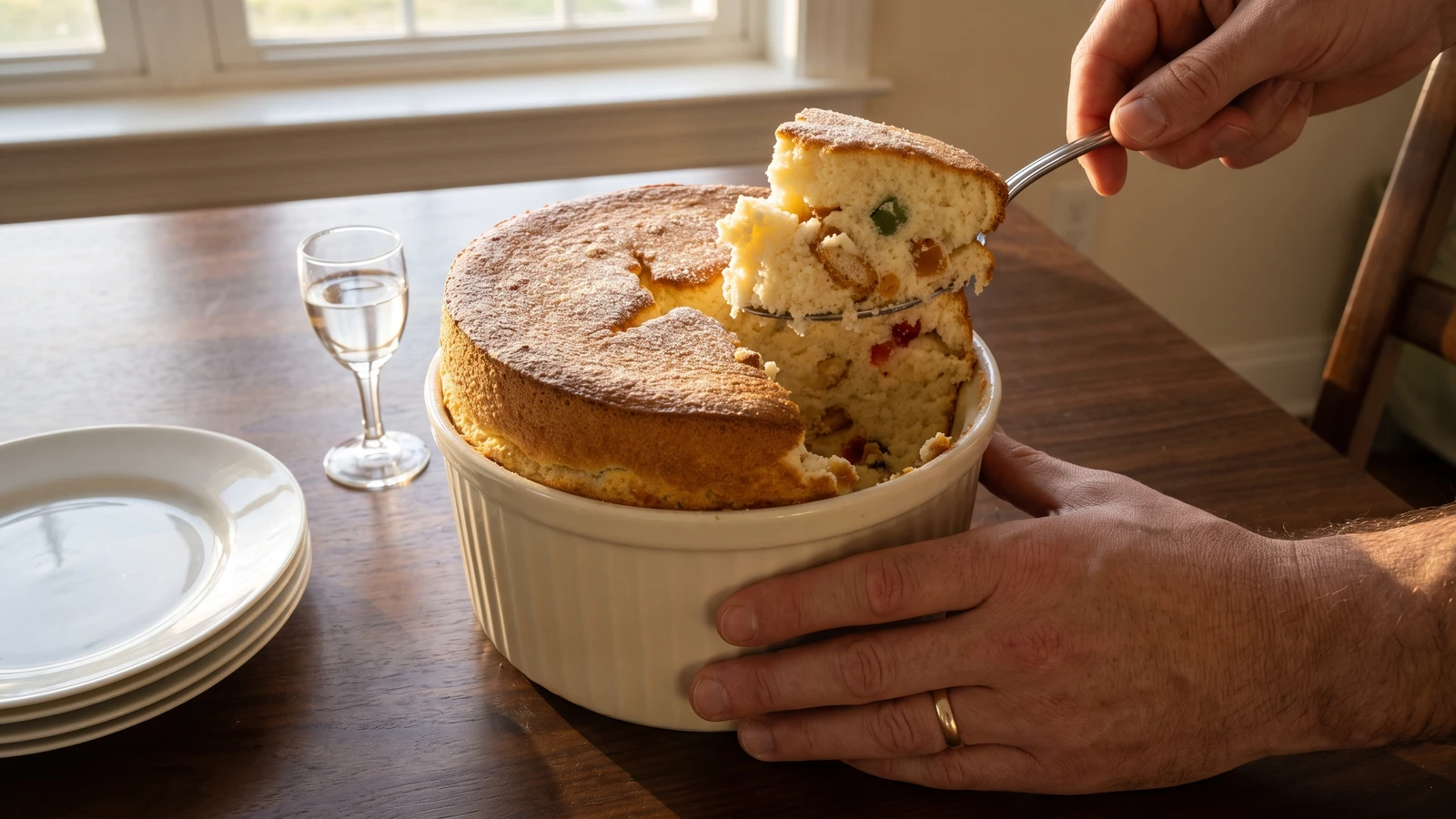
Vanilla Soufflé à la Royale rises around kirsch-soaked biscuits and bright diced fruit, a celebration of controlled moisture, glossy egg whites, and the nerve to carry it straight from oven to table.
Soufflé à la Royale (vanilla soufflé layered with kirsch-soaked biscuits and diced fruit) teaches the discipline beneath every sweet soufflé: air can lift richness, but it cannot carry carelessness with liquid. The pineapple, cherries, angelica, and grapes must taste clearly of Kirsch while giving the batter no loose syrup. Drain them until they look almost too dry. They are not.
The source entry assumes a pastry cook handing over a vanilla soufflé preparation, fruit already macerated, and a timbale, the tall straight-sided mold, waiting for service. It needs no saucier, stockpot, or salamander. At home, a small saucepan builds the base, a sieve and towel control the fruit, and a 1.5-liter soufflé dish goes into an ordinary oven. The separate hands were brigade scaffolding and can go; the alternating layers and last-minute egg-white lift are the dish and must stay. One cook, one stove, one evening.
Done properly, the crown rises gold over hidden bands of vanilla, soft biscuit, green angelica, cherry, grape, and pineapple, with Kirsch arriving as perfume rather than puddle. The one step that decides it comes before the whisking: macerate, drain, then blot every piece of fruit before it approaches the batter.
Soufflé à la Royale belongs to the formal Parisian grand-kitchen repertory, where royale signaled a lavish garnish and presentation, not proof that a monarch invented or favored the dish. Its vanilla base, Kirsch-soaked biscuits, and diced pantry fruits show how pastry cooks turned preserved luxuries into a hot dessert assembled to order. The misconception is that a classical soufflé must be empty and cloudlike; cooks also layered them around biscuits and fruit, provided every garnish was drained well enough to preserve the egg-white lift.
Quantity
1 tablespoon (15 ml / 14 g)
softened
Quantity
2 tablespoons (30 ml / 25 g)
Quantity
1/3 cup (80 ml / 55 g)
cut into 1/4-inch dice and thoroughly drained
Quantity
1/4 cup (60 ml / 45 g)
cut into 1/4-inch dice
Quantity
2 tablespoons (30 ml / 20 g)
cut into 1/4-inch dice
Quantity
1/3 cup (80 ml / 50 g)
cut into small dice
Quantity
2 tablespoons (30 ml / 28 g)
Quantity
8 biscuits (about 70 g)
cut into 2-inch lengths
Quantity
1/4 cup (60 ml / 56 g)
Quantity
1 cup (240 ml / 245 g)
Quantity
2 teaspoons (10 ml / 9 g)
Quantity
3 tablespoons (45 ml / 42 g)
Quantity
1/4 cup (60 ml / 30 g)
Quantity
1/2 cup (120 ml / 100 g)
divided
Quantity
4
separated
Quantity
2
Quantity
1/8 teaspoon (0.6 ml / 0.8 g)
| Ingredient | Quantity |
|---|---|
| unsalted butter for the dishsoftened | 1 tablespoon (15 ml / 14 g) |
| caster sugar for coating the dish | 2 tablespoons (30 ml / 25 g) |
| canned pineapple in juicecut into 1/4-inch dice and thoroughly drained | 1/3 cup (80 ml / 55 g) |
| glacé cherriescut into 1/4-inch dice | 1/4 cup (60 ml / 45 g) |
| candied angelicacut into 1/4-inch dice | 2 tablespoons (30 ml / 20 g) |
| seedless green grapescut into small dice | 1/3 cup (80 ml / 50 g) |
| Kirsch for macerating the fruit | 2 tablespoons (30 ml / 28 g) |
| biscuits à la cuillère, crisp ladyfingerscut into 2-inch lengths | 8 biscuits (about 70 g) |
| Kirsch for saturating the biscuits | 1/4 cup (60 ml / 56 g) |
| whole milk | 1 cup (240 ml / 245 g) |
| pure vanilla extract | 2 teaspoons (10 ml / 9 g) |
| unsalted butter for the vanilla base | 3 tablespoons (45 ml / 42 g) |
| plain flour | 1/4 cup (60 ml / 30 g) |
| caster sugardivided | 1/2 cup (120 ml / 100 g) |
| large eggsseparated | 4 |
| additional large egg whites | 2 |
| fine sea salt | 1/8 teaspoon (0.6 ml / 0.8 g) |
Set a rack in the lower third of the oven and place a rimmed baking sheet on it. Heat the oven to 190°C / 375°F conventional, or 180°C / 355°F fan. Brush a 1.5-liter straight-sided soufflé dish generously with the softened butter, working upward from base to rim, then coat it evenly with the 2 tablespoons of sugar. Tip out the excess and keep the top rim clean; the butter and sugar give the batter a dry, even surface to climb.
Combine the diced pineapple, cherries, angelica, and grapes with the 2 tablespoons of Kirsch. Leave them for 20 minutes, stirring once, then drain them in a fine sieve for at least 15 minutes. Spread the fruit over a clean towel and blot every surface. If droplets still gather underneath, ça se rattrape: give the fruit another dry towel and five more minutes. Loose syrup slackens the batter, and no amount of whisking later can argue with it.
Warm the milk, vanilla, and half the caster sugar, 1/4 cup or 50 g, until small bubbles ring the pan. In a second saucepan, melt the 3 tablespoons of butter over medium-low heat, stir in the flour, and cook for one minute without letting it color. Whisk in the warm milk in three additions, smoothing each before adding the next, then cook for 2 to 3 minutes until the base is glossy, thick, and holds the trace of the whisk. Remove it from the heat and whisk in the four yolks one at a time. If lumps appear, whisk firmly and press the warm base through a fine sieve. Spread it in a wide bowl and let it cool until barely warm, about 10 minutes.
Put all six egg whites and the salt in a spotless bowl. Beat at medium speed until foamy, then increase the speed and whip to soft peaks. Add the remaining 1/4 cup or 50 g sugar gradually, beating only until the whites are glossy and form medium-firm peaks whose tips still curl. Dry, clumped whites resist folding and leave pale knots through the batter; stop while they remain supple.
Whisk one quarter of the whites briskly into the cooled vanilla base to loosen it. Add the remaining whites in two additions, cutting down through the center with a broad spatula, sweeping across the bottom, and turning the mixture over itself. Stop when only the faintest white veins remain. A few streaks disappear during layering; repeated folding trades height for unnecessary neatness.
Lay the biscuits on a plate and spoon or brush the 1/4 cup of Kirsch slowly over both sides. Leave them for 2 minutes so they become saturated through but still hold their shape, then tip away any liquor left on the plate. Spoon one third of the soufflé mixture into the prepared dish. Arrange half the biscuits in a loose layer, keeping them away from the wall, and scatter over half the drained fruit. Repeat with another third of the mixture, the remaining biscuits, and the remaining fruit, then cover everything with the final third. Do not press the layers down. Run a clean thumb around the inside edge of the rim to form a shallow channel that helps the crown rise evenly.
Set the dish on the heated baking sheet and bake for 35 to 40 minutes without opening the oven during the first 30. The Soufflé à la Royale is ready when it stands several centimeters above the rim, the crown is deep butter-gold, and the center gives a contained wobble rather than a liquid slosh. If the center still moves loosely at 40 minutes, bake it for another 3 to 5 minutes; a darker crown is better than raw vanilla base. Carry it straight to the table and spoon down through every layer. A soufflé settles as it is served because it is alive, not because you failed it. À table!
1 serving (about 220g)
Culinary guides, cultural storytelling, and the editorial depth that makes cooking meaningful.
Discover Culinary ExplorerChef Juliette
Five almond preparations, one discipline: remove the skins cleanly, dry every kernel through, then cut, toast, or cloak it in pale caramel without letting its fragrant oils escape.

Chef Juliette
A pastry pantry lesson in one tray: filberts warmed only until their red skins release, rubbed clean, cooled, and chopped into a fragrant mise-en-place for cakes, creams, pralines, and petits fours.

Chef Juliette
The smallest pâtisserie discipline decides whether a cake leaves its mould intact: clarified butter in every corner, followed by the lightest veil of dry flour or fécule.

Chef Juliette
Four whites, one spotless bowl, and a patient change of speed: whisk gently until loosened, then briskly to glossy stiffness, with powdered sugar waiting if the foam begins to granulate.