
Chef Juliette
Various Almond Preparations
Five almond preparations, one discipline: remove the skins cleanly, dry every kernel through, then cut, toast, or cloak it in pale caramel without letting its fragrant oils escape.
A cooking platform built around craft, culture, and the stories behind what we eat.
Created by Chef Juliette
Based on No. 2528, Pomegranate Soufflé “à l’Orientale”, from Le Guide Culinaire (1907) by Auguste Escoffier
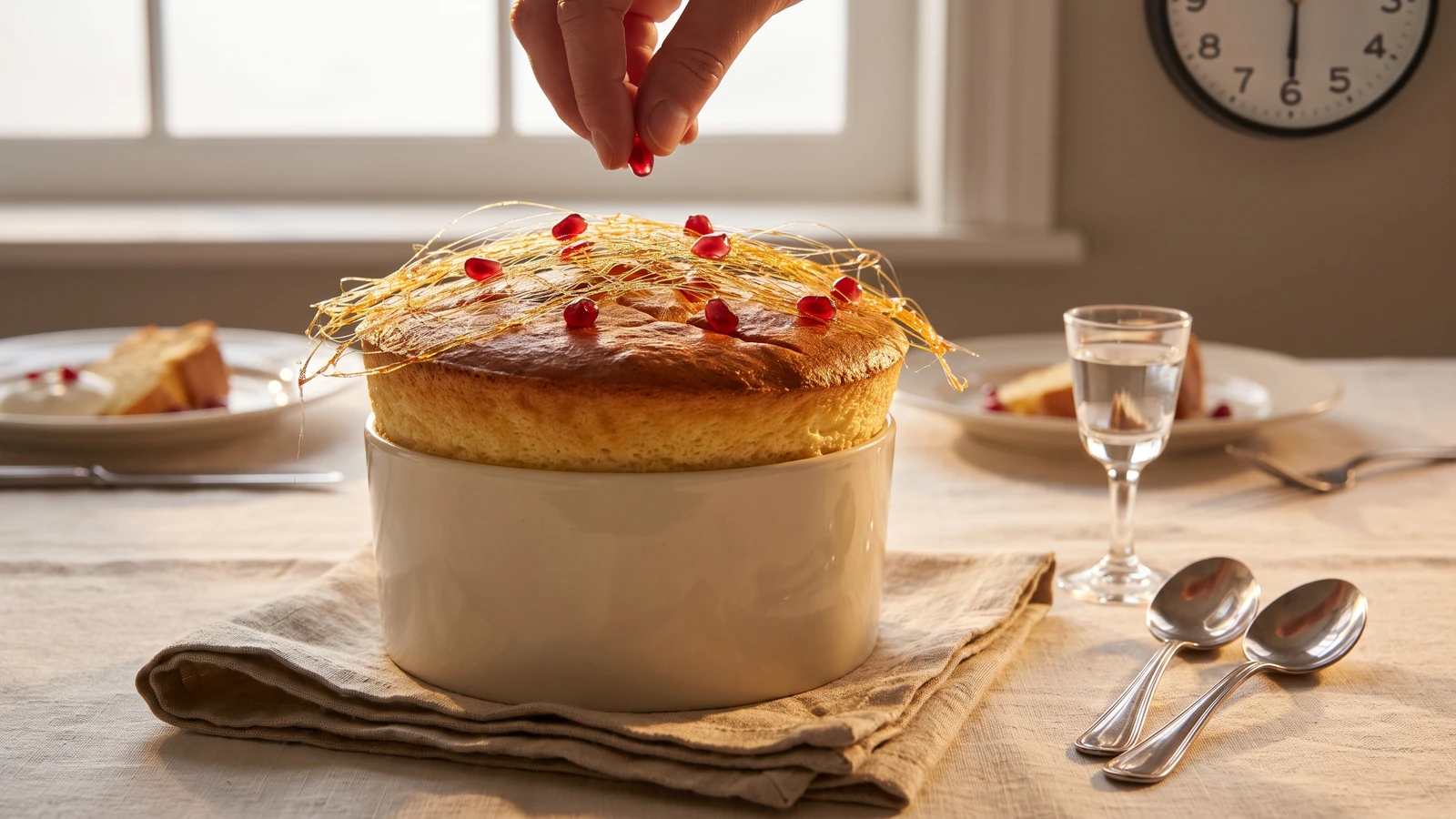
Soufflé à la Grenade “à l’Orientale” rises around vanilla cream and grenadine-soaked biscuits, then meets a spun-sugar veil at the oven door. The lesson is timing: the crown waits for the soufflé, never the reverse.
Soufflé à la Grenade “à l’Orientale” (pomegranate-style vanilla soufflé) teaches the hard, useful truth of every hot soufflé: the base may wait, but whipped whites and oven heat do not. Here a lightly vanilla custard rises around ladyfingers saturated with grenadine and Kirsch, then receives a fine spun-sugar veil and ruby sweets at the oven door. The finish is theatrical, but the lesson is discipline, not spectacle.
The original assumed a pastry brigade: one cook watching the timbale, another spinning sugar in a dry confectionery room, and trays of tiny grenadine sweets ready for service. A home kitchen gets one 1.4-litre straight-sided dish, a hand mixer, two wooden-spoon handles, and a timer. The brigade batch becomes four generous servings; the prepared sweets become quick grenadine sugar-paste seeds, while the vanilla soufflé, saturated biscuit layers, and spun-sugar veil remain intact. One cook, one stove, one evening.
A perfectly even sugar canopy is brigade scaffolding; spun sugar made at the last moment is the dish. Set out the serving spoons, shape the red sweets, prepare the sugar rig, and soak the biscuits before the whites are whipped. Once the whites meet the base, timing is the dish.
This entremets belongs to the Parisian grand-kitchen repertoire, where hot soufflés and spun sugar displayed the coordination of the pastry station and were carried directly from oven to dining room. The label à l’Orientale was a Parisian naming convention built around jewel-like colour and elaborate ornament, not a claim that the dish came from any particular Eastern table. Despite the pomegranate name, the source uses no fresh fruit: grenadine supplies the flavour, and small sweets imitate the seeds.
Quantity
1 tablespoon (15 ml / 14 g)
softened, for the dish
Quantity
2 tablespoons (30 ml / 25 g)
for coating the dish
Quantity
1 cup (240 ml / 245 g)
reserve 2 tablespoons
Quantity
1/2 bean
split lengthwise and scraped
Quantity
1/4 cup (60 ml / 50 g)
for the vanilla base
Quantity
1/4 cup (60 ml / 30 g)
Quantity
1/8 teaspoon (0.6 ml / 0.7 g)
Quantity
3
separated
Quantity
1
Quantity
1 tablespoon (15 ml / 14 g)
for finishing the vanilla base
Quantity
8 biscuits (about 2 1/2 ounces / 70 g)
Quantity
1/4 cup (60 ml / 70 g)
for soaking the biscuits
Quantity
2 tablespoons (30 ml / 28 g)
Quantity
2 tablespoons (30 ml / 25 g)
for the egg whites
Quantity
1
for rescuing overwhipped whites
Quantity
1/3 cup (80 ml / 40 g)
divided, for the crimson sweets
Quantity
1 teaspoon (5 ml / 3 g)
Quantity
2 teaspoons (10 ml / 12 g)
for the crimson sweets
Quantity
3/4 cup (180 ml / 150 g)
for the spun-sugar veil
Quantity
1 tablespoon (15 ml / 20 g)
Quantity
1/4 cup plus 1 tablespoon (75 ml / 75 g)
divided
| Ingredient | Quantity |
|---|---|
| unsalted buttersoftened, for the dish | 1 tablespoon (15 ml / 14 g) |
| granulated sugarfor coating the dish | 2 tablespoons (30 ml / 25 g) |
| whole milkreserve 2 tablespoons | 1 cup (240 ml / 245 g) |
| vanilla beansplit lengthwise and scraped | 1/2 bean |
| granulated sugarfor the vanilla base | 1/4 cup (60 ml / 50 g) |
| all-purpose flour | 1/4 cup (60 ml / 30 g) |
| fine salt | 1/8 teaspoon (0.6 ml / 0.7 g) |
| large eggsseparated | 3 |
| large egg white | 1 |
| unsalted butterfor finishing the vanilla base | 1 tablespoon (15 ml / 14 g) |
| crisp lady’s-finger biscuits | 8 biscuits (about 2 1/2 ounces / 70 g) |
| grenadine syrupfor soaking the biscuits | 1/4 cup (60 ml / 70 g) |
| Kirsch | 2 tablespoons (30 ml / 28 g) |
| granulated sugarfor the egg whites | 2 tablespoons (30 ml / 25 g) |
| additional egg white (optional)for rescuing overwhipped whites | 1 |
| powdered sugardivided, for the crimson sweets | 1/3 cup (80 ml / 40 g) |
| cornstarch | 1 teaspoon (5 ml / 3 g) |
| grenadine syrupfor the crimson sweets | 2 teaspoons (10 ml / 12 g) |
| granulated sugarfor the spun-sugar veil | 3/4 cup (180 ml / 150 g) |
| light glucose syrup | 1 tablespoon (15 ml / 20 g) |
| waterdivided | 1/4 cup plus 1 tablespoon (75 ml / 75 g) |
Brush the inside of a 1.4-litre straight-sided timbale or soufflé dish with the softened butter, using upward strokes along the walls. Add the coating sugar, turn the dish until every buttered surface is covered, then tap out the excess. Set out four dessert plates and serving spoons now. Secure two wooden-spoon handles beneath a heavy cutting board so they project about 20 cm beyond the counter, and spread parchment underneath; this is the home sugar-spinning rig.
Reserve one tablespoon of the powdered sugar, then mix the remainder with the cornstarch. Work in the grenadine a few drops at a time until a stiff crimson paste forms. Pinch and roll it into about twenty-four tiny oval sweets resembling pomegranate seeds, then leave them uncovered on parchment to dry. If the paste clings to your fingers, knead in the reserved powdered sugar a little at a time. Ça se rattrape.
Reserve 2 tablespoons of the milk, then put the rest in a saucepan with the vanilla pod and seeds. Bring it just to a simmer, cover, and leave it for 5 minutes before removing the pod. Whisk the three yolks with the base sugar, flour, and salt until smooth. Pour in the hot milk gradually while whisking, return everything to the saucepan, and cook over medium-low heat until the cream becomes very thick and gives one or two slow bubbles. Keep whisking for 1 minute to cook out the flour, then remove it from the heat and beat in the butter. If lumps appear, press the base through a fine sieve while it is still hot; do not throw it out. Loosen it with a spoonful of the reserved milk only if it becomes too stiff to fold. Press parchment against the surface and cool until barely warm.
Heat the oven to 190°C conventional or 170°C fan, with a baking sheet on the lower-middle rack. Mix the grenadine and Kirsch in a shallow dish. Lay in the lady’s fingers, spoon the liquid over them, and turn them once, giving the biscuits about 2 minutes to become saturated to the centre while remaining liftable. Break or cut them as needed to fit the timbale. If one collapses, piece it into the layer; it will disappear into the finished soufflé.
Whisk the four egg whites in a spotless bowl until they form soft peaks. Add the sugar a spoonful at a time and continue just until the whites are glossy and hold a firm peak whose tip bends slightly. Dry, clotted whites cannot expand properly. If they have gone only a little too far, add the optional unbeaten white and whisk briefly until smooth again. Stir one-quarter of the whites firmly into the vanilla base to lighten it, then fold in the remainder with broad turns of a flexible spatula, reaching to the bottom each time. Stop as soon as no white pockets remain.
Spoon one-third of the soufflé mixture into the prepared timbale. Add half the saturated lady’s fingers in a level layer without pressing them down, cover with another third of the mixture, then repeat with the remaining biscuits and soufflé. The dish should be filled to roughly 2 cm below its rim. Smooth the top and run a clean thumb around the inside edge to make a shallow channel, which helps the crown rise evenly. Set the dish on the heated baking sheet and bake for 25 to 28 minutes. Do not open the oven during the first 20 minutes. Set a second timer for 12 minutes, when the sugar work begins.
When the soufflé has baked for 12 minutes, put the spun-sugar granulated sugar, glucose, and 1/4 cup of the water into a small, clean, heavy saucepan. Warm gently until the sugar is completely dissolved, then cover for 2 minutes so the moisture cleans the sides of the pan. Uncover and cook without stirring until the syrup reaches 150 to 155°C and turns pale straw-gold. If crystals form before the syrup colours, remove the pan from the heat, let it settle briefly, and carefully add some or all of the remaining tablespoon of water down the side. Return it to low heat and dissolve the crystals before continuing. Burnt, bitter caramel cannot be rescued, so watch the colour as closely as the thermometer.
Take the caramel off the heat and wait until it thickens enough to fall from two back-to-back forks in fine threads. If it falls in heavy drops, wait another 20 seconds; if it hardens in the pan, warm it gently until it flows again. Flick the forks rapidly back and forth over the projecting spoon handles, building many fine strands. Once the threads are cool and crisp, gather them loosely with dry fingers into a veil large enough to cover the timbale. Molten sugar clings fiercely, so keep hands away from the syrup itself. In a damp kitchen, make a loose veil and leave it on the handles until the final moment, because height only gives humidity more to ruin.
Open the oven only after 25 minutes. The soufflé is ready when it stands several centimetres above the rim, the crown is deep butter-gold, and the centre trembles without looking liquid. Carry it directly to the table, lay the spun-sugar veil lightly over the crown, and scatter the grenadine sweets across the threads in imitation of pomegranate seeds. The sugar begins softening on contact and the soufflé starts settling within minutes. That urgency belongs to the dish. À table!
1 serving (about 220g)
Culinary guides, cultural storytelling, and the editorial depth that makes cooking meaningful.
Discover Culinary ExplorerChef Juliette
Five almond preparations, one discipline: remove the skins cleanly, dry every kernel through, then cut, toast, or cloak it in pale caramel without letting its fragrant oils escape.

Chef Juliette
A pastry pantry lesson in one tray: filberts warmed only until their red skins release, rubbed clean, cooled, and chopped into a fragrant mise-en-place for cakes, creams, pralines, and petits fours.

Chef Juliette
The smallest pâtisserie discipline decides whether a cake leaves its mould intact: clarified butter in every corner, followed by the lightest veil of dry flour or fécule.

Chef Juliette
Four whites, one spotless bowl, and a patient change of speed: whisk gently until loosened, then briskly to glossy stiffness, with powdered sugar waiting if the foam begins to granulate.