
Chef Juliette
Various Almond Preparations
Five almond preparations, one discipline: remove the skins cleanly, dry every kernel through, then cut, toast, or cloak it in pale caramel without letting its fragrant oils escape.
A cooking platform built around craft, culture, and the stories behind what we eat.
Created by Chef Juliette
Based on No. 2524, Soufflé à la Camargo, from Le Guide Culinaire (1907) by Auguste Escoffier
Two airy soufflés meet in one dish: bright tangerine, toasted filbert, and Curaçao-soaked ladyfingers layered quickly, baked tall, and carried straight to a celebration table before the crown can settle.
Soufflé à la Camargo (a layered tangerine and filbert soufflé) teaches the first law of every hot soufflé: beaten whites do not wait. Here they must lift two distinct preparations while holding bands of Curaçao-saturated biscuits, so the dish rewards order, speed, and a light folding hand.
The grand-kitchen entry lived inside a system with a saucier, a stockpot never far from the fire, and a salamander above the range, but none of those makes this sweet. Its real assumption was several hands preparing two soufflé bases at once. For one cook, one stove, one evening, we cook a single panade, divide it between tangerine and toasted filbert, then fold and layer both preparations in one ready dish. The shared foundation removes brigade scaffolding; the separate flavorings, soaked biscuits, and immediate baking remain because they are the dish.
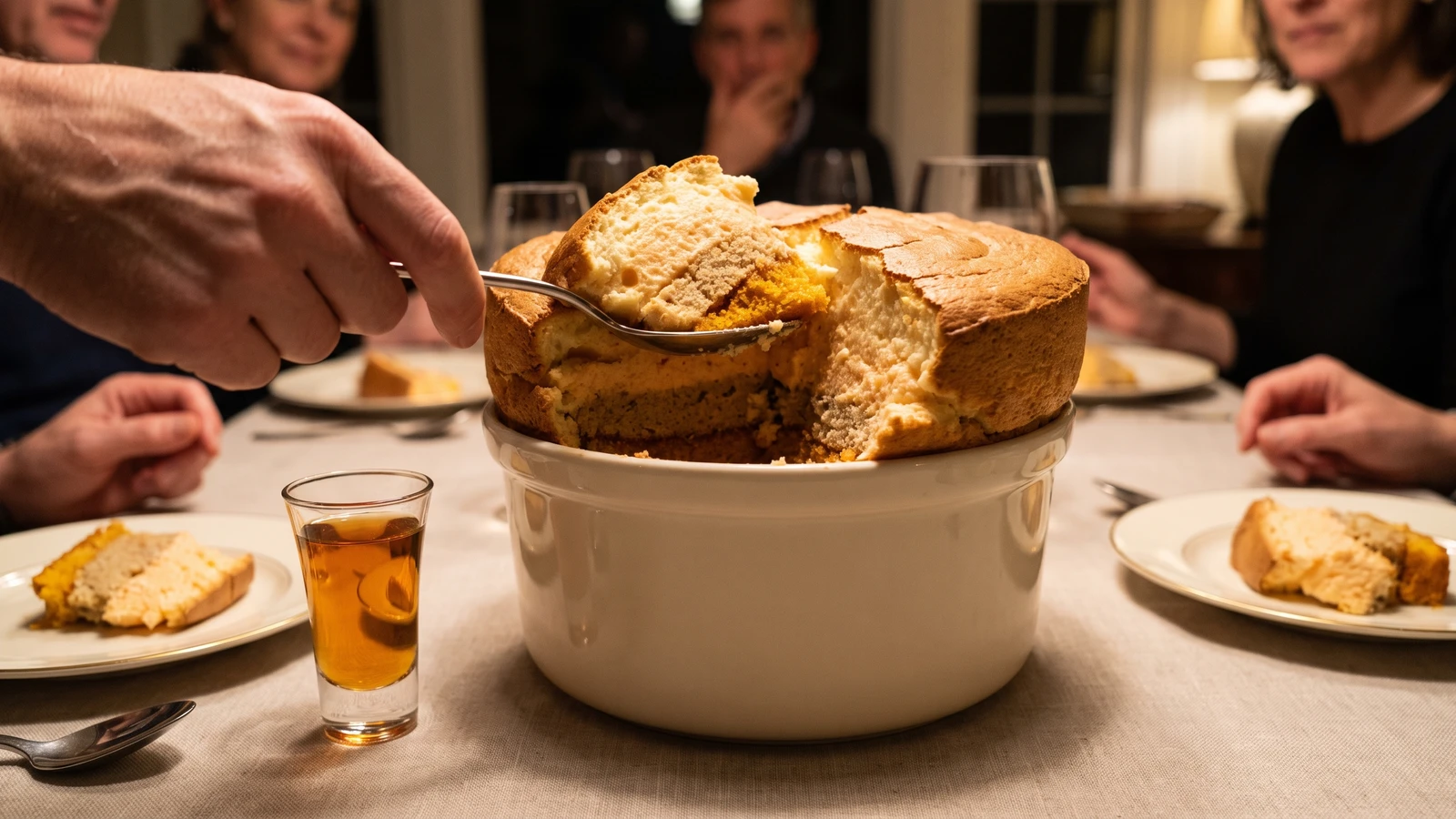
The finished crown rises butter-gold above the rim, with fragrant tangerine, warm filbert, and little amber bands of Curaçao-soaked biscuit beneath it. Have the oven hot, the dish coated, and every layer planned before you whip the whites; once the whites rise, build fast and bake at once.
Soufflé à la Camargo belongs to the named-dish repertory of Parisian grand kitchens rather than to a regional farmhouse table. Camargo refers not to a town or citrus variety but to La Camargo, the Brussels-born dancer of the Paris Opéra whose name became associated with elegance in French decorative and culinary naming. Its paired tangerine and filbert preparations, divided by Curaçao-soaked biscuits, turn the familiar hot soufflé into a composed celebration piece without changing its essential method.
Quantity
1 tablespoon (15 ml / 14 g)
softened
Quantity
2 tablespoons (30 ml / 25 g)
Quantity
1/2 cup (120 ml / 60 g)
Quantity
2 to 3, yielding 2 teaspoons (10 ml / 4 g) zest and 1/3 cup (80 ml / 80 g) juice
finely zested and juiced
Quantity
1 cup (240 ml / 245 g)
Quantity
2 tablespoons (30 ml / 28 g)
Quantity
1/3 cup (80 ml / 40 g)
Quantity
2/3 cup (160 ml / 135 g)
divided
Quantity
1/4 teaspoon (1.25 ml / 1.5 g)
Quantity
4
separated
Quantity
2
Quantity
1
Quantity
8 (about 2 oz / 55 g)
cut crosswise into short lengths
Quantity
3 tablespoons (45 ml / 43 g)
| Ingredient | Quantity |
|---|---|
| unsalted butter for the dishsoftened | 1 tablespoon (15 ml / 14 g) |
| granulated sugar for coating the dish | 2 tablespoons (30 ml / 25 g) |
| blanched filberts (hazelnuts) | 1/2 cup (120 ml / 60 g) |
| tangerinesfinely zested and juiced | 2 to 3, yielding 2 teaspoons (10 ml / 4 g) zest and 1/3 cup (80 ml / 80 g) juice |
| whole milk | 1 cup (240 ml / 245 g) |
| unsalted butter | 2 tablespoons (30 ml / 28 g) |
| all-purpose flour | 1/3 cup (80 ml / 40 g) |
| granulated sugardivided | 2/3 cup (160 ml / 135 g) |
| fine salt | 1/4 teaspoon (1.25 ml / 1.5 g) |
| large eggsseparated | 4 |
| large egg whites | 2 |
| additional large egg white for rescue (optional) | 1 |
| crisp ladyfinger biscuitscut crosswise into short lengths | 8 (about 2 oz / 55 g) |
| dry Curaçao liqueur | 3 tablespoons (45 ml / 43 g) |
Set a rack in the lower third of the oven and heat it to 400°F (200°C), or 360°F (180°C) with a fan. Butter the soufflé dish generously with upward strokes, coat the inside with the 2 tablespoons of sugar, and tap out the excess. Tie a buttered parchment collar around the outside so it stands about 2 inches (5 cm) above the rim, then chill the prepared dish. The upward buttering and sugared wall give the batter a clean path to climb.
Toast the filberts until fragrant and pale gold, about 7 minutes, then cool them completely and pulse them to a fine meal. Stop before they become oily or clump into paste, which would weigh down the soufflé. Meanwhile, boil the tangerine juice in a small saucepan until reduced from 1/3 cup (80 ml) to 2 tablespoons (30 ml), then cool it and stir in the zest. Reducing gives clear citrus flavor without watering the base.
Reserve 1/4 cup (60 ml / 50 g) of the measured sugar for the egg whites. Melt the 2 tablespoons of butter in a saucepan over medium-low heat, stir in the flour, and cook for 90 seconds without allowing it to brown. Whisk in the milk gradually, then add the remaining 85 g sugar and the salt. Cook, whisking constantly, until the panade, the cooked soufflé base, becomes smooth and thick enough to leave a clean line across the bottom of the pan. Remove it from the heat and let it cool for 5 minutes.
Beat the 4 yolks into the warm panade one at a time, making each addition completely smooth before the next. Divide the base equally between two mixing bowls. Stir the cooled tangerine reduction and zest into one bowl, and fold the finely ground filberts into the other. Let both bases cool until barely warm; a hot base melts the air from the whites before the oven can set it.
Whisk all 6 egg whites in a spotless bowl until they hold soft peaks. Add the reserved 1/4 cup (50 g) sugar gradually and continue whisking to glossy medium peaks whose tips bend gently. Dry, grainy whites have gone too far; if that happens, ça se rattrape. Whisk in the optional unbeaten white by hand until the mixture becomes glossy again. Stir a generous scoop of whites firmly into each flavored base to loosen it, then divide the remaining whites between the bowls and fold just until no white streaks remain.
Spread the ladyfinger pieces in a shallow dish, pour the Curaçao over them, and turn them once. Let them absorb the liqueur for about 30 seconds, until saturated but still firm enough to lift. Spoon half the tangerine preparation into the soufflé dish, cover it sparsely with one-third of the biscuits, then add half the filbert preparation and another third of the biscuits. Repeat with the remaining tangerine preparation, the last biscuits, and the remaining filbert preparation. Level the top lightly without pressing, then run a clean thumb around the inside rim to form a narrow channel. Do not tap the dish on the counter; those bubbles are the lift you worked for.
Put the dish into the oven and immediately reduce the heat to 375°F (190°C), or 340°F (170°C) with a fan. Bake for 28 to 32 minutes without opening the door during the first 25 minutes. It is ready when the crown stands well above the rim, the top is deep butter-gold, and the center trembles softly rather than sloshing when the dish is nudged. If the center is still liquid, return it to the oven immediately for 3 to 5 minutes. It may surrender a little height, but it will still be splendid.
Carry the soufflé directly to the table and remove the parchment collar. Break through the crown with a large serving spoon, reaching to the bottom so every portion receives tangerine soufflé, filbert soufflé, and the amber Curaçao-soaked biscuits between them. A hot soufflé settles because it is tender, not because you failed. Serve it at once. À table!
1 serving (about 150g)
Culinary guides, cultural storytelling, and the editorial depth that makes cooking meaningful.
Discover Culinary ExplorerChef Juliette
Five almond preparations, one discipline: remove the skins cleanly, dry every kernel through, then cut, toast, or cloak it in pale caramel without letting its fragrant oils escape.

Chef Juliette
A pastry pantry lesson in one tray: filberts warmed only until their red skins release, rubbed clean, cooled, and chopped into a fragrant mise-en-place for cakes, creams, pralines, and petits fours.

Chef Juliette
The smallest pâtisserie discipline decides whether a cake leaves its mould intact: clarified butter in every corner, followed by the lightest veil of dry flour or fécule.

Chef Juliette
Four whites, one spotless bowl, and a patient change of speed: whisk gently until loosened, then briskly to glossy stiffness, with powdered sugar waiting if the foam begins to granulate.