
Chef Juliette
Almond Pudding
Six almond-lined moulds, gently poached until softly risen, with white-wine sabayon scented by orgeat. The lesson is simple and exact: the bain-marie must tremble, never boil.
A cooking platform built around craft, culture, and the stories behind what we eat.
Created by Chef Juliette
Based on No. 2521, Almond Soufflé, from Le Guide Culinaire (1907) by Auguste Escoffier
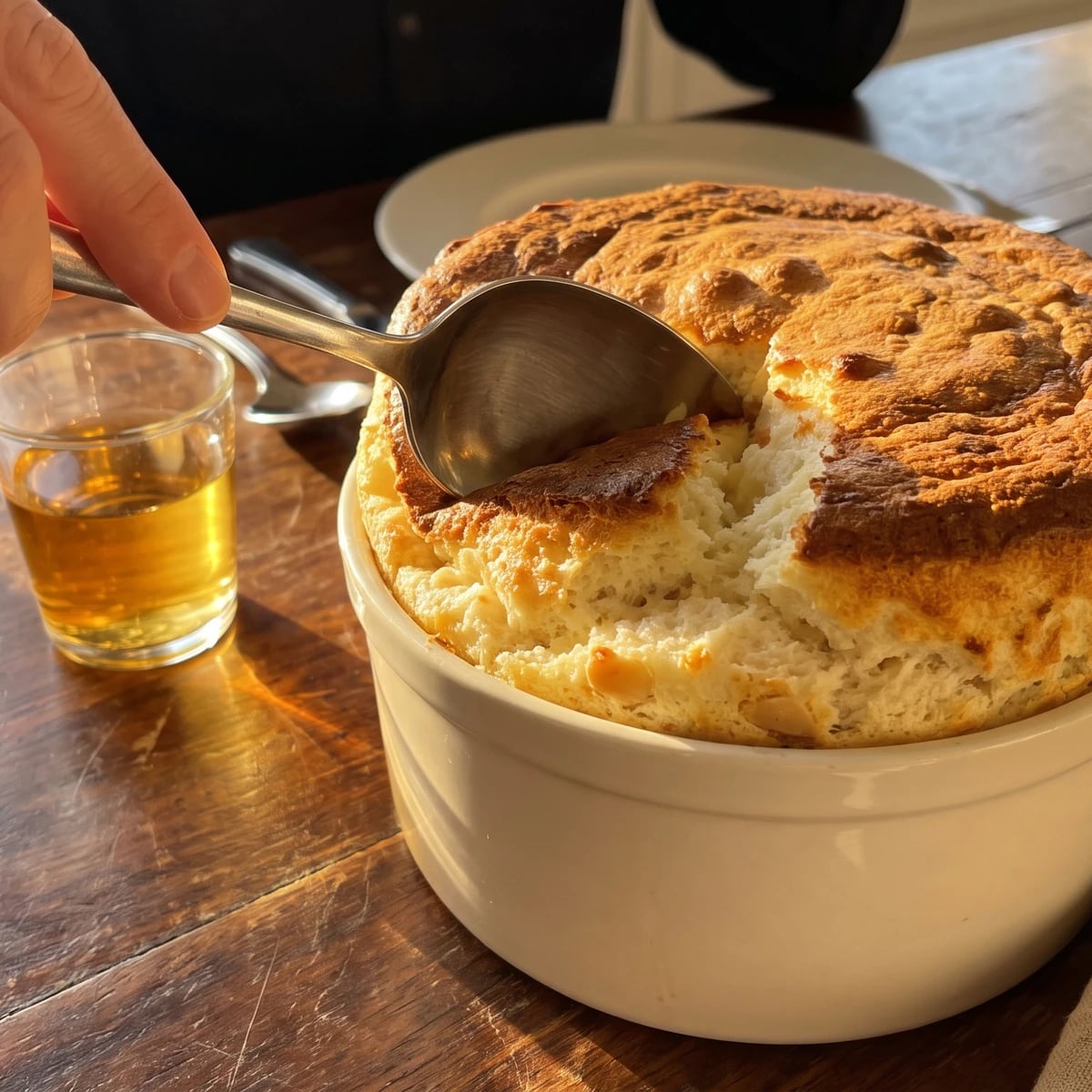
Soufflé aux amandes turns one careful fold into a tall golden dessert, fragrant with almond milk and lightly grilled nuts, its sugared timbale helping every spoonful climb.
Soufflé aux amandes (hot almond soufflé) teaches one liberating truth: the air held in the egg whites is the lift. Everything before the fold builds flavor and structure, but once the whites enter, your light hand decides whether the soufflé climbs. The buttered, sugared timbale matters too. Butter gives richness, while the sugar grips the batter all the way to the rim.
The original entry gives a professional ratio and assumes a pâtissier already fluent in the appareil à soufflé à la crème, the cooked cream-soufflé base, with a salamander ready to color the almonds. Here, one imperial half-pint becomes 284 ml almond milk with the prescribed 42 g of almonds, enough for one 1.2-liter dish and four generous servings. A domestic broiler replaces the salamander. The open-ended service batch and separate pastry station were brigade scaffolding; the cooked base, lightly grilled almonds, sugared timbale, careful fold, and immediate service are the dish itself.
The fold is the step that matters most. Loosen the thick almond base with the first quarter of the whites, then fold the rest only until the last large white pockets disappear. A few fine streaks do less harm than another dozen turns of the spatula.
Soufflé aux amandes belongs to the Parisian classical sweet kitchen, where pastry cooks treated soufflé mixtures as a family of formulas rather than isolated recipes. Pressed almond milk already had a settled place in French lean-day cooking and refined entremets, so its use here grows naturally from the classical pantry. Despite the name cream soufflé, the specified liquid is almond milk; crème describes the cooked base, not an added pour of dairy cream.
Quantity
2 tablespoons (30 ml / 28 g)
softened, for the timbale
Quantity
⅔ cup (160 ml / 135 g)
divided
Quantity
1 cup plus 3 tablespoons (284 ml / 284 g)
Quantity
⅓ cup (80 ml / 40 g)
Quantity
4
Quantity
4
at room temperature
Quantity
⅛ teaspoon (0.6 ml / 0.8 g)
Quantity
¼ cup plus 1 tablespoon (75 ml / 42 g; 1½ oz)
| Ingredient | Quantity |
|---|---|
| unsalted buttersoftened, for the timbale | 2 tablespoons (30 ml / 28 g) |
| superfine sugardivided | ⅔ cup (160 ml / 135 g) |
| rich unsweetened almond milk | 1 cup plus 3 tablespoons (284 ml / 284 g) |
| all-purpose flour | ⅓ cup (80 ml / 40 g) |
| large egg yolks | 4 |
| large egg whitesat room temperature | 4 |
| fine sea salt | ⅛ teaspoon (0.6 ml / 0.8 g) |
| blanched almonds | ¼ cup plus 1 tablespoon (75 ml / 42 g; 1½ oz) |
Heat the oven to 375°F (190°C), conventional setting, with a rimmed baking sheet on the lower-middle rack. Brush the softened butter over the bottom and sides of a 1.2-liter straight-sided soufflé dish, the timbale, using upward strokes and carrying the butter fully to the rim. Add 2 tablespoons (30 ml / 25 g) of the sugar, turn the dish until the bottom and sides are evenly coated, then tip out the excess and chill the dish. This coating is not decoration: the sugar gives the rising batter something to grip.
Spread the blanched almonds on a small metal tray and place them beneath a hot broiler for 1 to 3 minutes, shaking the tray once, until they show scattered pale-gold patches and smell distinctly nutty. This is the home equivalent of the salamander. Pull them before they turn brown, because their heat will carry the coloring further. Cool completely, then chop them into small, distinct pieces rather than a powder.
Reserve 2 tablespoons (30 ml / 30 g) of the almond milk and warm the remainder in a saucepan until small bubbles gather around the edge. In a bowl, whisk the yolks with 70 g of the remaining sugar, the flour, and the salt until smooth. Pour in the warm almond milk gradually while whisking, return everything to the saucepan, and cook over medium-low heat, whisking into every corner, until the base bubbles and becomes thick enough to hold a clear whisk trail. Cook for 1 minute more to remove the raw taste of flour, then take it off the heat and whisk in the reserved almond milk. If the base has formed lumps, do not keep beating them around the pan. Pass it through a fine sieve while warm. Ça se rattrape. Press reusable wrap or baking paper directly against the surface and cool until merely warm, about 10 minutes, then stir in the chopped almonds.
Whisk the egg whites in a perfectly clean bowl until they form soft peaks. Add the remaining 40 g sugar gradually and continue whisking only to glossy medium peaks whose tips bend softly; dry, stiff whites break into lumps and shed their air during folding. Stir one quarter of the whites firmly into the almond base. If the cooled base seems alarmingly stiff, this first addition is its rescue, so mix until supple without worrying about lost volume. Add the remaining whites in two batches, cutting down through the center with a broad spatula, sweeping across the bottom, and turning the bowl after each stroke. Stop as soon as no large white pockets remain.
Spoon the batter into the prepared timbale without tapping the dish, then level the surface lightly. Run a clean thumb around the inside edge to make a shallow channel about 1 cm wide; this frees the crown to rise evenly. Set the dish on the heated baking sheet and bake without opening the door for 22 minutes. Continue for 4 to 8 minutes, until the soufflé stands well above the rim, the crown is deep butter-gold, and the center trembles without sloshing. If a slender skewer shows liquid batter, return the dish to the oven immediately for 3 minutes. It may lose a little height when tested, but it will recover enough lift, and a properly cooked center matters more than theater.
Carry the soufflé straight to the table in its baking dish and spoon it into warm dessert bowls, cutting down through the bronzed crown so each serving receives some crust and some tender center. A soufflé begins settling as soon as it leaves the oven. That is its nature, not a failure. Guests wait for the soufflé; the soufflé does not wait for guests. À table!
1 serving (about 160g)
Culinary guides, cultural storytelling, and the editorial depth that makes cooking meaningful.
Discover Culinary Explorer
Chef Juliette
Six almond-lined moulds, gently poached until softly risen, with white-wine sabayon scented by orgeat. The lesson is simple and exact: the bain-marie must tremble, never boil.

Chef Juliette
Butter worked to a true pommade carries almonds, eggs, orange-flower water, and cream into a tender pouding, gently set in a bain-marie and brought to the table in the very dish that baked it.

Chef Juliette
Pouding aux biscuits turns crushed ladyfingers, hot milk, kirsch-soaked fruit, butter, and yolks into a tender pudding, with five late-folded whites keeping every spoonful light beneath warm apricot sauce.

Chef Juliette
Liqueur-soaked biscuits, jewel-bright fruit, and vanilla custard are packed into one mould and poached without a bubble. Fill slowly, and every slice holds its cabinet of colours.