Culinary Explorer

A cooking platform built around craft, culture, and the stories behind what we eat.
Discover Culinary Explorer
Souffléd Pudding à la Vésuvienne

Souffléd Pudding à la Vésuvienne

Created by Chef Juliette

Based on No. 2516, Souffléd Pudding à la Vésuvienne, from Le Guide Culinaire (1907) by Auguste Escoffier

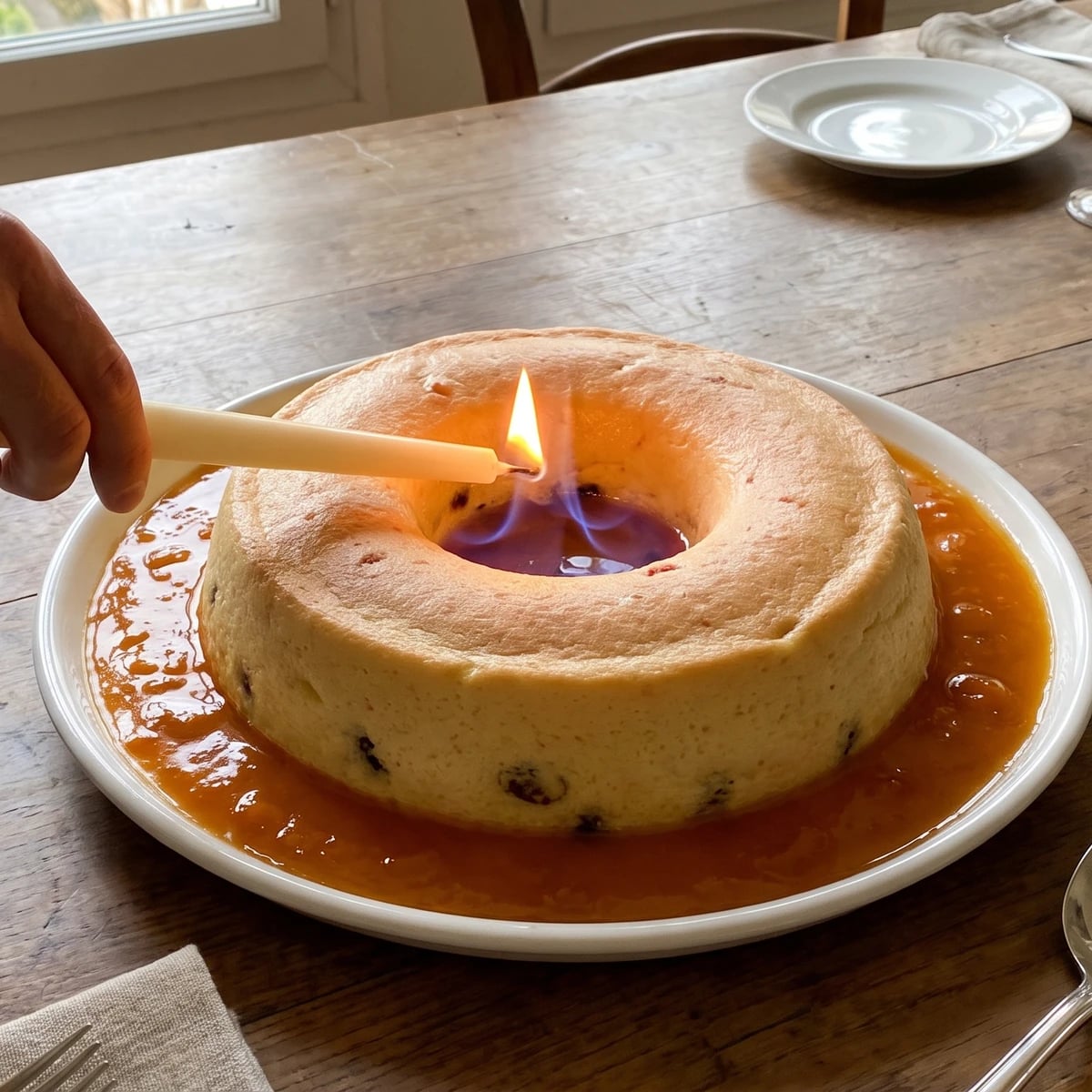
A tender ring of souffléd pudding holds tomato jam and Malaga raisins, poached gently in a bain-marie, then turned out with glossy apricot sauce and a living flame of rum.

Desserts
French
Celebration
New Years
Special Occasion
35 min
Active Time
55 min cook1 hr 30 min total
Yield6 servings

Pouding soufflé à la Vésuvienne (Vesuvius-style souffléd pudding) teaches the quiet side of a soufflé: air is useful only when gentle heat sets it before it escapes. This isn't a towering individual soufflé. It is a tender moulded pudding, spotted with Malaga raisins and tomato jam, surrounded by apricot sauce, then lit with warm rum in its central well. The little eruption is wit. The fine, light crumb beneath it is the craft.

The grand kitchen assumed a souffléd-pudding preparation ready to use, a saucier holding apricot sauce, tomato jam prepared in bulk, a professional central-tube mould, and enough hands for one cook to watch the bain-marie while another warmed the rum. At home, a compact panade supplies the base, smooth apricot preserves become the sauce, and a small ring mould handles six servings. The book's equal 1½-ounce measures of tomato jam and raisins stay exactly intact. Extra hands and bulk preparations are scaffolding; the equal flavourings, central well, gentle poach, apricot sauce, and flaming rum are the dish. One cook, one stove, one evening.

Before you touch the pan, know the one true thing: the bain-marie must tremble gently, never boil. If the water bubbles hard, lower the heat and add cool water. Ça se rattrape. The step that decides the pudding is this quiet poach, so give it your full attention.

Pouding soufflé à la Vésuvienne belongs to the Parisian grand-kitchen repertory, not to the domestic cooking of Naples or Campania. Its title is visual French wit: the central-tube mould forms Vesuvius's crater, apricot sauce suggests lava, and ignited rum supplies the eruption. Malaga raisins are Spanish, and the name does not make the pudding Italian; it is a French moulded dessert designed for celebratory service.

The technique, the tradition, and the story behind every dish.

Discover Culinary Explorer

Ingredients

unsalted butter

Quantity

3 tablespoons (45 ml / 42 g)

softened and divided

all-purpose flour

Quantity

⅓ cup (80 ml / 40 g)

whole milk

Quantity

1 cup (240 ml / 245 g)

superfine sugar

Quantity

⅓ cup (80 ml / 67 g)

divided

large eggs

Quantity

4

separated

fine sea salt

Quantity

⅛ teaspoon (0.6 ml / 0.8 g)

smooth sweet tomato jam

Quantity

2 tablespoons (30 ml / 42 g)

Malaga raisins

Quantity

¼ cup (60 ml / 42 g)

pipped

smooth apricot preserves

Quantity

¾ cup (180 ml / 240 g)

water

Quantity

¼ cup (60 ml / 60 g)

for the apricot sauce

dark rum, 40 to 50 percent alcohol by volume

Quantity

¼ cup (60 ml / 57 g)

Equipment Needed

  • 5 to 6 cup (1.2 to 1.4 litre) smooth ring mould with central tube
  • Deep roasting pan for the bain-marie
  • Medium heavy saucepan
  • Electric mixer or balloon whisk
  • Fine-mesh sieve
  • Flameproof serving platter
  • Small heatproof jug
  • Long match or taper

Instructions

  1. 1

    Prepare the mould

    Heat the oven to 325°F (160°C) with a rack in the lower middle. Coat a 5 to 6 cup (1.2 to 1.4 litre) ring mould thoroughly with 7 g of the softened butter, paying particular attention to the central tube and upper rim. Set the mould in a deep roasting pan and bring a kettle of water almost to a boil. The central tube isn't decoration; it carries gentle heat into the middle and leaves the well that will hold the rum.

  2. 2

    Cook the panade

    Melt the remaining 35 g butter in a medium heavy saucepan over medium-low heat. Add the flour and stir for one minute without letting it colour. Gradually whisk in the milk, then add 50 g of the sugar and the salt. Cook, stirring constantly, until the panade, the cooked flour-and-milk base, becomes smooth, glossy, and thick enough to pull cleanly from the sides of the pan, about three minutes. If it lumps, take it off the heat and whisk firmly; if stubborn lumps remain, push it through a sieve before adding the eggs. Nothing is lost.

  3. 3

    Finish the base

    Transfer the panade to a wide bowl and let it cool for five minutes. It should be warm, not hot enough to cook the yolks. Beat in the yolks one at a time until the base is satiny, then fold in the tomato jam and pipped Malaga raisins. Keep the two additions at equal weights, 42 g each. That ratio is the Vésuvienne's particular character and stays exactly as the source gives it.

  4. 4

    Whip and fold

    Whisk the egg whites in a clean, grease-free bowl until they hold soft peaks. Add the remaining 17 g sugar gradually and continue only until the whites are glossy and hold a supple medium peak. Stir one-quarter of the whites briskly into the panade to loosen it, then fold in the remainder in two additions, turning the bowl and lifting from underneath. Stop as soon as no white streaks remain. Dry, clotted whites have gone too far; glossy and flexible is what folds without losing the air.

  5. 5

    Poach in bain-marie

    Spoon the batter into the buttered mould and smooth the top lightly. Set the roasting pan in the oven, then pour in the hot water until it reaches halfway up the mould. Poach in this bain-marie for 45 to 55 minutes without opening the oven during the first 35 minutes. The pudding is ready when it has risen slightly, springs back under a light touch, and a slender skewer comes out without liquid batter; the centre should register about 180 to 185°F (82 to 85°C). Watch the water whenever you check. If it boils briskly, lower the oven to 300°F (150°C) and add a cup of cool water to the bath. Ça se rattrape.

    A hard-boiling bath drives the air from the pudding and leaves the custard coarse. The water should show only an occasional small bubble at the edge.
  6. 6

    Make apricot sauce

    While the pudding poaches, combine the apricot preserves and water in a small saucepan. Warm gently, whisking until fluid, then press the sauce through a fine sieve and keep it warm. It should pour in a glossy ribbon rather than sit in a mound. If too thick, add hot water one spoonful at a time; if too thin, simmer it briefly until it coats the spoon.

  7. 7

    Turn out pudding

    Lift the mould from the bain-marie and let it stand for three minutes, no longer. Run a thin knife around both the outer edge and central tube, place a flameproof serving platter over the mould, and invert decisively. If the pudding is reluctant, lay a hot damp towel over the mould for thirty seconds and try again. Pour the warm apricot sauce generously around the pudding, keeping the central well clear for the rum.

  8. 8

    Warm and flame rum

    Measure the rum into a small heatproof jug and stand the jug in a bowl of just-boiled water until the spirit reaches 120 to 130°F (50 to 55°C), about five minutes. Never warm rum over an open flame. Place the platter on a stable table away from loose fabric, pour the warmed rum into the central well, and ignite it with a long match or taper. Cold spirit will not take a flame reliably. If it refuses to light, don't add rum from the bottle; serve it unlit, because the flavour remains. Let the flame extinguish completely before slicing. À table!

    Ignite only after the platter is at the table, never carry it while lit, and treat the well as burning until you have seen the flame go out. Alcohol flames can be difficult to see in bright light.

Chef Tips

  • Tomato jam here means a smooth, sweet preserve of ripe tomato and sugar. A savoury relish with onion, garlic, chilli, or heavy vinegar belongs elsewhere; it will turn this delicate pudding into an argument.
  • Malaga raisins are large Muscat raisins and may still contain seeds, which is why the source specifies pipped. Remove every seed before weighing. If true Malaga raisins aren't available, plump Muscat raisins are the honest equivalent, but keep the weight at 42 g and don't replace them with currants.
  • Use a smooth ring or savarin mould with a central tube. A deeply patterned Bundt mould catches the tender pudding, and an ordinary basin loses the central well that makes the Vésuvienne itself.
  • The rum must be warm before it reaches the well, but it must never simmer. Warm it indirectly in hot water, keep the bottle away from the platter, and never pour additional alcohol onto a flame.

Advance Preparation

  • The apricot sauce can be made up to three days ahead, covered and chilled. Warm it gently and adjust its consistency with a spoonful of water before serving.
  • The panade can be prepared through the yolks, tomato jam, and raisins up to four hours ahead. Press parchment against its surface, chill it, then let it stand for twenty minutes and whisk it smooth before folding in freshly beaten whites.
  • Butter the mould and measure every ingredient earlier in the day. Once the whites are folded, the pudding must go directly into the bain-marie; the finished pudding is meant to be turned out and served hot, not held.

Frequently Asked Questions

Nutrition Information

1 serving (about 160g)

Calories
345 calories
Total Fat
10 g
Saturated Fat
5 g
Trans Fat
0 g
Unsaturated Fat
4 g
Cholesterol
145 mg
Sodium
135 mg
Total Carbohydrates
54 g
Dietary Fiber
1 g
Sugars
43 g
Protein
7 g

Note: Chef personas and recipes are created with AI assistance. Cook with care: follow safe food-handling practices, check doneness with a thermometer when needed, and adapt for allergies and your kitchen.

Where cooking meets culture.

Culinary guides, cultural storytelling, and the editorial depth that makes cooking meaningful.

Discover Culinary Explorer

More from Entremets (Sweets) - Puddings

Browse the full collection