Culinary Explorer

A cooking platform built around craft, culture, and the stories behind what we eat.
Discover Culinary Explorer
Souffléd Pudding, Denise

Souffléd Pudding, Denise

Created by Chef Juliette

Based on No. 2506, Souffléd Pudding, Denise, from Le Guide Culinaire (1907) by Auguste Escoffier

Pouding soufflé Denise turns a properly dried almond and crème de riz paste into a tender, buoyant pudding, enriched with yolks, lifted by whites, and unmoulded beneath apricot-almond sauce.

Desserts
French
Special Occasion
Dinner Party
Celebration
30 min
Active Time
50 min cook1 hr 30 min total
Yield6 servings

Pouding soufflé Denise (Denise-style souffléd pudding) teaches one exact lesson: the cooked base must be dry before it can carry its butter, yolks, almonds, and whipped whites. Stop while it still clings to the spatula and the pudding slumps; stir until the paste falls away cleanly and those eggs can lift it without making it wet.

The original assumed a pastry station with almonds pounded by hand, muslin, sheets of Pâte à Génoise Fine (No. 2376) ready to cut, a cabinet of small dome moulds, and, for another of its finishes, a red-hot iron. At home, a blender makes the same fresh almond milk, a nut-milk bag replaces muslin, a roasting pan becomes the bain-marie, and six small moulds replace a brigade batch. The home version keeps the source's Génoise-lined dome presentation and almond-apricot coating because those are the dish; hand pounding and the hot-iron option are scaffolding, so they can go.

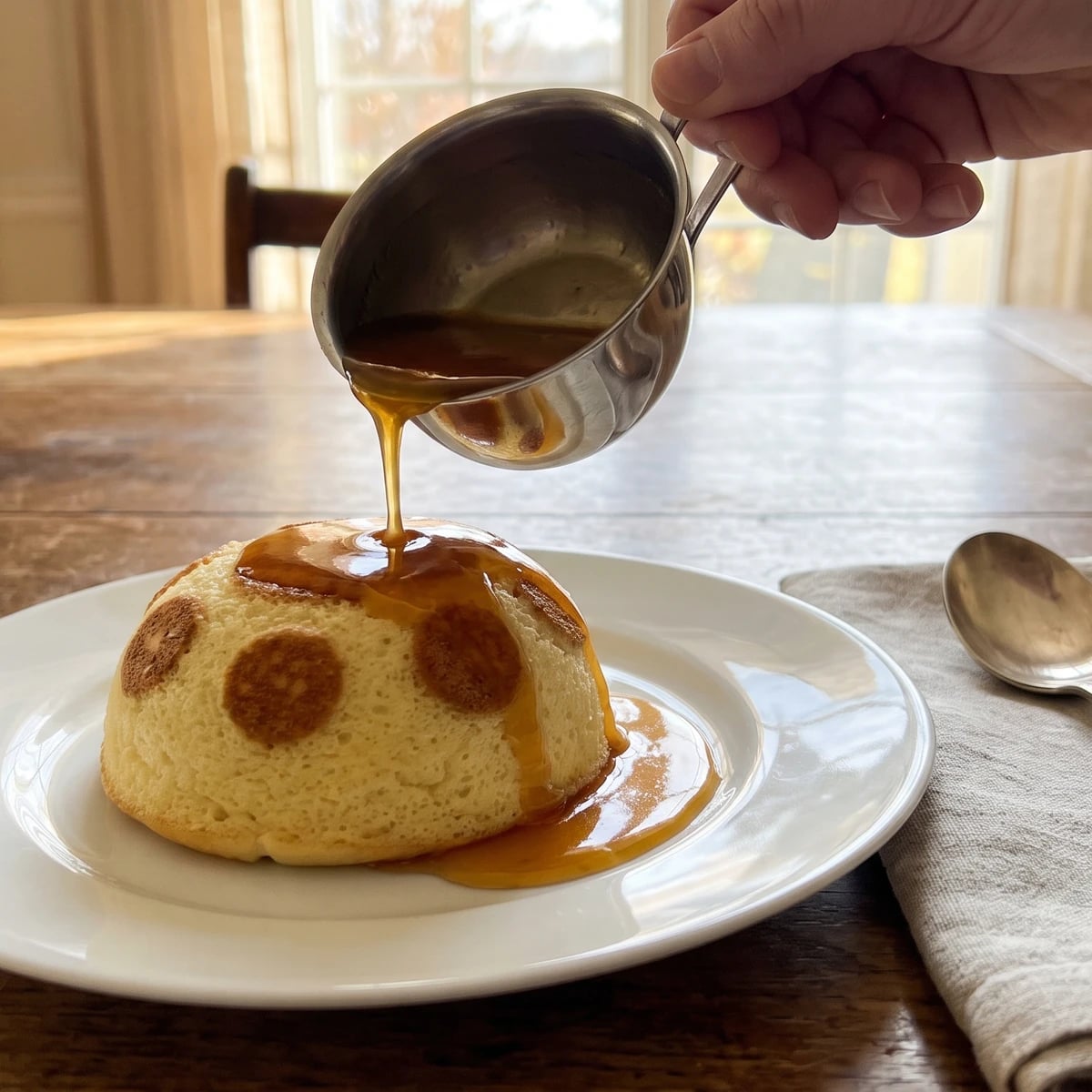
The result is pale gold and tremulous, with kirsch and maraschino held inside a deep almond perfume, each little dome showing its mosaic of Génoise beneath a warm gloss of apricot sauce. One cook, one stove, one evening. The moment that matters is the saucepan: cook the paste until the spatula comes away clean.

Pouding soufflé Denise belongs to the entremets course of the French grand dining-room table, not to a regional household repertoire: it joins the cooked starch base of a moulded pudding to the aeration of a soufflé. Its dedication is left unexplained in the canon, while its almond milk, kirsch, maraschino, Pâte à Génoise Fine (No. 2376) roundels, and apricot sauce mark the pastry station's composed style. Despite soufflé in the name, the pudding cooks gently in a bain-marie and is unmoulded, so it owes as much to the family of poached puddings as to the free-rising oven soufflé.

The technique, the tradition, and the story behind every dish.

Discover Culinary Explorer

Ingredients

softened unsalted butter

Quantity

2 teaspoons (10 ml / 9 g)

for the moulds

Pâte à Génoise Fine roundels

Quantity

36 one-inch (2.5 cm) roundels cut 1/3 inch (8 mm) thick from Pâte à Génoise Fine (No. 2376)

blanched almonds

Quantity

Scant 1/2 cup (120 ml / 63 g)

for the fresh almond milk

cold water

Quantity

About 1 1/2 cups (355 ml / 355 g)

as needed to yield 1 1/4 cups fresh almond milk

plain flour

Quantity

1/3 cup (80 ml / 43 g)

crème de riz (fine rice flour)

Quantity

1/3 cup (80 ml / 43 g)

granulated sugar

Quantity

1/3 cup (80 ml / 71 g)

unsalted butter

Quantity

3 tablespoons (45 ml / 43 g)

fine salt

Quantity

1/8 teaspoon (0.6 ml / 0.8 g)

softened unsalted butter

Quantity

2 tablespoons (30 ml / 28 g)

large egg yolks

Quantity

4

blanched almonds

Quantity

1/4 cup plus 1 tablespoon (75 ml / 28 g)

finely ground

kirsch

Quantity

1 1/2 teaspoons (7.5 ml / 7 g)

maraschino liqueur

Quantity

1 1/2 teaspoons (7.5 ml / 7 g)

large egg whites

Quantity

1/3 cup (80 ml / 75 g), about 2 1/2 whites

smooth apricot preserves

Quantity

2/3 cup (160 ml / 200 g)

Equipment Needed

  • Digital scale
  • High-speed blender
  • Nut-milk bag or doubled muslin
  • Fine-mesh sieve and stiff heatproof spatula
  • Six shallow 5-to-6-ounce (150-to-180 ml) dome or dariole moulds
  • Deep roasting pan and kettle for the bain-marie
  • Electric hand mixer or balloon whisk

Instructions

  1. 1

    Line the moulds

    Heat the oven to 325°F (165°C). Butter six shallow 5-to-6-ounce (150-to-180 ml) dome moulds thoroughly. Arrange six roundels of Pâte à Génoise Fine (No. 2376) inside each mould, pressing them lightly against the butter in a simple flower pattern. The pattern will face outward when the puddings are unmoulded. Set the prepared moulds in a deep roasting pan.

    Prepare every mould before beating the whites. Once the batter is folded, it should go directly into the bain-marie.
  2. 2

    Make the almond milk

    Put the blanched almonds in a blender with 2 tablespoons of the cold water and process to a smooth paste, stopping to scrape the sides. Add the remaining water gradually and blend until the liquid is milky and finely textured. Strain it through doubled muslin or a nut-milk bag, twisting gently to express the liquid without forcing coarse almond pulp through. Add enough cold water to make exactly 1 1/4 cups (315 ml) almond milk. Measure 1 cup plus 3 tablespoons (285 ml) for the pudding and reserve 2 tablespoons (30 ml) for the sauce.

  3. 3

    Cook the paste dry

    Mix the plain flour and crème de riz in a heavy saucepan. Whisk in the 1 cup plus 3 tablespoons (285 ml) almond milk a little at a time, keeping the mixture smooth, then pass it through a fine sieve back into the clean pan. Add the sugar, 3 tablespoons butter, and salt. Bring to a boil over medium heat, stirring constantly. Once it boils, change to a stiff spatula and beat briskly until the preparation becomes a heavy, glossy paste that pulls cleanly from the pan and falls from the spatula without leaving a coating, about 5 to 7 minutes. This dryness is the dish. If lumps appear before the mixture thickens, remove it from the heat and pass it through the sieve again. Ça se rattrape. If the bottom scorches, transfer only the clean paste to another pan and continue without scraping the burnt layer.

  4. 4

    Enrich the base

    Scrape the paste into a wide mixing bowl and beat it for 3 to 5 minutes, until it remains hot but no longer gives off fierce heat. Add the 2 tablespoons softened butter a little at a time, beating each addition in completely. Beat in the yolks one by one. Mix the finely ground almonds with the kirsch and maraschino, then beat them into the base. If butter gathers in a slick around the edge, stop adding and beat firmly until the paste becomes smooth again before continuing.

  5. 5

    Fold in the whites

    Beat the egg whites until they hold a stiff, glossy peak without looking dry or granular. Fold one-third into the almond base to loosen it, then fold in the remainder with broad strokes, lifting from the bottom and turning the bowl as you work. Stop as soon as no white streaks remain. A few deliberate folds preserve more lift than endless gentle stirring.

  6. 6

    Bake in bain-marie

    Divide the batter among the lined moulds, filling each no more than three-quarters full, and smooth the tops lightly. Pour very hot water into the roasting pan until it reaches halfway up the moulds. Bake in this bain-marie, a hot-water bath, for 30 to 38 minutes. The puddings are ready when they have risen, their tops feel lightly springy, and a skewer finds moist crumbs rather than liquid paste. The water should tremble but never boil hard; if it begins bubbling vigorously, add a little cool water to the bath and lower the oven heat.

  7. 7

    Make the apricot sauce

    While the puddings bake, warm the apricot preserves over gentle heat until fluid. Whisk in the reserved 2 tablespoons (30 ml) fresh almond milk, then pass the sauce through a fine sieve. Keep it warm. If it is too tight to pour, loosen it with a teaspoon of water; if it runs thinly like juice, simmer it for a minute until it coats the back of a spoon.

  8. 8

    Unmould and sauce

    Lift the moulds from the bain-marie and rest them for 5 minutes. Run a thin knife only around the upper rim, place a warm dessert plate over each mould, and invert decisively. If one clings, cover the upturned mould with a hot damp towel for 20 seconds, then lift again. Coat each pudding with a spoonful of apricot-almond sauce and serve the remainder separately in a warm sauceboat. Bring them to the table at once. À table!

Chef Tips

  • Crème de riz is finely milled rice flour, not liquid rice cream and not a coarse breakfast cereal. Its fine starch helps the paste set smoothly while keeping the finished pudding tender.
  • The fresh almond milk is the foundation, not a shopping convenience. Carton almond milk is usually much weaker and may contain gums that alter the paste; blend blanched almonds with water and measure the strained milk precisely.
  • Kirsch is dry cherry spirit, while maraschino is sweeter and carries the perfume of cherry stones. The source uses both in equal measure, and together they sharpen the almond without turning the pudding into a liqueur dessert.
  • Serve the puddings soon after unmoulding. They are sturdier than a free-rising soufflé, but their best texture is warm, tender, and newly lifted. Coffee or a small glass of kirsch suits them better than a heavy sweet wine.

Advance Preparation

  • Prepare Pâte à Génoise Fine (No. 2376) up to two days ahead according to its own entry, wrap it well, and cut the roundels before beginning the pudding.
  • The fresh almond milk can be made the morning of service and kept covered in the cold. Stir it thoroughly before measuring because fine almond solids settle.
  • The apricot preserves can be sieved ahead, but add the almond milk and warm the sauce while the puddings bake. Beat and fold the final batter only when the bain-marie and moulds are ready.
  • Leftover puddings keep covered in the cold for up to two days. Warm them gently in a covered bain-marie, knowing that the texture will be closer and less buoyant than it was at first service.

Frequently Asked Questions

Nutrition Information

1 serving (about 145g)

Calories
405 calories
Total Fat
19 g
Saturated Fat
9 g
Trans Fat
0 g
Unsaturated Fat
10 g
Cholesterol
160 mg
Sodium
100 mg
Total Carbohydrates
52 g
Dietary Fiber
1 g
Sugars
32 g
Protein
7 g

Note: Chef personas and recipes are created with AI assistance. Cook with care: follow safe food-handling practices, check doneness with a thermometer when needed, and adapt for allergies and your kitchen.

Where cooking meets culture.

Culinary guides, cultural storytelling, and the editorial depth that makes cooking meaningful.

Discover Culinary Explorer

More from Entremets (Sweets) - Puddings

Browse the full collection