
Chef Juliette
Various Almond Preparations
Five almond preparations, one discipline: remove the skins cleanly, dry every kernel through, then cut, toast, or cloak it in pale caramel without letting its fragrant oils escape.
A cooking platform built around craft, culture, and the stories behind what we eat.
Created by Chef Juliette
Based on No. 2492, Scotch Bread Pudding, from Le Guide Culinaire (1907) by Auguste Escoffier
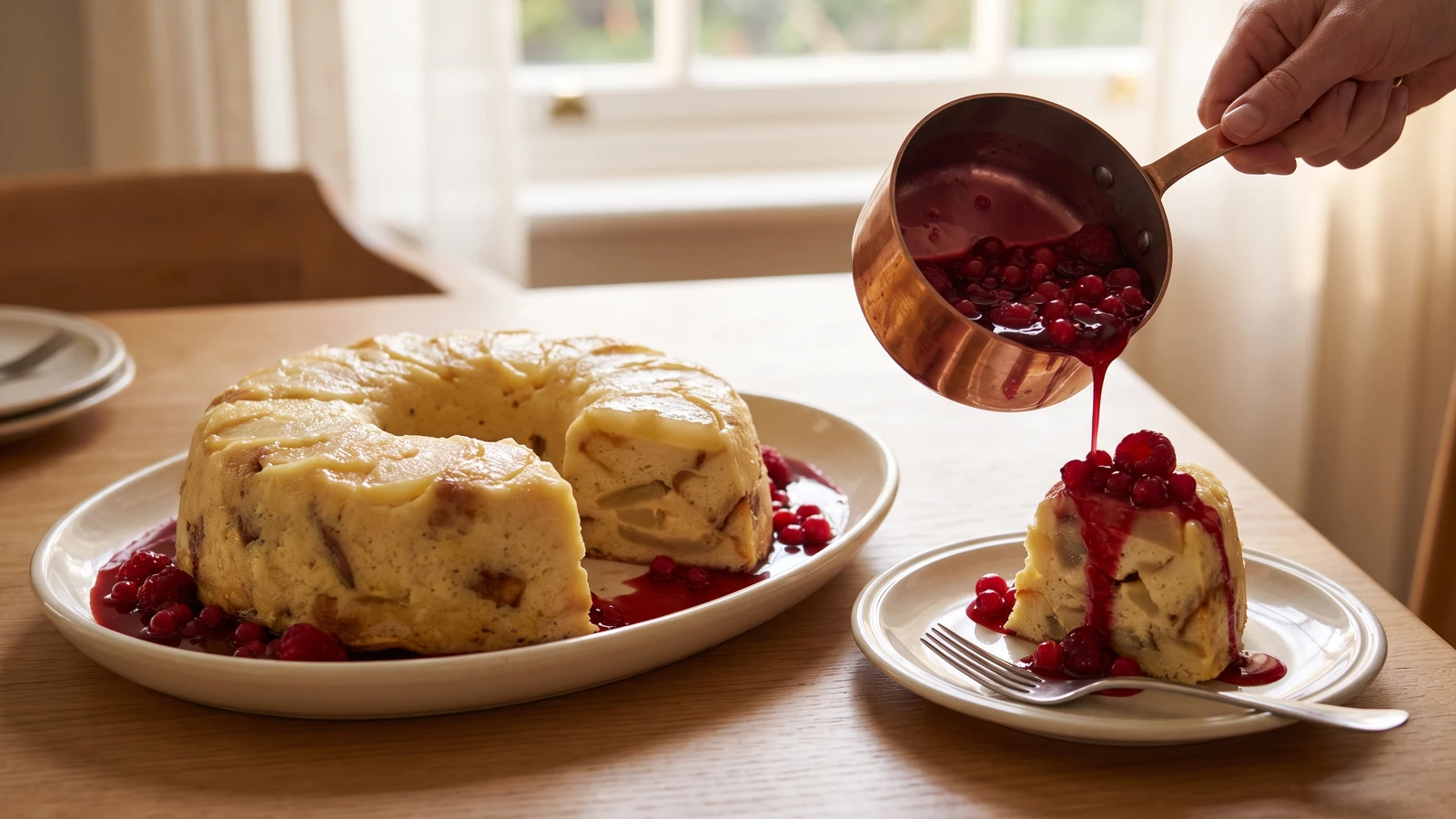
Pouding de Pain à l’Écossaise turns vanilla bread custard light with beaten whites, suspends thin seasonal fruit through it, then meets a glossy red-currant sauce sharpened with raspberry.
Pouding de Pain à l’Écossaise (Scotch bread pudding) teaches one precise custard lesson: fruit stays suspended only when it is sliced almost transparent, dried well, and folded into a base with enough body to carry it. Thick pieces sink. Wet pieces drag the delicate crumb down with them. The slicing is the dish.
The source proceeds from French Bread Pudding (No. 2490), then adds seasonal fruit before the mould is poached. Its brigade kitchen assumed a pastry station, a deep border mould, a dedicated poaching bath, and a saucier ready with the red-currant accompaniment. Here the formula is halved for six servings, the old border mould becomes a small metal ring mould, and a roasting pan supplies the bain-marie. The separate attendants were scaffolding and can go. Sieving the bread base, folding the whites without crushing them, and poaching gently must stay. One cook, one stove, one evening.
Turned out, the pouding is ivory-gold and tender, with fine slices of fruit visible through the crumb and a garnet sauce pooling around it. Slice the fruit no thicker than a coin and blot every surface before it meets the pudding base. That is the step to give your full attention.
Pouding de Pain à l’Écossaise belongs to the French grand-kitchen dessert table rather than a particular French region: the household economy of soaked stale bread was refined by sieving the crumb, lifting it with egg white, and poaching it in a mould. Its à l’Écossaise title marks the canon’s named variation on French Bread Pudding (No. 2490), with sliced seasonal fruit in the custard and red-currant sauce scented by raspberry; the title does not by itself establish a Scottish household origin. The dish shows the passage from family pot to formal service, thrift kept intact while texture and presentation gained discipline.
Quantity
½ recipe French Bread Pudding (No. 2490)
prepared through the final egg-white fold but not yet moulded or poached
Quantity
About ½ cup (120 ml / 70 g; 2½ oz)
sliced no thicker than 2 mm and blotted dry
Quantity
½ cup (120 ml / 160 g)
Quantity
½ cup (120 ml / 60 g)
Quantity
3 tablespoons (45 ml / 45 g)
| Ingredient | Quantity |
|---|---|
| prepared pudding baseprepared through the final egg-white fold but not yet moulded or poached | ½ recipe French Bread Pudding (No. 2490) |
| ripe but firm seasonal fruitsliced no thicker than 2 mm and blotted dry | About ½ cup (120 ml / 70 g; 2½ oz) |
| red-currant jelly | ½ cup (120 ml / 160 g) |
| fresh or frozen raspberries | ½ cup (120 ml / 60 g) |
| water | 3 tablespoons (45 ml / 45 g) |
Heat the oven to 325°F (160°C). Prepare ½ recipe French Bread Pudding (No. 2490) exactly through its final egg-white fold, reserving the butter and bread crumbs specified there to coat a 6-cup (1.4 litre) metal ring mould. Do not mould or poach the base yet. Fold only until the whites disappear; a few pale streaks are preferable to a pudding made heavy by determined stirring.
Choose one ripe but firm fruit and slice it no thicker than 2 mm. Pear, apple, apricot, peach, or plum all suit the formula. Spread the slices between clean towels and blot them carefully, especially if using stone fruit. Wet fruit releases juice into the custard and sinks; if the slices are already weeping, leave them on the towel for five minutes and blot again.
Add the fruit to the prepared base in two additions, using a broad spatula to lift the mixture from the bottom and turn it over the slices. Stop as soon as the fruit is distributed. Spoon the mixture into the prepared mould and smooth the top without pressing it down. If a few slices immediately collect at the bottom, lift them once through the mixture with the spatula. Ça se rattrape. Do not keep stirring, or the beaten whites lose the air that gives this pudding its tenderness.
Cover the mould loosely with buttered parchment and foil, then set it in a deep roasting pan. Pour very hot water into the pan to reach halfway up the mould and transfer it carefully to the oven. Poach for 45 to 55 minutes, until the edges are firm, the centre trembles gently, and the middle reaches about 172°F (78°C). The bain-marie must remain calm. If the water begins to bubble hard, add a little cool water and lower the oven by 25°F (15°C); catch it there and the custard stays smooth.
While the pouding poaches, put the raspberries and water in a small saucepan. Bring them just to a simmer, crush the berries, and cook for 3 minutes. Press the mixture through a fine sieve into a clean pan, then add the red-currant jelly and warm gently until it melts into the raspberry juice. Simmer for 1 to 2 minutes, just until the sauce coats a spoon with a light garnet gloss. If it sets too thick, whisk in water a teaspoon at a time; if it is thin, simmer it briefly. Keep it warm without boiling.
Lift the mould from the water and rest it for 15 minutes. Run a thin knife around both edges, place a warm serving platter over the mould, and invert decisively. If the pouding clings, wrap the mould in a hot damp towel for 30 seconds and try again. Spoon a little red-currant and raspberry sauce around the base and into the centre of the ring, leaving the fruit-flecked surface visible. Serve the remaining sauce alongside. À table!
1 serving (about 200g)
Culinary guides, cultural storytelling, and the editorial depth that makes cooking meaningful.
Discover Culinary ExplorerChef Juliette
Five almond preparations, one discipline: remove the skins cleanly, dry every kernel through, then cut, toast, or cloak it in pale caramel without letting its fragrant oils escape.

Chef Juliette
A pastry pantry lesson in one tray: filberts warmed only until their red skins release, rubbed clean, cooled, and chopped into a fragrant mise-en-place for cakes, creams, pralines, and petits fours.

Chef Juliette
The smallest pâtisserie discipline decides whether a cake leaves its mould intact: clarified butter in every corner, followed by the lightest veil of dry flour or fécule.

Chef Juliette
Four whites, one spotless bowl, and a patient change of speed: whisk gently until loosened, then briskly to glossy stiffness, with powdered sugar waiting if the foam begins to granulate.