
Chef Juliette
Various Almond Preparations
Five almond preparations, one discipline: remove the skins cleanly, dry every kernel through, then cut, toast, or cloak it in pale caramel without letting its fragrant oils escape.
A cooking platform built around craft, culture, and the stories behind what we eat.
Created by Chef Juliette
Based on No. 2480, Almond Pudding, from Le Guide Culinaire (1907) by Auguste Escoffier
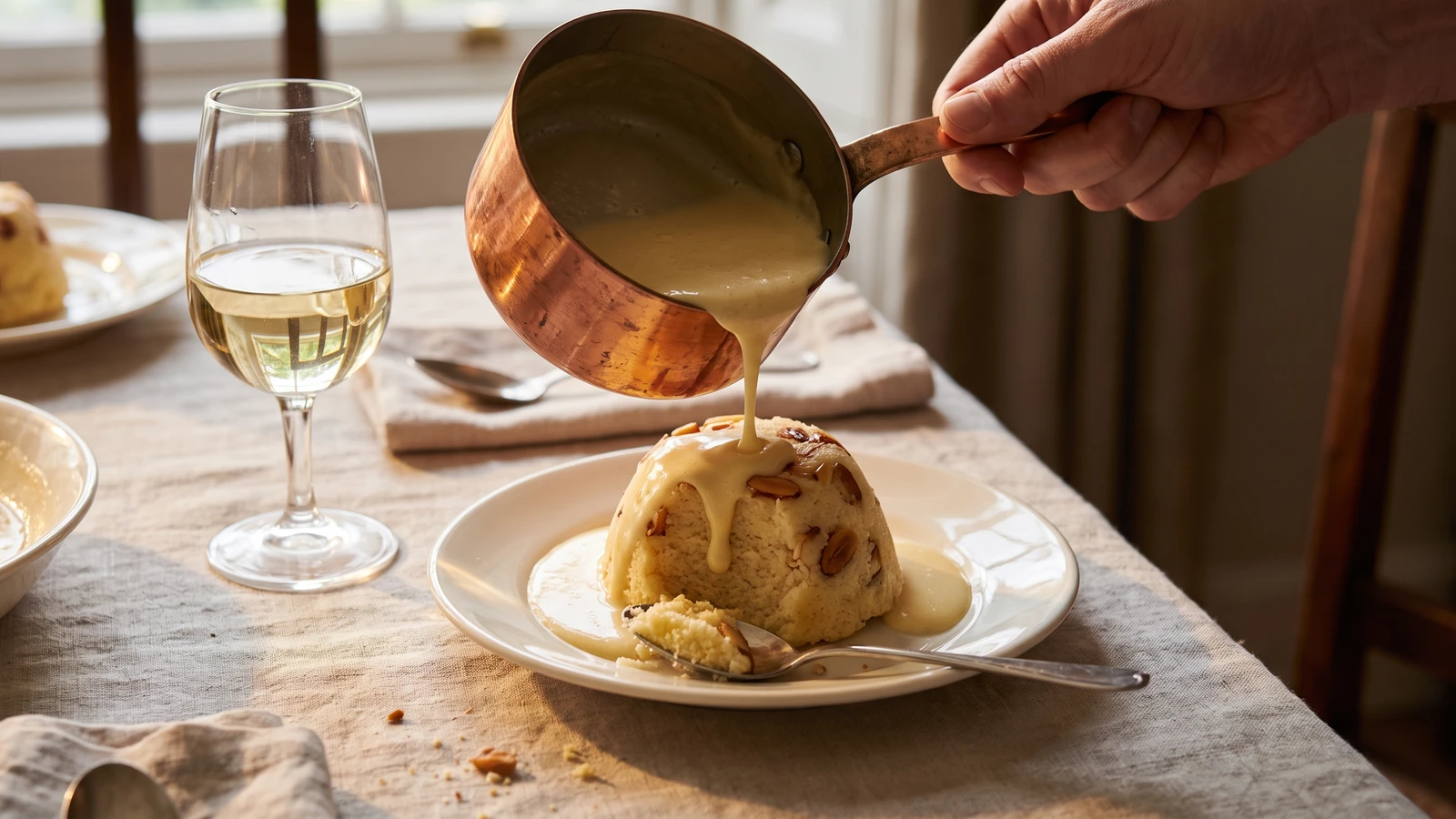
Six almond-lined moulds, gently poached until softly risen, with white-wine sabayon scented by orgeat. The lesson is simple and exact: the bain-marie must tremble, never boil.
Pouding aux amandes (almond pudding) teaches controlled poaching. Its souffléd mixture must set without curdling, keeping a fine, tender crumb beneath its coat of grilled almonds. One true thing before you touch a pan: the bain-marie (hot-water bath) must quiver, never boil.
The original entry assumes Almond Souffléd Pudding (No. 2505) already prepared, a bank of metal moulds, a salamander for grilling the almonds, and a saucier free to whisk the sabayon (warm wine-and-yolk sauce) as the puddings leave the water. At home, six small moulds replace the brigade quantity, your broiler replaces the salamander, and one heatproof bowl makes the sauce while the puddings poach. The rows of moulds and separate saucier are scaffolding and can go. The almond lining, gentle poach, and last-minute sabayon are the dish and must stay. One cook, one stove, one evening.
Unmoulded, each pudding is pale and softly risen, with bronzed almond splinters fixed around its sides and orgeat-scented sabayon pooling at the base. Keep your attention on the water: a tremble gives tenderness, while a boil leaves the pudding riddled with holes. That is the step that matters most.
The name pouding carries an English pudding form absorbed into the Parisian grand-kitchen repertoire of entremets, then reshaped through French moulding, sauce work, and service. Almond milk, grilled almonds, and orgeat joined the confectioner's pantry to the sauce station, producing a dessert intended for the formal dining table rather than a regional farmhouse tradition. Unlike a free-standing oven soufflé, this pudding is judged by its fine, moist texture and gentle rise, both protected by poaching in a bain-marie.
Quantity
1 home-scale batch Almond Souffléd Pudding (No. 2505), enough for six 6-fluid-ounce moulds
prepared with almond milk immediately before filling
Quantity
3 tablespoons (45 ml / 42 g), plus more if needed
very soft
Quantity
1/2 cup (120 ml / 55 g)
Quantity
4
Quantity
1/4 cup (60 ml / 50 g)
Quantity
1/2 cup (120 ml / 120 g)
chilled, with 1 tablespoon reserved
Quantity
2 tablespoons (30 ml / 40 g)
| Ingredient | Quantity |
|---|---|
| Almond Souffléd Puddingprepared with almond milk immediately before filling | 1 home-scale batch Almond Souffléd Pudding (No. 2505), enough for six 6-fluid-ounce moulds |
| unsalted buttervery soft | 3 tablespoons (45 ml / 42 g), plus more if needed |
| slivered almonds | 1/2 cup (120 ml / 55 g) |
| large egg yolks | 4 |
| granulated sugar | 1/4 cup (60 ml / 50 g) |
| dry white winechilled, with 1 tablespoon reserved | 1/2 cup (120 ml / 120 g) |
| orgeat (almond syrup) | 2 tablespoons (30 ml / 40 g) |
Set the broiler to high. Spread the slivered almonds on a small baking sheet and grill them close to the heat until evenly golden, turning once and watching without distraction during the final minute. They pass from bronze to bitter quickly. Let them cool, then switch the oven to 325°F (165°C). Brush six 6-fluid-ounce (180 ml) moulds copiously with the softened butter, covering the bases and sides without a bare patch. Sprinkle in the grilled almonds and rotate each mould until they cling all around.
Have the Almond Souffléd Pudding (No. 2505) ready exactly as its own entry directs, using almond milk. Spoon it gently into the prepared moulds without pressing out its air, filling each about three-quarters full. Wipe the rims clean and arrange the moulds in a deep roasting pan with space between them. Pour very hot water around the moulds until it reaches halfway up their sides.
Transfer the roasting pan carefully to the oven and poach for 22 to 28 minutes. The water should barely tremble, with no rolling bubbles, while the puddings rise softly and set around the edges. If the bain-marie begins boiling, lower the oven by 25°F (15°C) and add a cup of cool water around the moulds. Ça se rattrape if you cool it promptly. The puddings are ready when their centres still give a slight tremble and a fine skewer returns with moist crumbs rather than liquid batter.
While the puddings poach, bring an inch of water to the barest simmer in a saucepan. In a heatproof bowl, whisk the yolks and sugar until pale, then whisk in the white wine, keeping the reserved tablespoon cold. Set the bowl over the saucepan without letting its base touch the water and whisk continuously for 6 to 8 minutes, until the sabayon triples in volume, holds a soft ribbon, and reaches 160°F (71°C). Remove it from the heat and whisk in the orgeat. If it begins looking grainy, lift the bowl away at once and whisk in the reserved cold wine. Ça se rattrape when caught early. Hold the finished sabayon over the warm water, off the heat, for no longer than 10 minutes.
Lift the moulds from the bain-marie and rest them for 2 minutes. Run a thin knife around each rim, place a warm dessert plate on top, and invert decisively. If a pudding clings, wrap the base of its mould in a hot damp towel for 10 seconds and try again. Spoon the white-wine sabayon around each pudding, leaving the grilled almond coat visible, and serve at once. À table!
1 serving (about 195g)
Culinary guides, cultural storytelling, and the editorial depth that makes cooking meaningful.
Discover Culinary ExplorerChef Juliette
Five almond preparations, one discipline: remove the skins cleanly, dry every kernel through, then cut, toast, or cloak it in pale caramel without letting its fragrant oils escape.

Chef Juliette
A pastry pantry lesson in one tray: filberts warmed only until their red skins release, rubbed clean, cooled, and chopped into a fragrant mise-en-place for cakes, creams, pralines, and petits fours.

Chef Juliette
The smallest pâtisserie discipline decides whether a cake leaves its mould intact: clarified butter in every corner, followed by the lightest veil of dry flour or fécule.

Chef Juliette
Four whites, one spotless bowl, and a patient change of speed: whisk gently until loosened, then briskly to glossy stiffness, with powdered sugar waiting if the foam begins to granulate.