
Chef Juliette
Various Almond Preparations
Five almond preparations, one discipline: remove the skins cleanly, dry every kernel through, then cut, toast, or cloak it in pale caramel without letting its fragrant oils escape.
A cooking platform built around craft, culture, and the stories behind what we eat.
Created by Chef Juliette
Based on No. 2479, Puddings, from Le Guide Culinaire (1907) by Auguste Escoffier
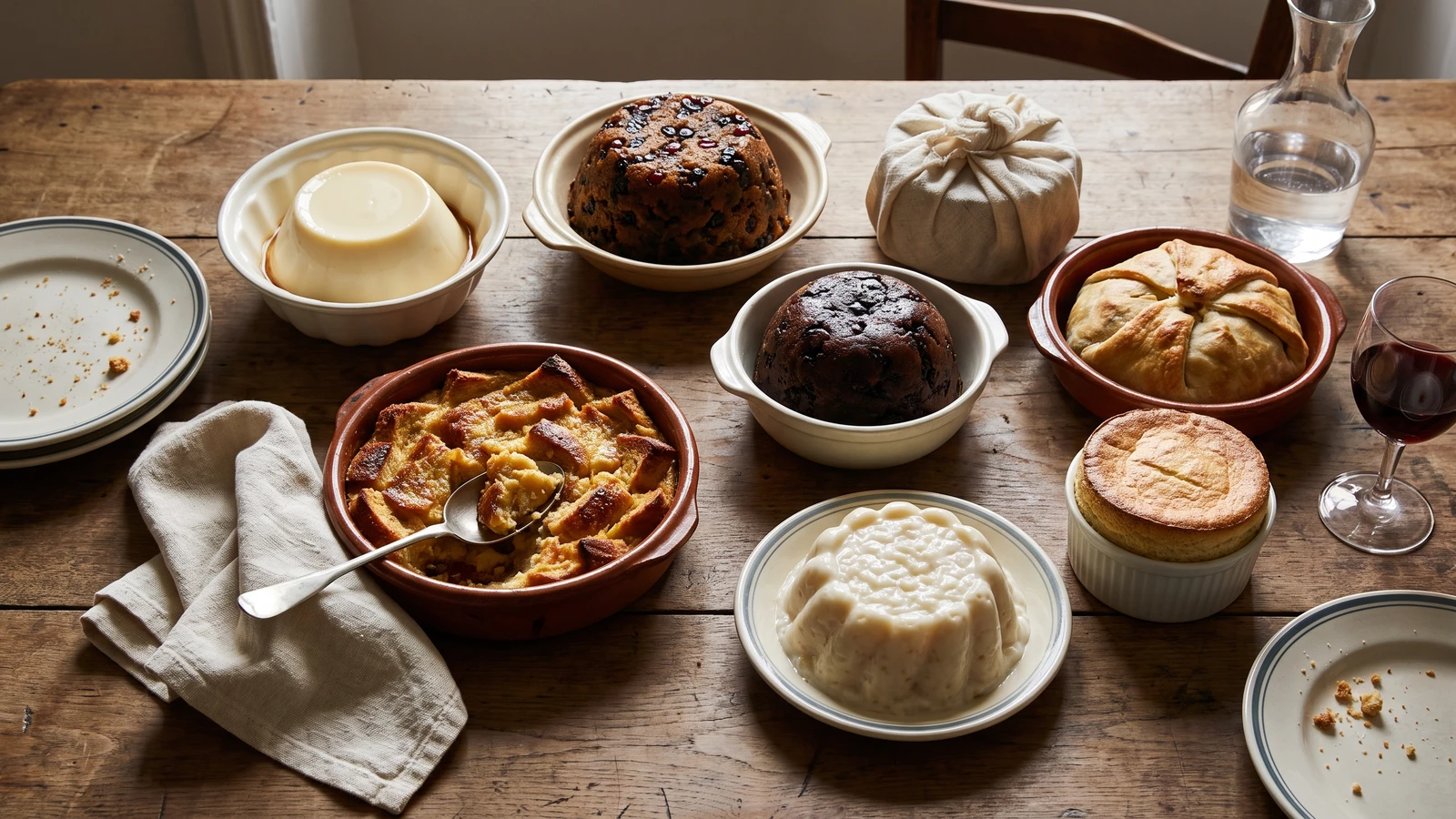
Eight families, one grammar: classify the pudding before you cook it, then let cream, fruit, bread, paste, rice, or a souffléd base decide the method, mould, timing, and sauce.
Les poudings classiques teach classification before cooking. The one true thing to know is that pudding names describe different structures, not interchangeable flavours. A cream pudding, a bread pudding, and a souffléd pudding may all arrive among the hot sweets, but they cannot share one batter or one cooking method. C'est la même grammaire only after you identify which sentence you are making.
The original entry assumed its eight generic formulas would follow close at hand, with a brigade able to prepare the chosen pudding and its sauce as separate work. A home kitchen needs an honest equivalent: select one family, open its complete formula, scale every proportion together for four diners, and prepare one appropriate accompaniment. The eight-part enumeration is brigade scaffolding. The ratios, sequence, mould, and cooking method are the dish, and none can be manufactured from a classification alone.
This page is therefore the map, not an invented master batter. One cook, one stove, one evening begins with a choice. Before touching a pan, decide which of the eight families you intend to cook and place its dedicated formula in front of you.
At English tables, pudding names cover an enormous territory, from boiled fruit preparations to custards, while the French classical kitchen narrowed that abundance into a working system for hot sweets. Its eight-part division records the passage of English domestic practice into French professional organization, set beside French and German traditions of bread and paste puddings. The useful correction is that a preparation called custard pudding may simply be a custard; this entry deliberately sets ordinary custards aside.
Quantity
1 four-serving formula
Quantity
1 four-serving batch
Quantity
1 four-serving portion
use only when appropriate to the selected English pudding
| Ingredient | Quantity |
|---|---|
| complete pudding formula from one of the eight classical classes | 1 four-serving formula |
| finished accompanying sauce specified by the pudding formula | 1 four-serving batch |
| stewed fruit, Melba sauce, or crème Chantilly (optional)use only when appropriate to the selected English pudding | 1 four-serving portion |
Place the pudding in one of the source entry's eight classes: puddings with cream; fruit puddings; English fruit puddings; plum puddings; French and German bread puddings; English and French paste puddings; rice puddings; or souffléd puddings. Keep the full names intact. They distinguish structures and traditions, not eight possible flavourings for one mixture.
Confirm that the preparation is a pudding proper rather than an ordinary custard carrying the word pudding in its title. The source excludes those custards before establishing its eight classes. This distinction matters because a custard formula cannot supply the starch, bread, paste, rice, fruit structure, or egg-white lift required by another family.
Use the dedicated generic recipe for the selected family before measuring anything. This classification entry contains no ratios, temperatures, mould sizes, or cooking times, so inventing them would change the source rather than modernize it. If the dedicated formula isn't in front of you, stop. Ça se rattrape: nothing has been heated or combined, and retrieving the complete formula now is the rescue.
Reduce the selected formula to four servings by applying one scaling factor to every weight and volume. Keep the proportion of eggs, butter, cream, fruit, bread, paste, or rice unchanged. If scaling produces part of an egg, beat the whole egg, weigh it, and use the required fraction. Brigade quantity can go; the ratio must stay.
Make the sauce specified by the selected pudding formula as a finished component, following its own entry rather than rebuilding it inside the pudding. Many English puddings may instead be accompanied by stewed fruit, Melba sauce, or crème Chantilly (sweetened whipped cream). A brigade could hand this work to another cook; at home, prepare the accompaniment first whenever the pudding must be served without delay.
Cook with the mould, sequence, heat, and doneness cues named by the selected family formula. Do not transfer the schedule of a plum pudding to a cream pudding, or the handling of a bread pudding to a souffléd one. Similar names do not make similar systems. Cooking well is not cooking fancy, but it is cooking the preparation actually in front of you.
Bring the finished pudding to the table according to its own nature, with its sauce or accompaniment ready. A formula that permits resting may wait; a souffléd pudding does not. Serve generously from the mould or dish when that is how it was cooked. À table!
1 serving (about 250g)
Culinary guides, cultural storytelling, and the editorial depth that makes cooking meaningful.
Discover Culinary ExplorerChef Juliette
Five almond preparations, one discipline: remove the skins cleanly, dry every kernel through, then cut, toast, or cloak it in pale caramel without letting its fragrant oils escape.

Chef Juliette
A pastry pantry lesson in one tray: filberts warmed only until their red skins release, rubbed clean, cooled, and chopped into a fragrant mise-en-place for cakes, creams, pralines, and petits fours.

Chef Juliette
The smallest pâtisserie discipline decides whether a cake leaves its mould intact: clarified butter in every corner, followed by the lightest veil of dry flour or fécule.

Chef Juliette
Four whites, one spotless bowl, and a patient change of speed: whisk gently until loosened, then briskly to glossy stiffness, with powdered sugar waiting if the foam begins to granulate.