
Chef Juliette
Various Almond Preparations
Five almond preparations, one discipline: remove the skins cleanly, dry every kernel through, then cut, toast, or cloak it in pale caramel without letting its fragrant oils escape.
A cooking platform built around craft, culture, and the stories behind what we eat.
Created by Chef Juliette
Based on No. 2475, Various Surprise Omelets, from Le Guide Culinaire (1907) by Auguste Escoffier
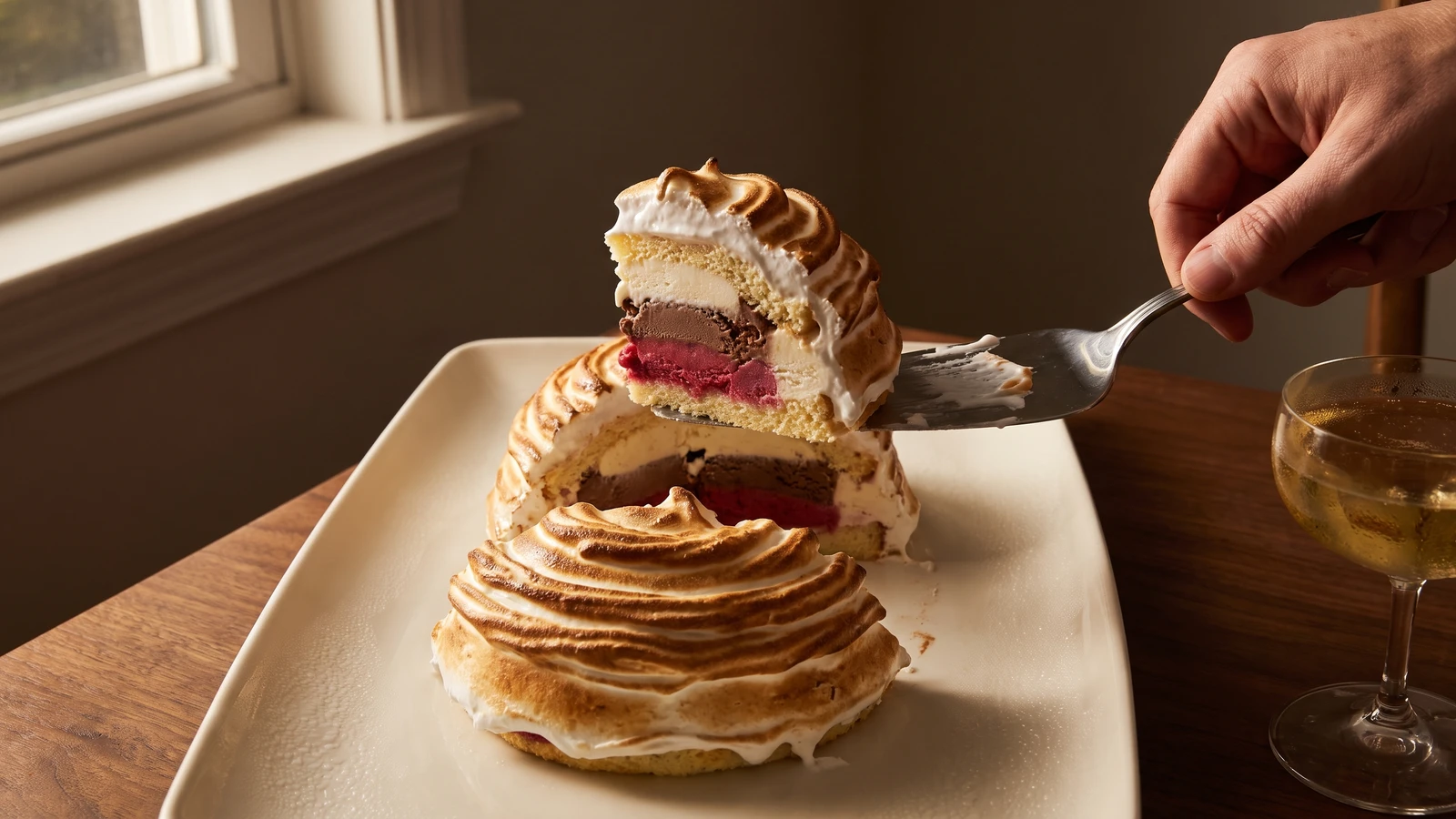
Three identical golden shells, three named surprises within: vanilla, chocolate, and raspberry ice protected by Swiss meringue, then browned in seconds under the broiler for a celebration table.
Omelettes-surprises variées (various surprise omelets) teach one clean principle: insulation, not speed, protects the ice. Before touching a pan, know this one thing: the meringue must form an unbroken coat around the frozen center. A bare patch or thin seam gives the heat a door, and the ice will find it.
The original dessert assumed a pastry brigade with sheets of biscuit ready, molded ices frozen hard, and a salamander waiting to brown each order. Here, one thin biscuit génoise, three hand-shaped ice logs, and the broiler give a home cook the same result. Individual molds were brigade scaffolding, so they go. The frozen core, biscuit base, complete meringue seal, and fierce final heat are the dish itself, so every one stays. Three small omelettes-surprises make the variation visible without producing a banquet's quantity: one cook, one stove, one evening.
When cut, the exterior is butter-gold and identical, while the centers announce themselves as vanilla ivory, chocolate brown, and raspberry crimson. If the coating cracks before browning, patch it with more meringue and freeze it hard again. Ça se rattrape. The step that matters most is the seal: cover every side, close the meringue firmly against the sponge, and leave the heat nowhere to enter.
Omelette surprise belongs to the Parisian grand-dessert table, where an oval of ice was set on biscuit, buried under meringue, and flashed beneath a salamander so the exterior browned before the center softened. It is also called omelette norvégienne, a name referring to the dramatic contrast of fierce heat and protected cold rather than to a Norwegian regional recipe. The source's instruction to announce every ice in the title preserves the joke: the browned exterior never changes, while the first cut reveals which dessert has reached the table.
Quantity
3 large eggs (about 150 g without shells)
Quantity
½ cup (120 ml / 100 g)
Quantity
¾ cup (180 ml / 90 g)
sifted
Quantity
2 tablespoons (30 ml / 28 g)
melted and cooled
Quantity
1 teaspoon (5 ml / 4 g)
Quantity
⅛ teaspoon (0.6 ml / 0.75 g)
Quantity
3 tablespoons (45 ml / 45 g)
Quantity
3 tablespoons (45 ml / 38 g)
Quantity
1 tablespoon (15 ml / 14 g)
Quantity
1 cup (240 ml / 180 g)
Quantity
1 cup (240 ml / 190 g)
Quantity
1 cup (240 ml / 220 g)
Quantity
5 large egg whites (about 150 g)
Quantity
1¼ cups (300 ml / 250 g)
Quantity
1 teaspoon (5 ml / 5 g)
| Ingredient | Quantity |
|---|---|
| large eggs | 3 large eggs (about 150 g without shells) |
| caster sugar for the biscuit génoise | ½ cup (120 ml / 100 g) |
| cake floursifted | ¾ cup (180 ml / 90 g) |
| unsalted buttermelted and cooled | 2 tablespoons (30 ml / 28 g) |
| vanilla extract | 1 teaspoon (5 ml / 4 g) |
| fine sea salt | ⅛ teaspoon (0.6 ml / 0.75 g) |
| water for the soaking syrup | 3 tablespoons (45 ml / 45 g) |
| caster sugar for the soaking syrup | 3 tablespoons (45 ml / 38 g) |
| orange liqueur (optional) | 1 tablespoon (15 ml / 14 g) |
| firm vanilla ice cream | 1 cup (240 ml / 180 g) |
| firm chocolate ice cream | 1 cup (240 ml / 190 g) |
| firm raspberry sorbet | 1 cup (240 ml / 220 g) |
| large egg whites | 5 large egg whites (about 150 g) |
| caster sugar for the meringue suisse | 1¼ cups (300 ml / 250 g) |
| fresh lemon juice | 1 teaspoon (5 ml / 5 g) |
Heat the oven to 190°C (375°F) and line a 23 x 33 cm (9 x 13 inch) rimmed baking sheet with parchment. Whisk the whole eggs, ½ cup caster sugar, vanilla, and salt with an electric mixer until very pale, tripled in volume, and thick enough to leave a ribbon on the surface for several seconds. Fold in the sifted flour in three additions, keeping as much air as you can. Stir a large spoonful of batter into the melted butter, then fold that lightened butter mixture gently through the bowl. Spread the batter about 1 cm thick and bake for 10 to 12 minutes, until pale gold and springy under a fingertip. Cool completely.
Let each ice soften separately for 5 to 10 minutes, only until it can be pressed without turning liquid. Spoon each flavor onto its own sheet of plastic wrap and shape it into a compact oval log about 13 cm long, 6 cm wide, and 5 cm high (5 by 2½ by 2 inches). Wrap tightly, label each flavor, and freeze on a level tray for at least 4 hours, until solid through the center. If an ice grows glossy or slumps while shaping, stop and return it to the freezer for 15 minutes before continuing.
Bring the water and 3 tablespoons caster sugar to a simmer in a small saucepan, stirring only until the sugar dissolves. Simmer for 1 minute, then cool completely and stir in the orange liqueur, if using. The syrup should perfume and moisten the biscuit, not saturate it; a sodden base cannot support the ice.
Use the wrapped ice logs as guides to cut three oval biscuit bases, each about 1 cm wider than its ice on every side. Set the bases on separate labeled pieces of parchment and brush each lightly with about 1 tablespoon of syrup. Unwrap the ice, place each log on its matching base, and trim away any biscuit extending more than 1 cm. Freeze the assembled centers for at least 30 minutes while you prepare the meringue.
Combine the egg whites, 1¼ cups caster sugar, and lemon juice in a spotless heatproof bowl. Set it over a saucepan holding 2.5 cm (1 inch) of barely simmering water, making certain the bowl doesn't touch the water. Whisk constantly until the sugar has dissolved and the mixture reaches 71°C (160°F). Remove it from the heat and beat with an electric mixer until the meringue is dense, glossy, cool, and holds a firm peak, about 6 to 8 minutes. If it feels grainy, the sugar hasn't dissolved; return it to the bain-marie and whisk gently until smooth. If it remains loose, keep beating until the bowl is cool. Ça se rattrape.
Work with one frozen center at a time and keep the others in the freezer. Cover the ice with a layer of meringue about 2 cm (¾ inch) thick, carrying it down to meet the biscuit and pressing the join closed all the way around. No ice may remain visible. Shape broad ridges with the back of a spoon, then repeat with the other flavors. Reserve a little meringue for repairs. Freeze the coated omelettes-surprises uncovered for at least 1 hour. Inspect them before browning; if a crack or thin patch appears, cover it with reserved meringue and freeze for another 20 minutes.
Heat the broiler for a full 10 minutes with a rack about 15 cm (6 inches) beneath the element. Chill a heavy metal baking sheet in the freezer, then transfer one omelette-surprise to it. Broil for 45 to 90 seconds, turning the sheet once if necessary, until the ridges are deeply golden while the hollows remain ivory. Watch without looking away. Brown the remaining two the same way. If one side colors too quickly, move that area away from the element; if the ice begins to soften at the base, stop and return the dessert to the freezer for 10 minutes.
Transfer the omelettes-surprises to a chilled platter and identify them as vanille, chocolat, and framboise before cutting, because the exterior gives nothing away. Dip a long knife in hot water, dry it thoroughly, and slice each dessert in half. Serve at once while the meringue is browned and supple and the centers remain firm. À table!
1 serving (about 230g)
Culinary guides, cultural storytelling, and the editorial depth that makes cooking meaningful.
Discover Culinary ExplorerChef Juliette
Five almond preparations, one discipline: remove the skins cleanly, dry every kernel through, then cut, toast, or cloak it in pale caramel without letting its fragrant oils escape.

Chef Juliette
A pastry pantry lesson in one tray: filberts warmed only until their red skins release, rubbed clean, cooled, and chopped into a fragrant mise-en-place for cakes, creams, pralines, and petits fours.

Chef Juliette
The smallest pâtisserie discipline decides whether a cake leaves its mould intact: clarified butter in every corner, followed by the lightest veil of dry flour or fécule.

Chef Juliette
Four whites, one spotless bowl, and a patient change of speed: whisk gently until loosened, then briskly to glossy stiffness, with powdered sugar waiting if the foam begins to granulate.