
Chef Juliette
Example: Omelet With Rum
Omelette au rhum teaches two kinds of heat: set the sugared eggs softly, then warm the rum just enough to catch, bathing the butter-gold roll in a brief blue flame at the table.
A cooking platform built around craft, culture, and the stories behind what we eat.
Created by Chef Juliette
Based on No. 2469, Surprise Omelet with Cherries, from Le Guide Culinaire (1907) by Auguste Escoffier
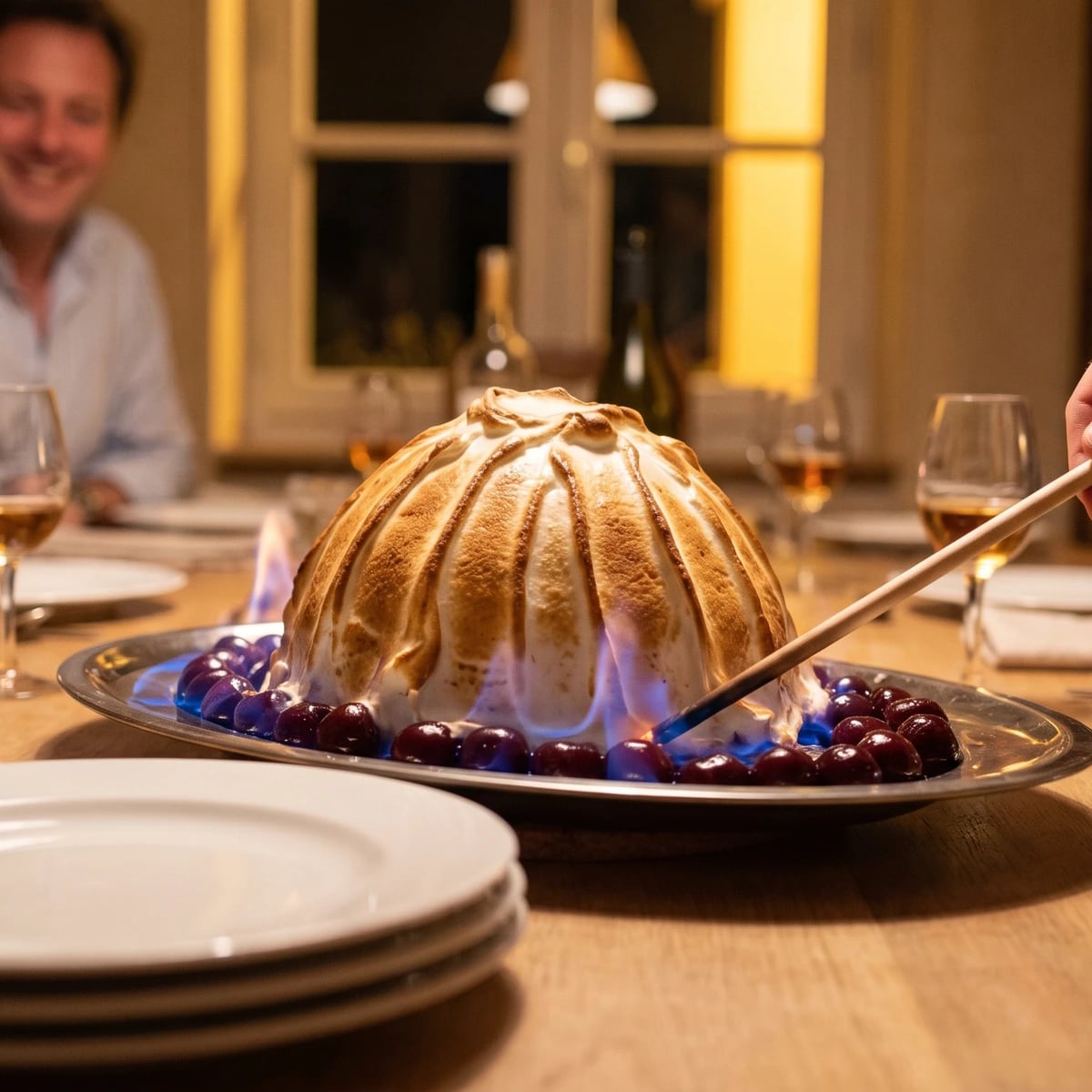
Hard-frozen red-currant and cherry ices hide beneath a bronzed meringue shell, with kirsch-soaked cherries inside and brandied cherries aflame around the base: a celebration dessert built on nerve and temperature.
Omelette surprise aux cerises (surprise omelet with cherries) teaches one true thing: the ice must be frozen hard enough that a thumb leaves no dent before it goes near the oven. The Génoise and meringue buy you a few fierce minutes of protection, no more. Begin with a soft centre and it floods the cake before the shell can bronze.
The original kitchen assumed a pâtissier with red-currant and cherry ices already waiting, brigade quantities of Pâte à Génoise Fine (No. 2376), and a salamander ready to colour the meringue at service. Here, prepared fruit sorbets replace the separate brigade batches, a small lined bowl shapes six to eight portions, and the hottest setting of a household oven does the salamander's work. Those separate batches were service scaffolding. The equal fruit proportions, the hard freeze, the complete meringue seal, and the tableside flame are the dish, so they stay.
Work while the sorbets are barely pliable, drain the cherries until they cannot leak, then freeze the filled dome without mercy. If it softens during assembly, stop and return it to the freezer. Ça se rattrape. One cook, one stove, one evening, and a dessert that arrives browned, cold-hearted, and briefly ringed with blue flame.
Omelette surprise, also called omelette norvégienne, belongs to the Parisian grand-kitchen repertoire, not to Norway; its name plays on the surprise that frozen ice survives a fierce oven beneath cake and meringue. The protection comes from air trapped in the Génoise and whipped whites, making this a lesson in insulation rather than an omelet in the egg-pan sense. From banquet dining rooms it passed to home celebration tables, while the cherry variation kept the full spectacle with red-currant and cherry ices, Kirsch, preserved fruit, and a final flambé.
Quantity
1 prepared 8-inch (20 cm) round Pâte à Génoise Fine (No. 2376)
about 3/4 inch (2 cm) thick
Quantity
1 cup (240 ml / 215 g)
Quantity
1/4 cup (60 ml / 55 g)
Quantity
1 1/4 cups (300 ml / 270 g)
Quantity
1 1/4 cups (300 ml / 200 g)
fresh or thawed from frozen
Quantity
1/2 cup (120 ml / 100 g)
Quantity
3 tablespoons (45 ml / 42 g)
Quantity
6 large whites (about 3/4 cup / 180 g)
at room temperature
Quantity
1 1/2 cups (360 ml / 300 g)
Quantity
1 1/2 cups drained (360 ml / 240 g)
well drained
Quantity
1/4 cup (60 ml / 56 g)
| Ingredient | Quantity |
|---|---|
| Pâte à Génoise Fineabout 3/4 inch (2 cm) thick | 1 prepared 8-inch (20 cm) round Pâte à Génoise Fine (No. 2376) |
| prepared red-currant sorbet | 1 cup (240 ml / 215 g) |
| raspberry sorbet | 1/4 cup (60 ml / 55 g) |
| cherry sorbet | 1 1/4 cups (300 ml / 270 g) |
| pitted sour cherriesfresh or thawed from frozen | 1 1/4 cups (300 ml / 200 g) |
| superfine sugar for the half-sugared cherries | 1/2 cup (120 ml / 100 g) |
| Kirsch for macerating | 3 tablespoons (45 ml / 42 g) |
| pasteurized egg whitesat room temperature | 6 large whites (about 3/4 cup / 180 g) |
| superfine sugar for the meringue | 1 1/2 cups (360 ml / 300 g) |
| brandied cherrieswell drained | 1 1/2 cups drained (360 ml / 240 g) |
| Kirsch for flaming | 1/4 cup (60 ml / 56 g) |
Toss the sour cherries with the 1/2 cup (100 g) sugar in a nonreactive bowl. This is the home equivalent of half-sugared cherries: sugar equal to half the fruit's weight, enough to protect their texture without turning them into candied fruit. Leave them for 45 minutes, add the 3 tablespoons (45 ml) Kirsch, then cover and chill for another 30 minutes. Drain in a sieve for at least 15 minutes and blot lightly. They must be cold and remarkably dry; loose syrup cuts melting channels through the ice.
Line a 7-inch (18 cm) bowl with two crossing sheets of plastic wrap, leaving generous overhang. Soften the sorbets separately for 5 to 10 minutes, only until a spoon passes through with resistance. Stir the red-currant and raspberry sorbets together to make 1 1/4 cups of raspberry-scented red-currant ice, then fold it with an equal volume of cherry sorbet and the drained half-sugared cherries. Keep broad streaks rather than beating everything smooth. Pack the mixture firmly into the bowl, cover, and freeze for at least 4 hours, until the centre is solid and pressure leaves no dent. If the mixture slumps while you work, stop and freeze it in the bowl before handling it again. Ça se rattrape; a longer freeze costs nothing, while a soft centre costs the dessert.
Set the Pâte à Génoise Fine (No. 2376) on an ovenproof metal platter. Uncover the frozen fruit dome and invert it in the centre of the cake, leaving a narrow Génoise border all around. If the dome refuses to release, press a warm towel against the outside of the bowl for 3 to 5 seconds, then try again; do not run water over it. Remove the plastic wrap and return the entire platter to the freezer for 30 minutes.
Set a rack in the centre of the oven and heat it to 500°F (260°C). Beat the pasteurized whites in a spotless bowl at medium speed until they form an even foam, then raise the speed and add the 1 1/2 cups (300 g) sugar a tablespoon at a time. Continue until the meringue is dense, glossy, and holds a stiff peak. Rub a little between two fingers: if it feels gritty, keep beating until the sugar has dissolved. A soft meringue slides from the ice, so don't proceed until the peak stands cleanly.
Take the frozen dome from the freezer and cover it immediately with meringue, making a layer about 3/4 inch (2 cm) thick over the top and sides. Carry the meringue all the way down to the platter so no ice, cherry, or Génoise remains exposed. The seal is insulation, not decoration; one bare seam gives the oven a door into the centre. Raise loose ridges with the back of a spoon, then freeze the covered omelette for 20 to 30 minutes while the oven finishes heating.
Transfer the omelette directly from the freezer to the fully heated oven. Bake for 3 to 5 minutes, watching continuously, until the ridges are hazelnut brown and the hollows remain ivory. Rotate the platter once if the colour develops unevenly. Do not wait for every pale patch to darken; lingering is how the centre melts. If a little ice begins to seep, remove the dessert at once and serve it immediately. The meringue has given you all the protection it can.
Arrange the drained brandied cherries in a generous ring around the hot-browned omelette. Have every guest seated, the plates ready, and a metal lid close at hand. Warm the 1/4 cup (60 ml) Kirsch in a small saucepan over low heat to about 120°F (50°C), warm but never simmering, then turn off the burner and move the pan away from the stove. At the table, pour the measured Kirsch over the cherry ring and touch a long match to its edge. Never pour alcohol from a bottle near a flame, and never add more once it is lit. Let the blue flame subside, or cover it with the metal lid to extinguish it, then cut through the meringue and frozen centre without delay. À table!
1 serving (about 270g)
Culinary guides, cultural storytelling, and the editorial depth that makes cooking meaningful.
Discover Culinary Explorer
Chef Juliette
Omelette au rhum teaches two kinds of heat: set the sugared eggs softly, then warm the rum just enough to catch, bathing the butter-gold roll in a brief blue flame at the table.

Chef Juliette
Omelette aux Abricots rolls tender eggs around bright apricot jam, then flashes icing sugar beneath fierce heat, giving a caramelized top while the center stays soft.

Chef Juliette
A butter-gold sweet omelette wrapped around warm, spice-dark mincemeat, rolled while its centre stays creamy, then glossed with rum and set alight at the Christmas table.

Chef Juliette
Omelette soufflée à la vanille turns ribboned yolks and whites beaten stiff into one golden, vanilla-scented oval, simply piped, glazed with icing sugar, and carried straight from oven to table.