
Chef Juliette
Various Almond Preparations
Five almond preparations, one discipline: remove the skins cleanly, dry every kernel through, then cut, toast, or cloak it in pale caramel without letting its fragrant oils escape.
A cooking platform built around craft, culture, and the stories behind what we eat.
Created by Chef Juliette
Based on No. 2463, Example: Apricot Omelet, from Le Guide Culinaire (1907) by Auguste Escoffier
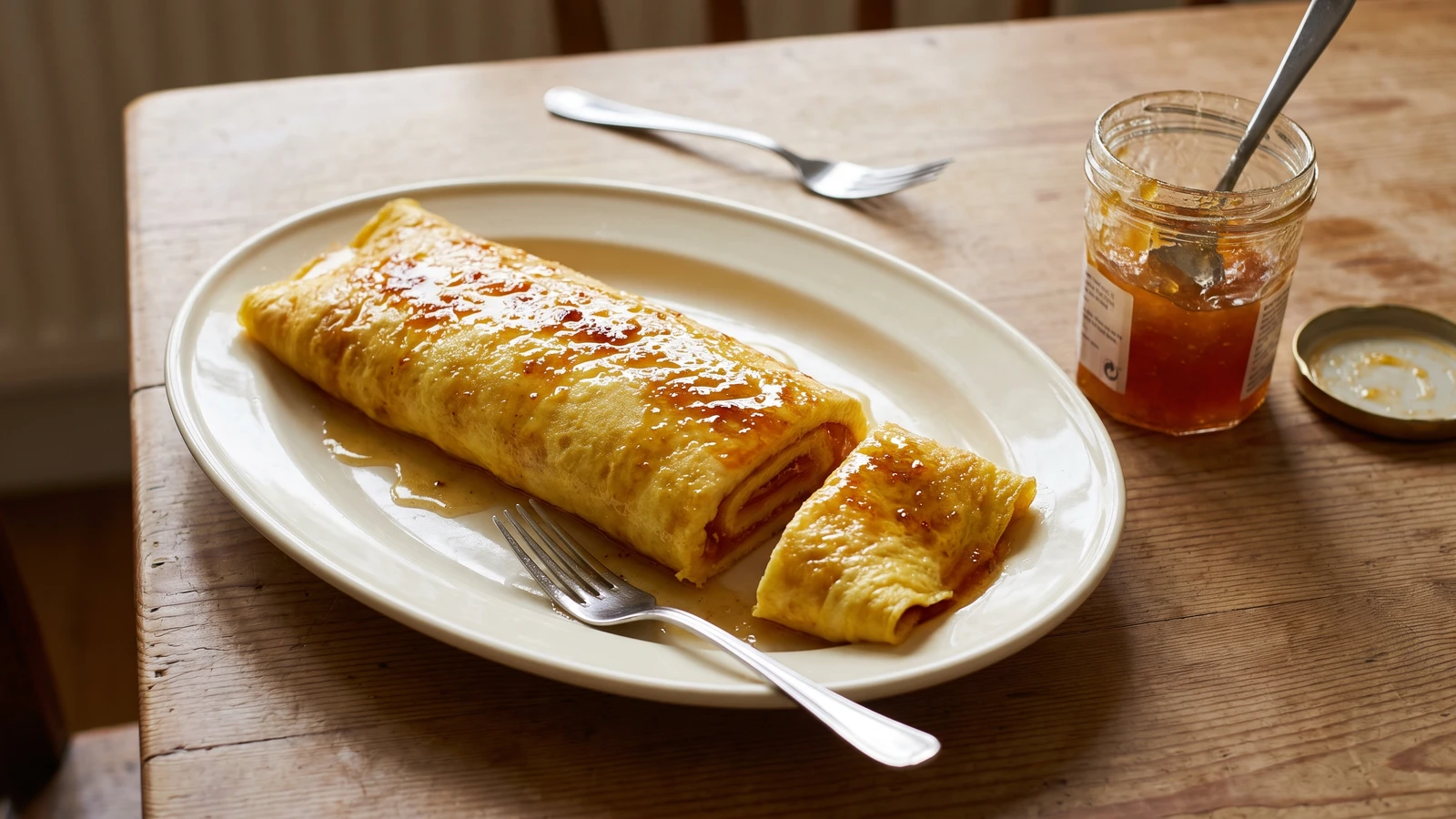
Omelette aux Abricots rolls tender eggs around bright apricot jam, then flashes icing sugar beneath fierce heat, giving a caramelized top while the center stays soft.
Omelette aux Abricots (apricot omelet) teaches one clean lesson: an omelette can become dessert without ceasing to be an omelette. Keep the eggs tender, place a measured spoonful of preserve at the center, then glaze the sugar fast enough that the surface bronzes before the middle tightens. Know this before touching the pan: the omelette must leave it slightly softer than you intend to eat it, because the broiler finishes the cooking.
The book's formula assumed six eggs, two tablespoons of apricot jam, a long fireproof dish, and either a red-hot iron or a salamander waiting above the range. Here the egg and jam quantities are halved without disturbing their ratio: three eggs and one tablespoon of jam make dessert for two, manageable in a 20 cm skillet. The red-hot iron can go; it was brigade scaffolding. A fierce home broiler supplies the same swift overhead heat. One cook, one stove, one evening.
Folding the supple eggs around the jam and glazing the icing sugar quickly are the dish, and both must stay. Have the platter, sugar, and loosened jam waiting before the eggs meet the butter. Once the pan is hot, everything happens in minutes.
Sweet omelettes belong to French cuisine bourgeoise and the classical dining rooms of Paris rather than to one particular province; pantry preserves allowed cooks to turn eggs into an immediate dessert when no pastry was waiting. Apricot jam became a favored filling because its acidity balances the richness of eggs and butter, while its smooth texture rolls without tearing the omelette. The criss-crossed red-hot iron and the salamander were two means to the same end, caramelizing icing sugar quickly before the eggs could toughen.
Quantity
3
Quantity
⅛ teaspoon (0.6 ml / 0.8 g)
Quantity
1 tablespoon (15 ml / 14 g)
Quantity
1 tablespoon (15 ml / 20 g)
stirred until spreadable
Quantity
1 tablespoon (15 ml / 8 g)
sifted
| Ingredient | Quantity |
|---|---|
| large eggs | 3 |
| fine salt | ⅛ teaspoon (0.6 ml / 0.8 g) |
| unsalted butter | 1 tablespoon (15 ml / 14 g) |
| smooth apricot jamstirred until spreadable | 1 tablespoon (15 ml / 20 g) |
| icing sugarsifted | 1 tablespoon (15 ml / 8 g) |
Set an oven rack about 10 cm beneath the broiler and heat it to its highest setting. Put a room-temperature, broiler-safe oval platter nearby, or use a small rimmed metal baking sheet if your serving dish cannot face direct heat. Stir the apricot jam until smooth and spreadable, warming it only gently if it is stiff, and place the icing sugar in a small sieve. Once the eggs reach the pan, there is no useful moment for searching through a cupboard.
Beat the eggs with the salt just until the whites and yolks are completely joined, without whipping in a cap of foam. Heat a 20 cm skillet over medium-high heat, add the butter, and swirl as it foams. When the foam begins to subside but the butter is still golden, pour in the eggs. Stir briskly with a flexible spatula while shaking the pan until small, soft curds form, then spread them into an even layer and stop stirring. The underside should be set while the surface remains glossy and softly moist, not liquid. If the eggs begin setting too quickly, lift the pan from the heat and continue stirring in the retained warmth. Ça se rattrape.
Take the pan off the heat while the omelette is still supple. Spoon the apricot jam in a narrow line across its center, keeping it away from the rim, then fold one third over the filling and roll the omelette toward the opposite edge. Turn it seam-side down onto the prepared long platter. If the surface cracks, do not unfold it and begin again; tuck the split underneath with the spatula. The sugar will cover small imperfections, and the omelette will still eat beautifully.
Sift the icing sugar evenly over the entire surface, including the rounded sides. Set the omelette beneath the fully heated broiler and watch without looking away. In roughly 20 to 60 seconds, the sugar will melt into tiny bubbles and catch amber over the highest points. Pull it out immediately. If one area colors first, rotate the platter; if a small patch scorches, remove the omelette, scrape away that patch while warm, and cover the mark with a fresh breath of icing sugar. The glaze must be fierce and brief, because a long bake turns the tender center firm.
Let the glazed omelette settle for only 30 seconds, then divide it diagonally into two portions. The fold should remain tender, the apricot warm and bright inside, and the icing sugar should form a thin caramelized glaze over the butter-gold surface. This dessert waits for no one. À table!
1 serving (about 90g)
Culinary guides, cultural storytelling, and the editorial depth that makes cooking meaningful.
Discover Culinary ExplorerChef Juliette
Five almond preparations, one discipline: remove the skins cleanly, dry every kernel through, then cut, toast, or cloak it in pale caramel without letting its fragrant oils escape.

Chef Juliette
A pastry pantry lesson in one tray: filberts warmed only until their red skins release, rubbed clean, cooled, and chopped into a fragrant mise-en-place for cakes, creams, pralines, and petits fours.

Chef Juliette
The smallest pâtisserie discipline decides whether a cake leaves its mould intact: clarified butter in every corner, followed by the lightest veil of dry flour or fécule.

Chef Juliette
Four whites, one spotless bowl, and a patient change of speed: whisk gently until loosened, then briskly to glossy stiffness, with powdered sugar waiting if the foam begins to granulate.