
Chef Juliette
Various Almond Preparations
Five almond preparations, one discipline: remove the skins cleanly, dry every kernel through, then cut, toast, or cloak it in pale caramel without letting its fragrant oils escape.
A cooking platform built around craft, culture, and the stories behind what we eat.
Created by Chef Juliette
Based on No. 2458, Croûte à la Normande, from Le Guide Culinaire (1907) by Auguste Escoffier
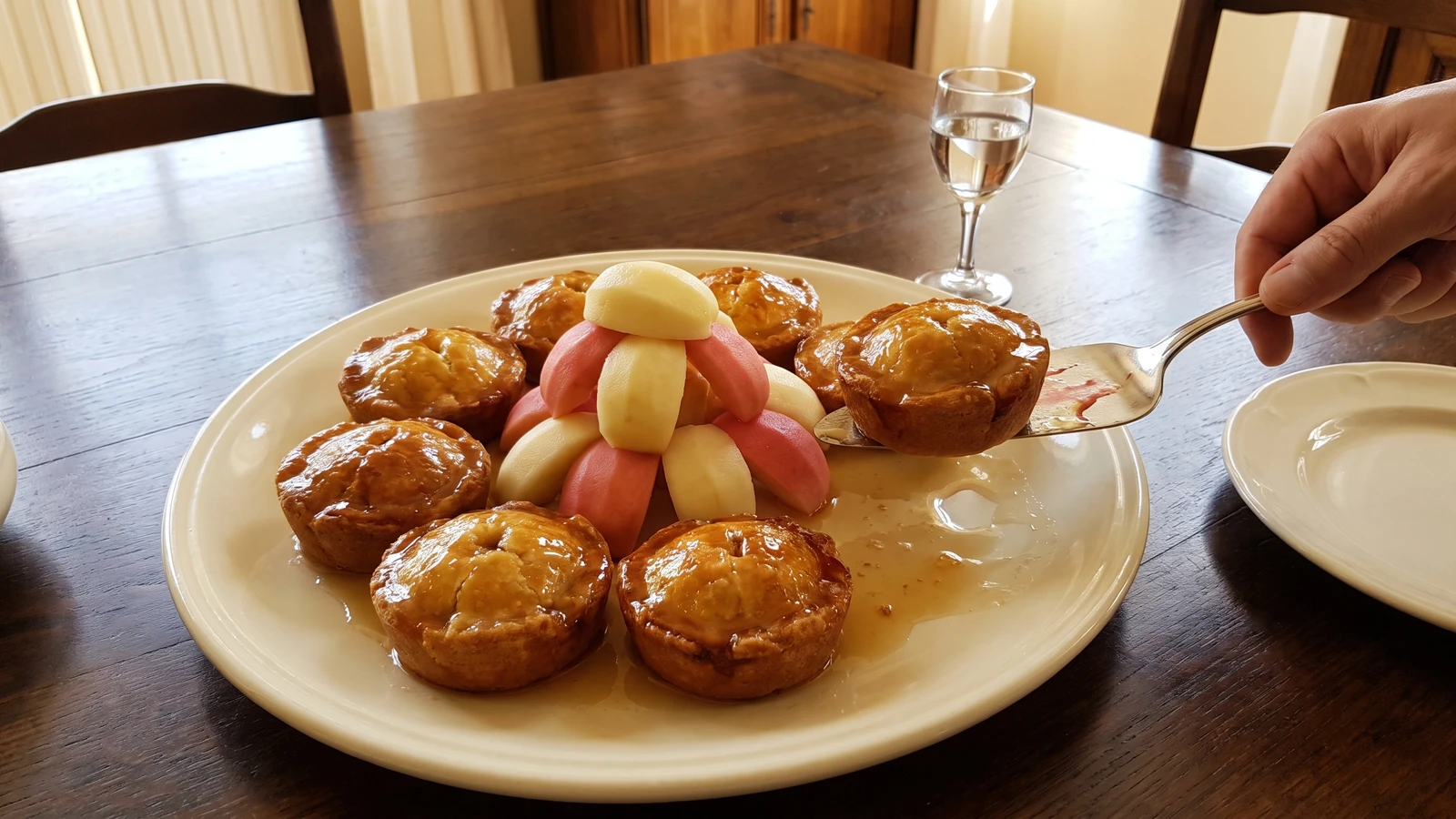
Normandy’s apple croûte teaches the discipline of dryness: glazed Savarin crusts, stiff compote, and syrup-poached white and pink quarters, finished with a glossy apple sauce scented with Kirsch or old rum.
Croûte à la Normande (Norman apple croûte) teaches one hard, useful truth: the apple beneath the fruit must be dry enough to hold it. If the compote flows, the crown slumps and the glazed Savarin drinks itself soft. Stew it until a spoon leaves a trench that stays open, and the whole construction stands proud.
The original assumes a pâtissier’s tray of unsoaked Savarin, glazed crusts ready for service, several pans of apple preparation, and enough hands to poach pale and pink fruit separately. Here the crust work remains exactly where the book placed it, in Croûte aux Fruits (No. 2454), while one wide pan makes a stiff apple base divided among its three duties and one syrup poaches the fruit in sequence. Separate pans and waiting hands are brigade scaffolding. The stiff compote, glazed crusts, fruit pyramid, and spirit-scented apple glaze are the dish, and they stay.
The finished croûte is generous and architectural without becoming fussy: butter-gold crusts in a ring, a compact mound of apple within, and ivory and rose quarters stacked under a translucent glaze. One cook, one stove, one evening. Before you touch the platter, get the compote stiff enough to carry the fruit. That is the step that decides everything.
Croûte à la Normande belongs to Normandy by its apples, but its composed crown of glazed Savarin, apple marmalade, and syrup-poached fruit comes from the classical dessert kitchen rather than the farmhouse oven. Across generations, grand kitchens turned the region’s orchard abundance into a formal sweet course, alternating pale and rose fruit for contrast and glazing the whole with reduced apple syrup. The common assumption that Calvados must finish every Norman apple dish is wrong here: the source calls specifically for Kirsch or old rum, and that choice belongs to the recipe.
Quantity
8 slices, prepared according to Croûte aux Fruits (No. 2454)
completely cooled
Quantity
6 cups (1.4 L / 900 g)
peeled and thinly sliced
Quantity
1/2 cup (120 ml / 100 g)
Quantity
2 tablespoons (30 ml / 30 g)
Quantity
4 medium, about 4 cups (950 ml / 700 g)
peeled, cored, and quartered
Quantity
2 cups (480 ml / 480 g)
Quantity
1 cup (240 ml / 200 g)
Quantity
2 drops
Quantity
1 tablespoon (15 ml / 14 g)
| Ingredient | Quantity |
|---|---|
| glazed Savarin crustscompletely cooled | 8 slices, prepared according to Croûte aux Fruits (No. 2454) |
| tart cooking applespeeled and thinly sliced | 6 cups (1.4 L / 900 g) |
| granulated sugar for the compote | 1/2 cup (120 ml / 100 g) |
| water for the compote | 2 tablespoons (30 ml / 30 g) |
| firm dessert applespeeled, cored, and quartered | 4 medium, about 4 cups (950 ml / 700 g) |
| water for the poaching syrup | 2 cups (480 ml / 480 g) |
| granulated sugar for the poaching syrup | 1 cup (240 ml / 200 g) |
| rose-pink liquid food coloring | 2 drops |
| Kirsch or old dark rum | 1 tablespoon (15 ml / 14 g) |
Put the sliced cooking apples, 1/2 cup sugar, and 2 tablespoons water in a wide sauté pan. Cover and cook over low heat for 7 minutes, just until the apples release their juice, then uncover and cook for 20 to 25 minutes, stirring and crushing frequently. Keep going until the apple is very thick and a spoon drawn across the pan leaves a dry trench that does not close. Purée it completely smooth with a food mill or immersion blender. You should have about 2 1/2 cups. Reserve 1/4 cup for the sauce, set aside 1 cup for the crusts, and keep the remainder for the center. If the purée still spreads, do not add starch. Ça se rattrape: return it to the widest pan you own and cook gently until the excess water is gone.
Combine the 2 cups water and 1 cup sugar in a saucepan. Bring to a boil, stirring only until the sugar dissolves, then lower the heat so the syrup barely trembles. Add half of the apple quarters and poach for 6 to 9 minutes, turning once, until a knife enters with gentle resistance but the pieces still hold their clean edges. Lift them carefully into a shallow dish and cover them with 1/2 cup of the clear syrup. A hard boil breaks the fruit. If a quarter splits, place it low in the finished pyramid where the intact fruit can support it.
Tint the syrup remaining in the saucepan with 2 drops of rose-pink coloring. It should be the palest blush, not red. Poach the remaining apple quarters exactly as before, then lift them into a second shallow dish with a few spoonfuls of pink syrup. Return the holding syrups from both dishes to the saucepan and boil until reduced to about 3/4 cup. Whisk in the reserved 1/4 cup smooth apple purée and simmer for 2 minutes, until the sauce coats a spoon in a translucent, glossy layer. If it becomes jammy, loosen it with a tablespoon of hot water; if it runs like juice, reduce it a little longer. Remove from the heat and stir in the Kirsch or old rum.
Arrange the 8 glazed Savarin crusts prepared according to Croûte aux Fruits (No. 2454) in a close circle on a 12 inch serving platter, their edges just touching. Spread the reserved 1 cup stiff apple purée over them, allowing about 2 tablespoons per crust. Keep the coating thick and slightly domed. A thin layer disappears into the bread; this firm cap protects the crust and gives the outer crown its proper weight.
Spoon the remaining stiff apple purée into the center of the crust circle and shape it into a compact mound. Arrange 8 white and pink apple quarters alternately around its base, rounded sides outward. Add a second staggered tier of 5 quarters, then finish with the remaining 3 at the top. Use the softer pieces on the bottom and the cleanest quarters above. Press each tier lightly into the compote, just enough to secure it without squeezing the fruit.
Warm the apple sauce gently if it has begun to set, then spoon it over the pyramid and crusts, letting the glaze follow the fruit rather than flood the platter. Pass any remaining sauce separately. Let the croûte settle for 5 minutes, then serve while the fruit is tender and the Savarin crusts still keep their glazed edges. À table!
1 serving (about 550g)
Culinary guides, cultural storytelling, and the editorial depth that makes cooking meaningful.
Discover Culinary ExplorerChef Juliette
Five almond preparations, one discipline: remove the skins cleanly, dry every kernel through, then cut, toast, or cloak it in pale caramel without letting its fragrant oils escape.

Chef Juliette
A pastry pantry lesson in one tray: filberts warmed only until their red skins release, rubbed clean, cooled, and chopped into a fragrant mise-en-place for cakes, creams, pralines, and petits fours.

Chef Juliette
The smallest pâtisserie discipline decides whether a cake leaves its mould intact: clarified butter in every corner, followed by the lightest veil of dry flour or fécule.

Chef Juliette
Four whites, one spotless bowl, and a patient change of speed: whisk gently until loosened, then briskly to glossy stiffness, with powdered sugar waiting if the foam begins to granulate.