
Chef Juliette
Various Almond Preparations
Five almond preparations, one discipline: remove the skins cleanly, dry every kernel through, then cut, toast, or cloak it in pale caramel without letting its fragrant oils escape.
A cooking platform built around craft, culture, and the stories behind what we eat.
Created by Chef Juliette
Based on No. 2454, Croûte aux Fruits, from Le Guide Culinaire (1907) by Auguste Escoffier
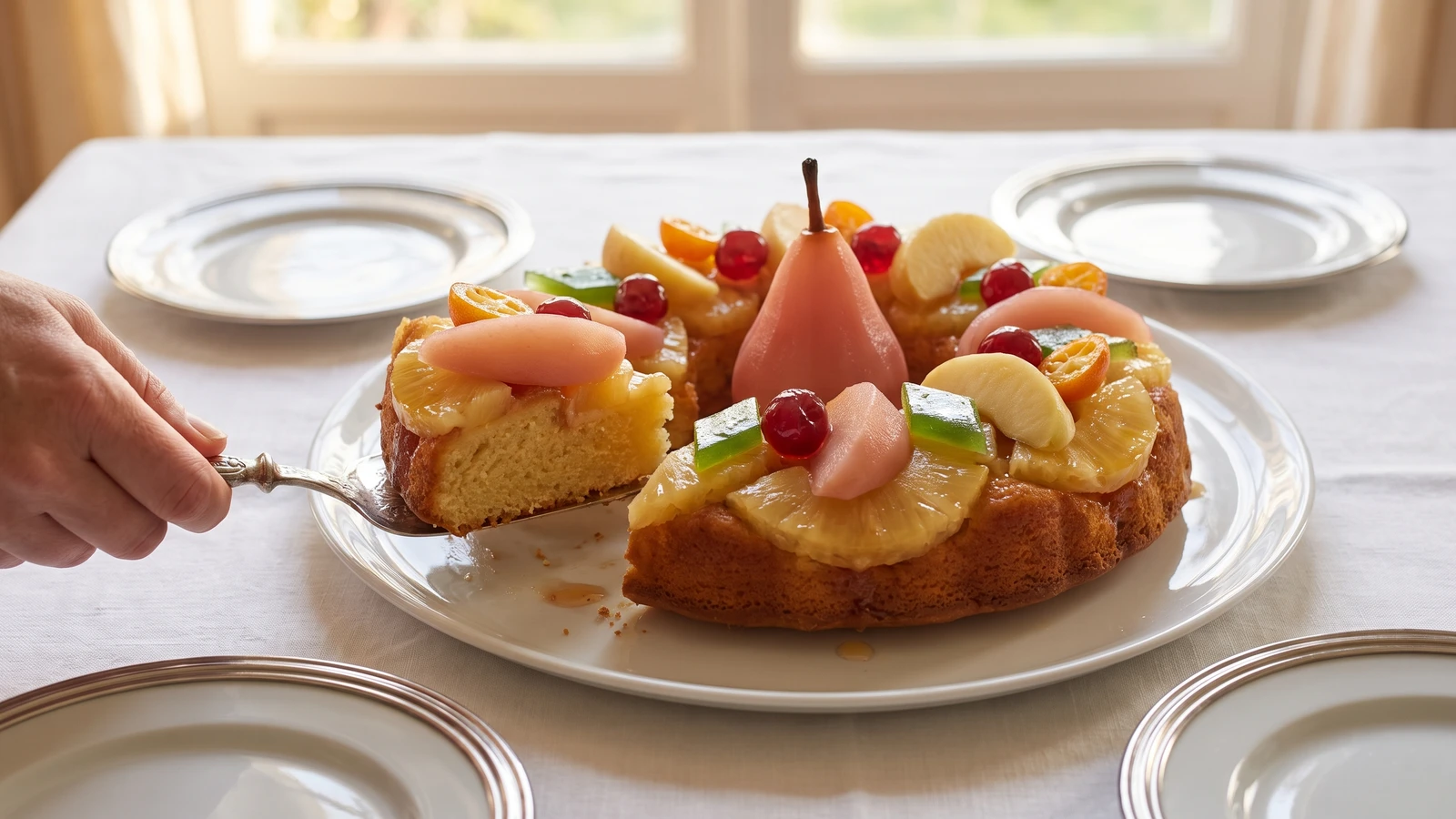
Thin savarin slices dried beneath icing sugar, alternated with pineapple, crowned with apples and pink-poached pears, then lacquered in apricot and Kirsch: a grand fruit dessert held together by crispness.
Croûte aux Fruits (a glazed fruit crown on crisp cake) teaches one severe little truth: the savarin must be dry before syrup comes near it. The contrast is the dish. Its sugared edges should crack cleanly beneath tender apples, pink pears, pineapple, and a shining apricot-Kirsch coat; begin with damp cake and the crown sinks into pudding.
The original formula assumed pastry-side abundance, not the saucier and stockpot behind a savory sauce: unsyruped savarin already stale, a steady drying oven, a cook turning identical fruit, a Hatelet (ornamental skewer), and hands to build a banquet crown. Here eight savarin slices serve four. A low oven followed by brief high heat handles the drying and glazing, while a short wooden skewer replaces the Hatelet because support, not metalwork, matters. Scarce Chinois may become candied kumquats, losing the green-and-yellow display but keeping the tiny candied-citrus note. The ornamental metal and exact colors are brigade scaffolding; the dry savarin, matched pineapple, poached fruit, fried bread cushion, and apricot-Kirsch coating are the dish. One cook, one stove, one evening.
Work backward from the assembly. Poach the fruit until tender but still geometric, drain it until the rack beneath is nearly dry, then test a cooled savarin slice between your fingers. If it bends, it returns to the oven. Ça se rattrape. That dry slice is the one step that matters most before you build the crown.
Croûte aux Fruits belongs to the Parisian classical entremets repertoire, where unsyruped savarin left from pastry work was dried, glazed, and rebuilt as a formal fruit crown. The dish traveled from grand-kitchen service to bourgeois celebration tables because its architecture relied on practical pantry goods, preserved fruit and cake made deliberately stale, disciplined into a festive centerpiece. In this formula, Chinois are tiny candied oranges, not the conical strainer now commonly called a chinois, while the Hatelet is the ornamental skewer that held the turned pear aloft.
Quantity
1, about 7 inches (18 cm) across and 14 ounces (400 g)
unsyruped and at least 1 day stale
Quantity
1/2 cup (120 ml / 60 g)
Quantity
8 pieces, each 1/5 inch (5 mm) thick, about 10 ounces (285 g) trimmed
cut to match the savarin slices
Quantity
2 medium, about 12 ounces (340 g) total
peeled, cored, and quartered
Quantity
3 small, about 1 pound (450 g) total
peeled; two quartered and one left whole and turned
Quantity
1 cup (240 ml / 200 g)
Quantity
3 cups plus 3 tablespoons (765 ml / 765 g)
divided
Quantity
1 drop
Quantity
1 compact cylinder, 3 inches wide by 2 inches high (7.5 by 5 cm), about 2 ounces (55 g)
crust removed
Quantity
1/4 cup (60 ml / 56 g)
Quantity
3/4 cup (180 ml / 240 g)
Quantity
2 tablespoons (30 ml / 28 g)
Quantity
8, about 2 ounces (55 g)
well drained
Quantity
2 tablespoons (30 ml / 25 g)
cut into lozenges
Quantity
4
quartered
| Ingredient | Quantity |
|---|---|
| plain savarinunsyruped and at least 1 day stale | 1, about 7 inches (18 cm) across and 14 ounces (400 g) |
| icing sugar | 1/2 cup (120 ml / 60 g) |
| fresh pineapplecut to match the savarin slices | 8 pieces, each 1/5 inch (5 mm) thick, about 10 ounces (285 g) trimmed |
| firm-tart applespeeled, cored, and quartered | 2 medium, about 12 ounces (340 g) total |
| firm-ripe pearspeeled; two quartered and one left whole and turned | 3 small, about 1 pound (450 g) total |
| granulated sugar | 1 cup (240 ml / 200 g) |
| waterdivided | 3 cups plus 3 tablespoons (765 ml / 765 g) |
| natural pink food coloring (optional) | 1 drop |
| day-old white breadcrust removed | 1 compact cylinder, 3 inches wide by 2 inches high (7.5 by 5 cm), about 2 ounces (55 g) |
| clarified butter | 1/4 cup (60 ml / 56 g) |
| smooth apricot preserves | 3/4 cup (180 ml / 240 g) |
| Kirsch | 2 tablespoons (30 ml / 28 g) |
| preserved cherrieswell drained | 8, about 2 ounces (55 g) |
| candied angelicacut into lozenges | 2 tablespoons (30 ml / 25 g) |
| yellow and green Chinois (very small candied oranges), or small candied kumquatsquartered | 4 |
Turn the smallest pear, meaning pare it into a smooth, even oval, and leave it whole. Bring the granulated sugar and 3 cups (720 ml / 720 g) of the water to a gentle simmer in a shallow saucepan. Add the apple quarters and poach at a bare tremble for 6 to 10 minutes, just until a knife enters with light resistance and the corners still hold; lift them carefully onto a wire rack. Tint the syrup pale pink with the food coloring, if using. Add the whole pear first, cook it for 5 minutes, then add the pear quarters and cover the surface with a round of parchment. Poach gently for another 10 to 15 minutes. Lift all the pears onto the rack and leave the fruit to drain for at least 30 minutes, then blot the undersides. If a quarter softens too far, cool it untouched and tuck it low in the finished crown rather than balancing it on top.
Heat the oven to 275°F (135°C). With a serrated knife, cut eight even savarin slices, each 1/5 inch (5 mm) thick, allowing two per person. Set them on a wire rack over a baking sheet and sift the icing sugar generously over their upper faces. Bake for 25 to 35 minutes, rotating the tray once, until the slices feel rigid and dry. Raise the oven to 375°F (190°C) for 3 to 5 minutes, watching continuously, until the sugar melts into a pale, thin glaze. Cool one slice for 5 minutes and test it. If it flexes rather than breaking crisply at the edge, ça se rattrape: lower the oven to 250°F (120°C) and dry every slice for another 10 to 15 minutes. Do not assemble until they pass this test.
Use a dried savarin slice as the pattern and trim eight pineapple pieces to the same outline and thickness. The pieces need not be mathematically perfect, but neither should heavy pineapple hang beyond the cake and pull the crown apart. Lay them on a clean rack or towel for at least 10 minutes and blot both faces thoroughly. Drain the cherries, quarter the Chinois, and cut the angelica into small lozenges while the pineapple rests.
Heat the clarified butter in a small skillet over medium heat. Fry the crustless bread cylinder on every face for 6 to 8 minutes, turning carefully, until deep gold and firm enough to hold the centerpiece pear. Set this fried bread cushion in the center of a 12-inch (30 cm) platter. For the apricot sauce, warm the apricot preserves with the remaining 3 tablespoons (45 ml / 45 g) water, strain if they contain pieces, and simmer for 2 to 3 minutes until the sauce coats the back of a spoon. Remove it from the heat and stir in the Kirsch. If it is too thick to brush, loosen it with a teaspoon of water; if it runs like syrup, simmer it for another minute.
Arrange the savarin slices in a circle around the fried bread cushion, standing them at a shallow angle and placing one matching pineapple piece between every two slices. Overlap the edges slightly so the ring supports itself; if one piece slips, a small dab of apricot sauce behind it will hold it. Arrange the drained apple and pear quarters alternately over the crown, keeping their clean-cut faces visible. Add the preserved cherries, angelica lozenges, and quartered Chinois between the larger fruit. Insert a short wooden skewer vertically into the bread cushion and seat the whole pear on it. This is the home Hatelet. Remember that it remains hidden inside the centerpiece.
Immediately before serving, brush the warm apricot-Kirsch sauce lightly over the fruit and exposed savarin. Brush, do not pour. The coating should gleam without collecting beneath the cake; if a pool forms, wick it away at once with the corner of a clean towel. Bring the whole crown to the table, remove the hidden skewer before portioning, and serve two savarin slices with pineapple and poached fruit to each guest. À table!
1 serving (about 490g)
Culinary guides, cultural storytelling, and the editorial depth that makes cooking meaningful.
Discover Culinary ExplorerChef Juliette
Five almond preparations, one discipline: remove the skins cleanly, dry every kernel through, then cut, toast, or cloak it in pale caramel without letting its fragrant oils escape.

Chef Juliette
A pastry pantry lesson in one tray: filberts warmed only until their red skins release, rubbed clean, cooled, and chopped into a fragrant mise-en-place for cakes, creams, pralines, and petits fours.

Chef Juliette
The smallest pâtisserie discipline decides whether a cake leaves its mould intact: clarified butter in every corner, followed by the lightest veil of dry flour or fécule.

Chef Juliette
Four whites, one spotless bowl, and a patient change of speed: whisk gently until loosened, then briskly to glossy stiffness, with powdered sugar waiting if the foam begins to granulate.