
Chef Juliette
Various Almond Preparations
Five almond preparations, one discipline: remove the skins cleanly, dry every kernel through, then cut, toast, or cloak it in pale caramel without letting its fragrant oils escape.
A cooking platform built around craft, culture, and the stories behind what we eat.
Created by Chef Juliette
Based on No. 2440, Crème Meringuée, from Le Guide Culinaire (1907) by Auguste Escoffier
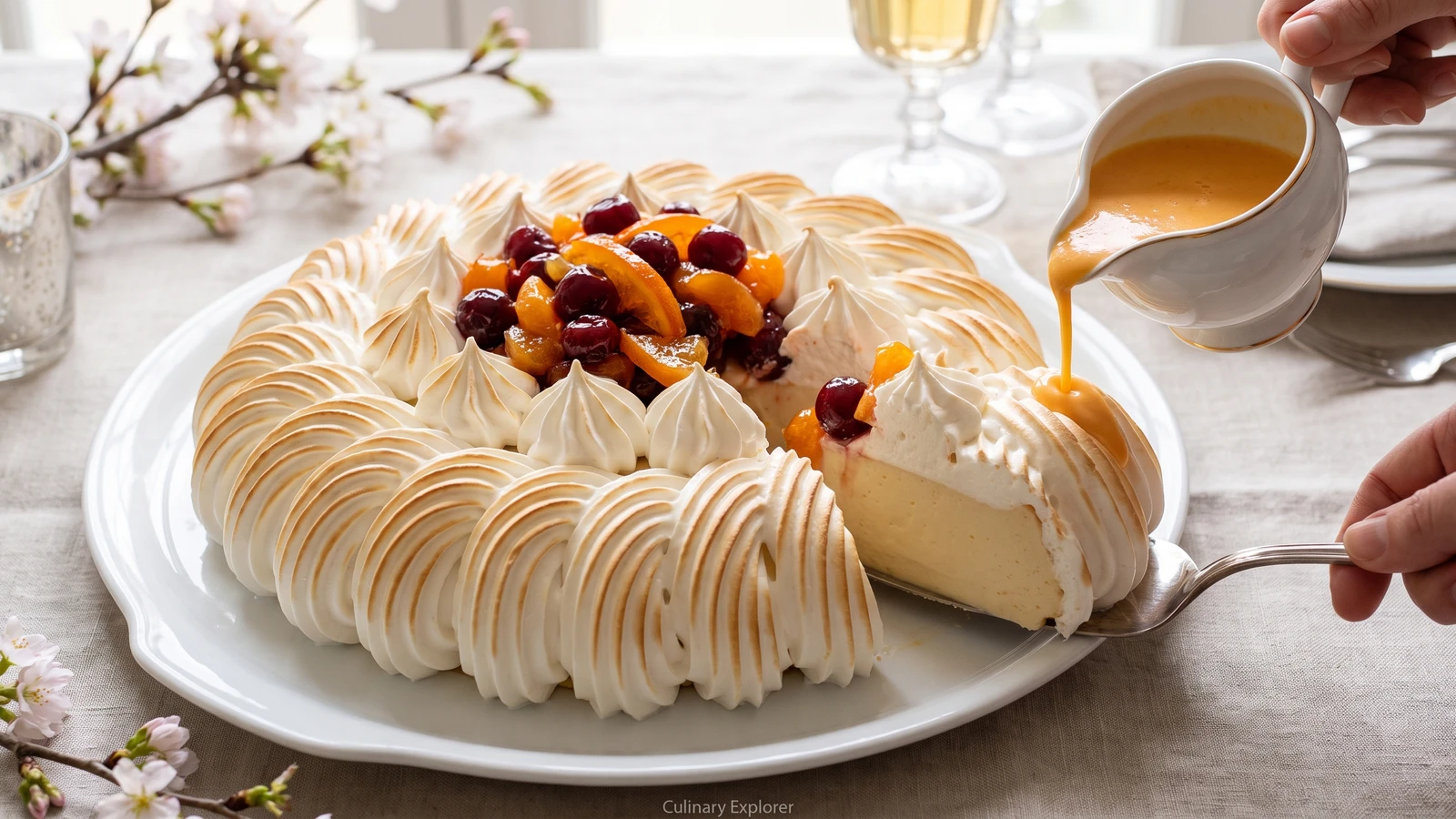
Poached Régence cream, kirsch-bright preserved fruit, and Meringue à l’Italienne (No. 2383) meet in one generous ring, browned only to a blush and served with orange crème anglaise at the table.
Crème Meringuée, poached Régence cream with kirsch-soaked fruit and Italian meringue, teaches one discipline: gentle heat. The custard must set without a bubble, then the meringue must bronze without surrendering syrup. Restraint gives you a smooth ivory ring and toasted ridges; force gives you holes below and tears above.
The original recipe assumed a pastry station with Crème à la Régence ready, a full batch of Meringue à l’Italienne (No. 2383), a deep border mould, and another pair of hands for piping. The separate preparations are not disposable brigade scaffolding; they are the structure of the dish and remain separate here. What changes is the scale: one 1.5-litre ring mould, one piping bag, and enough dessert for eight. One cook, one stove, one evening.
Turned out and filled, the Régence cream is pale and tender beneath a crown of kirsch-scented fruit and satin meringue, with orange crème anglaise poured beside each serving. The source asks for a moderate oven, not the fierce blast of a salamander or broiler, because violent heat makes meringue weep. Before touching a pan, arrange the bain-marie properly and promise yourself it will never boil; that is the step that decides the dish.
Crème meringuée belongs to the formal Parisian table and the classical French pastry kitchen rather than to any single provincial larder. Its construction shows the kitchen’s component grammar: poached Crème à la Régence from one preparation, Meringue à l’Italienne (No. 2383) from another, then preserved fruit, kirsch, piping, and controlled browning at service. The separately served orange-flavoured “English custard” is crème anglaise in French kitchen language, a small reminder that names traveled while technique remained exact.
Quantity
5 cups (1.2 L / 1.2 kg)
unpoached and cool
Quantity
1 tablespoon (15 ml / 14 g)
softened, for the mould
Quantity
3/4 cup (180 ml / 130 g)
cut into a neat 6 mm salpicon
Quantity
2 tablespoons (30 ml / 28 g)
Quantity
4 cups (960 ml / 400 g) Meringue à l’Italienne (No. 2383)
freshly prepared and divided
Quantity
2 cups (480 ml / 490 g)
Quantity
1
zest removed in broad strips without the white pith
Quantity
5
Quantity
1/3 cup (80 ml / 67 g)
| Ingredient | Quantity |
|---|---|
| prepared Crème à la Régenceunpoached and cool | 5 cups (1.2 L / 1.2 kg) |
| unsalted buttersoftened, for the mould | 1 tablespoon (15 ml / 14 g) |
| mixed preserved fruitcut into a neat 6 mm salpicon | 3/4 cup (180 ml / 130 g) |
| Kirsch | 2 tablespoons (30 ml / 28 g) |
| Meringue à l’Italiennefreshly prepared and divided | 4 cups (960 ml / 400 g) Meringue à l’Italienne (No. 2383) |
| whole milk | 2 cups (480 ml / 490 g) |
| large orangezest removed in broad strips without the white pith | 1 |
| large egg yolks | 5 |
| caster sugar | 1/3 cup (80 ml / 67 g) |
Cut the preserved fruit into a salpicon, a neat small dice of about 6 mm, so every spoonful receives several colours and textures rather than one large sticky piece. Toss the fruit with the Kirsch and leave it for at least 30 minutes. Drain it in a sieve for five minutes before folding it into the meringue; the fruit should carry the Kirsch, not trail a puddle that loosens the foam.
Heat the oven to 160°C / 325°F. Butter a 1.5 L deep border mould thoroughly, covering the central tube and every corner, then fill it with the prepared Crème à la Régence and cover the top loosely with buttered baking paper and foil. Set the mould in a deep roasting pan and pour very hot water around it until the water reaches halfway up the sides. This bain-marie, a hot-water bath, protects the custard from the oven’s direct heat.
Poach the cream in the bain-marie for 55 to 70 minutes. The water should remain calm, never bubbling, and the cream is ready when the edges are set while the centre gives one soft, unified tremble; an instant-read thermometer should register about 80°C / 176°F near the centre. If the surface begins to puff or split, the bath is too hot. Ça se rattrape: add a cup of cool water to the roasting pan, lower the oven by 15°C / 25°F, and continue gently. A fine surface crack can later be covered by the piped meringue.
While the cream poaches, warm the milk with the orange zest until small bubbles gather at the edge, then cover and infuse for 10 minutes. Whisk the yolks with the caster sugar until smooth, pour in the warm milk gradually, and return everything to a clean saucepan. Cook over low heat, stirring continuously, until the crème anglaise, the orange-flavoured English custard specified by the source, coats the spoon and a finger drawn through it leaves a clean path. Never let it boil. If you see fine grains, take it off the heat immediately, whisk in a tablespoon of cold milk, and strain it into a cold bowl. Cool and cover.
Lift the mould from the bain-marie and leave it undisturbed for 20 to 25 minutes, until warm rather than hot. Run a thin knife carefully around the outer rim and central tube, place an ovenproof serving platter over the mould, and invert in one confident movement. If the cream clings, wrap the mould briefly in a towel dipped in hot water and try again. Do not shake it. If a small piece stays behind, press it gently into place; the decoration will cover the repair.
During the cream’s rest, prepare 4 cups of Meringue à l’Italienne (No. 2383) according to its own entry and use it while it remains glossy and supple. Keep 1 1/2 cups plain for piping, untouched by fruit, and reserve the remaining 2 1/2 cups for the centre. The source treats this as a finished component, and so do we; its cooked-sugar method belongs whole in its own preparation.
Blot the drained salpicon lightly, then fold it through the reserved 2 1/2 cups of Meringue à l’Italienne (No. 2383) with a broad spatula, turning only until the fruit is evenly distributed. Heap this fruit meringue generously into the centre of the Régence ring. If wet fruit has loosened the mixture, stop folding and mound it with a spoon instead of trying to pipe it; keep the plain meringue firm for the border.
Raise the oven to 175°C / 350°F. Fit a piping bag with a 12 mm grooved or open-star tip, fill it with the remaining plain Meringue à l’Italienne (No. 2383), and pipe ridged shells or rosettes over the exposed Régence border. Bake for 8 to 12 minutes, rotating the platter once, until only the raised ridges are pale amber. Do not use the broiler. If colour races ahead or syrup beads appear, remove the dish immediately and let it settle for two minutes; more heat will only make the weeping worse.
Rest the Crème Meringuée for five minutes after browning. Bring it to the table whole, with the cool orange crème anglaise in a sauceboat. Cut through the custard ring with a thin knife, spoon some fruit-filled meringue beside each slice, and pour the anglaise around it rather than over the toasted piping. À table!
1 serving (about 285g)
Culinary guides, cultural storytelling, and the editorial depth that makes cooking meaningful.
Discover Culinary ExplorerChef Juliette
Five almond preparations, one discipline: remove the skins cleanly, dry every kernel through, then cut, toast, or cloak it in pale caramel without letting its fragrant oils escape.

Chef Juliette
A pastry pantry lesson in one tray: filberts warmed only until their red skins release, rubbed clean, cooled, and chopped into a fragrant mise-en-place for cakes, creams, pralines, and petits fours.

Chef Juliette
The smallest pâtisserie discipline decides whether a cake leaves its mould intact: clarified butter in every corner, followed by the lightest veil of dry flour or fécule.

Chef Juliette
Four whites, one spotless bowl, and a patient change of speed: whisk gently until loosened, then briskly to glossy stiffness, with powdered sugar waiting if the foam begins to granulate.