Culinary Explorer

A cooking platform built around craft, culture, and the stories behind what we eat.
Discover Culinary Explorer
Melting Almond Paste (for Stuffing and Imitating Fruit)

Melting Almond Paste (for Stuffing and Imitating Fruit)

Created by Chef Juliette

Based on No. 2386, Melting Almond Paste (for Stuffing and Imitating Fruit), from Le Guide Culinaire (1907) by Auguste Escoffier

A hot small-crack syrup turns finely crushed almonds into a supple pâte d’amandes fondante, ready to fill prunes while tender or cool into fruit-shaped confections with a clean, yielding bite.

Desserts
French
Make Ahead
Holiday
Special Occasion
20 min
Active Time
15 min cook2 hr 35 min total
YieldAbout 12 ounces (340 g)

Pâte d’amandes fondante (melting almond paste for stuffing and imitating fruit) teaches one decisive principle: the temperature of the sugar determines the character of the paste. Stop below the small-crack stage and it stays sticky; cook beyond it and the finished paste becomes brittle. The thermometer must read 285°F (141°C) before the syrup leaves the pan.

The original formula assumed an almond crusher, a heavy mortar, and enough hands for one cook to pour while another worked the pestle. Here the crusher becomes a food processor, the mortar becomes a metal mixer bowl and paddle, and the old finger test for boiling sugar becomes a digital thermometer. I’ve halved the brigade quantity but kept its one-part almond to two-parts sugar ratio exactly. The machinery was scaffolding and can go; finely crushing the almonds, cooking the sugar correctly, and adding it little by little are the dish and must stay. One cook, one stove, one evening.

When it’s right, the warm paste gathers into a dense, satin-soft mass with the perfume of almonds and your chosen vanilla or liqueur. It firms as it rests but yields cleanly under the fingers, tender enough for stuffing dried fruit and strong enough for modeling. Have the almond mixture ready before the sugar reaches temperature, because the gradual incorporation of that hot syrup is the moment that decides everything.

Pâte d’amandes fondante belongs to the confiserie tradition of Paris, where almond pastes moved between pastry kitchens and sweet shops as both filling and modeling material. Cooking the sugar to small crack produced a smoother, more stable paste than merely kneading almonds with dry sugar, while varying the sugar let confectioners move from tender fillings to imitation fruits. It is not the calisson paste of Aix-en-Provence, which contains candied melon and citrus peel; this preparation remains deliberately plain so vanilla or liqueur can direct it.

The technique, the tradition, and the story behind every dish.

Discover Culinary Explorer

Ingredients

dry blanched almonds

Quantity

¾ cup (180 ml / 113 g)

vanilla sugar or liqueur

Quantity

1½ teaspoons (7.5 ml / 6 g) vanilla sugar, or 1 tablespoon (15 ml / 15 g) liqueur

granulated sugar

Quantity

1 cup plus 2 tablespoons (270 ml / 227 g) for The Cooking of Sugar (No. 2344)

brought to the small-crack stage

water

Quantity

¼ cup (60 ml / 60 g), plus up to 2 tablespoons (30 ml / 30 g) for washing the pan or rescuing the paste

glucose syrup (optional)

Quantity

1½ teaspoons (7.5 ml / 10 g)

Equipment Needed

  • Food processor with metal blade
  • Stand mixer with metal bowl and paddle, or heavy heatproof bowl and stout wooden spoon
  • Small deep, light-colored saucepan
  • Digital instant-read or clip-on sugar thermometer
  • Heatproof pastry brush
  • Parchment paper

Instructions

  1. 1

    Prepare for hot sugar

    Fit a stand mixer with its paddle, line the work surface with parchment, and set a digital sugar thermometer beside the stove. Measure everything before applying heat. Small-crack syrup waits for nobody, and reaching for equipment while it races toward caramel is how a calm confection becomes an argument. Keep bare hands well away from the syrup and use the thermometer rather than testing it with your fingers.

    A deep, light-colored saucepan gives the syrup room to boil and lets you see if it begins to color. Hot sugar clings and burns immediately, so keep the handle turned inward and the work area clear.
  2. 2

    Crush the almonds

    Put the dry blanched almonds and your chosen vanilla sugar or liqueur in a food processor. Process in short bursts, scraping the bowl often, until the almonds resemble very fine damp sand and hold together when pinched. Stop before they become oily almond butter. Transfer the mixture to the metal mixer bowl and loosen it with the paddle for a few seconds on low speed. This replaces the crusher and mortar while preserving their real purpose: reducing the almonds finely enough to release just enough oil for a smooth paste.

  3. 3

    Cook to small crack

    Combine the granulated sugar, ¼ cup (60 ml / 60 g) water, and optional glucose syrup in the saucepan. Following The Cooking of Sugar (No. 2344), warm gently until the sugar has dissolved, then bring it to a steady boil without stirring. Brush any crystals from the pan wall with a clean pastry brush dipped in water. Cook until the syrup reaches precisely 285°F (141°C), the small-crack stage, then remove it from the heat at once. If the syrup turns cloudy and grainy before reaching temperature, stop. Ça se rattrape: cover the pan for one minute so condensation washes the walls, then dissolve the crystals over gentle heat and begin the rise to temperature again. If necessary, let the pan settle briefly before carefully adding 1 tablespoon (15 ml / 15 g) of the reserved water. Never pour water into syrup that has already reached small crack.

    The glucose is permitted by the sugar formula and discourages crystallization. It changes neither the almond-to-sugar proportion nor the intended flavor.
  4. 4

    Work in the syrup

    Start the mixer on its lowest speed. Pour the hot syrup into the almonds in a thin, steady thread down the inside wall of the bowl, never onto the moving paddle, allowing each addition to disappear before adding more. Continue mixing until the mass becomes thick, cohesive, and slightly satin-sheened. It will stiffen quickly and may look alarmingly rough at first. This is exactly why the original used a mortar. If it seizes into dry lumps, warm the outside of the bowl over barely simmering water while continuing to mix; if crumbs remain, add reserved hot water 1 teaspoon (5 ml / 5 g) at a time, stopping as soon as the paste gathers. If it looks loose, keep mixing as it cools rather than adding dry sugar, which would make it gritty.

  5. 5

    Knead and rest

    As soon as the paste is cool enough to handle safely but still warm, turn it onto the parchment and knead with firm folds until smooth and evenly textured. If a little almond oil appears, let the paste cool for 10 minutes and knead again; the fat will return to the mass as it firms. Shape it into a flat block, wrap it tightly, and rest it at room temperature for 2 hours. The finished pâte d’amandes fondante should cut without crumbling and yield slowly when pressed.

  6. 6

    Stuff or shape

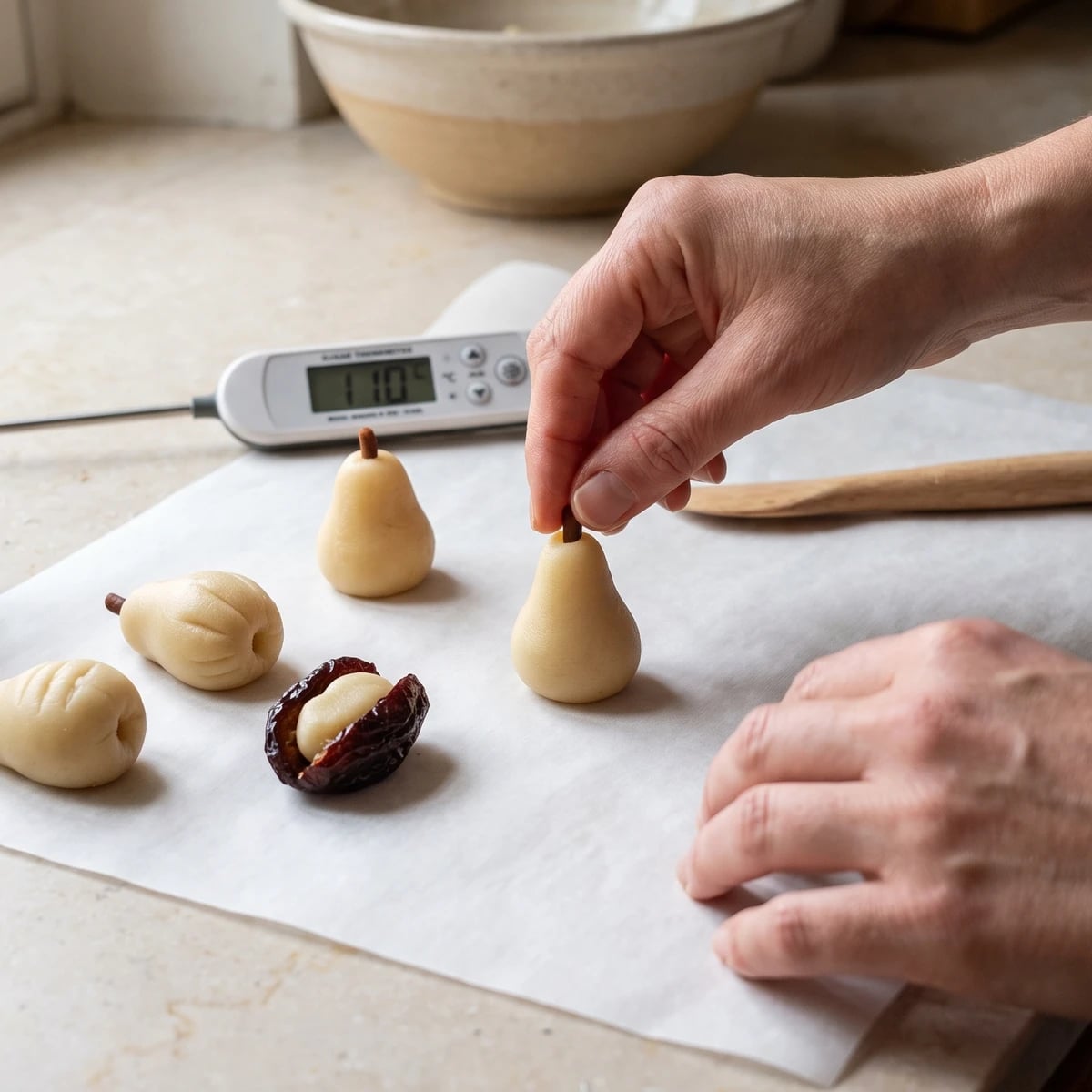
    For fruits déguisés, meaning stuffed dried fruits, roll the paste into small tapered pieces and press them into split prunes, dates, or apricots. For imitation fruit, portion the paste while supple, roll it smooth, and pinch or press it into the desired forms before leaving the surface to set. Coloring and glazing are separate finishing operations and do not belong to this base formula. More sugar in a future batch makes a firmer modeling paste; less makes a softer filling. À table!

Chef Tips

  • Choose whole blanched almonds that smell sweet and fresh, then make certain they are dry. Damp almonds introduce uncontrolled water, while stale almonds carry their tired oil into every bite.
  • A digital thermometer is the honest home equivalent of repeated finger tests. Check its accuracy in boiling water before a holiday batch, and position the probe in the syrup without letting it touch the pan floor.
  • The base ratio is one part almonds to two parts sugar by weight. The original permits varying the sugar for the intended work: use a little more in the next batch for sharp modeled details, or a little less for a tender stuffing. Don’t repair a finished batch with loose dry sugar, because the grains remain on the tongue.
  • A small glassful of liqueur is translated here as 2 tablespoons for the full formula, then halved with the rest of the recipe. Choose one clear, fragrant liqueur and let it speak alone; piling aromas together only muddies the almond.
  • If you have no stand mixer, work the hot syrup into the almonds in a heavy heatproof bowl with a stout wooden spoon. The batch is small enough for one cook, but the bowl must be secured on a damp towel before the syrup comes near it.

Advance Preparation

  • Make the paste at least 2 hours before shaping so its moisture can settle evenly. For the smoothest modeled pieces, prepare it the day before and bring it back to room temperature while still tightly wrapped.
  • Keep unused pâte d’amandes fondante pressed into a flat block and wrapped airtight in the refrigerator for up to 2 weeks. Let it soften at room temperature, then knead briefly before using.
  • For longer storage, wrap the block twice and freeze it for up to 2 months. Thaw it overnight in the refrigerator while wrapped so condensation stays outside the paste.

Frequently Asked Questions

Nutrition Information

1 serving (about 28g)

Calories
130 calories
Total Fat
5 g
Saturated Fat
0 g
Trans Fat
0 g
Unsaturated Fat
5 g
Cholesterol
0 mg
Sodium
0 mg
Total Carbohydrates
21 g
Dietary Fiber
1 g
Sugars
20 g
Protein
2 g

Note: Chef personas and recipes are created with AI assistance. Cook with care: follow safe food-handling practices, check doneness with a thermometer when needed, and adapt for allergies and your kitchen.

Where cooking meets culture.

Culinary guides, cultural storytelling, and the editorial depth that makes cooking meaningful.

Discover Culinary Explorer

More from Entremets (Sweets)

Browse the full collection