
Chef Juliette
Various Almond Preparations
Five almond preparations, one discipline: remove the skins cleanly, dry every kernel through, then cut, toast, or cloak it in pale caramel without letting its fragrant oils escape.
A cooking platform built around craft, culture, and the stories behind what we eat.
Created by Chef Juliette
Based on No. 2345, Glace à l’Ancienne, from Le Guide Culinaire (1907) by Auguste Escoffier
Icing sugar, fragrance, and the gentlest warmth make a thin, opaque glaze that flows cleanly over a cooled cake and dries fast. The whole technique is knowing when to stop heating.
Glace à l’ancienne (old-fashioned poured icing) teaches restraint with heat. The one true thing to know before touching the pan is that this glaze is warmed to make it flow, never cooked. Keep it lukewarm and it falls in an opaque ribbon, settles smoothly over the cake, and dries quickly into a delicate satin shell.
The original entry assumes something quieter than a saucier, a stockpot, or a salamander: a pastry cook with trays waiting on the bench and enough practice to judge an unnamed quantity by eye. At home, the honest equivalent is 240 grams of icing sugar, the smallest saucepan you own, and one cooled 20 to 23 centimetre cake. The open-ended brigade quantity is scaffolding, so it goes. The stiff first mixture and the barely warm pour are the dish, so they stay.
Vanilla, orange, lemon, Kirsch, rum, anisette, and marasquin all belong here, but choose one clear voice rather than making a chorus of the bottle shelf. The decisive moment comes over the lowest heat: stop as soon as the glaze runs freely, because another minute makes it thin and translucent. If that happens, fresh sifted sugar brings it back.
Glace à l’ancienne belongs to the workbench of classical French pâtisserie, particularly the Parisian pastry tradition, where it gave cakes and petits fours a thin, quick-setting sugar coat rather than a thick layer of cream or fondant. Here glace means icing, not frozen cream, and à l’ancienne identifies a poured preparation warmed only enough to flow. Requiring little more than icing sugar, fragrance, and a warm corner, it traveled easily from professional pastry rooms to celebration cakes at home throughout France.
Quantity
2 cups (475 ml / 240 g)
sifted
Quantity
1/4 cup (60 ml / 30 g)
sifted and held in reserve
Quantity
1/4 cup (60 ml / 60 g)
Quantity
1/2 vanilla bean or 3 broad strips rind
Quantity
2 to 3 tablespoons (30 to 45 ml / about 29 to 43 g)
Quantity
2 to 3 tablespoons (30 to 45 ml / 30 to 45 g)
Quantity
1 teaspoon vanilla sugar (5 ml / 4 g), or 1 teaspoon grated rind (5 ml / 2 g)
Quantity
1 to 3 drops
| Ingredient | Quantity |
|---|---|
| icing sugarsifted | 2 cups (475 ml / 240 g) |
| icing sugar for correctionsifted and held in reserve | 1/4 cup (60 ml / 30 g) |
| water for the infusion route (optional) | 1/4 cup (60 ml / 60 g) |
| vanilla bean or orange or lemon rind for the infusion route (optional) | 1/2 vanilla bean or 3 broad strips rind |
| Kirsch, rum, anisette, or marasquin for the liqueur route (optional) | 2 to 3 tablespoons (30 to 45 ml / about 29 to 43 g) |
| water for the direct water route (optional) | 2 to 3 tablespoons (30 to 45 ml / 30 to 45 g) |
| vanilla-flavoured sugar or finely grated orange or lemon rind (optional) | 1 teaspoon vanilla sugar (5 ml / 4 g), or 1 teaspoon grated rind (5 ml / 2 g) |
| vanilla, orange, or lemon essence (optional) | 1 to 3 drops |
Choose one route only. For an infusion, put the water and vanilla bean or citrus rind in a small saucepan, bring it just to the first quiver, then cover and take it off the heat for 10 minutes. Strain, cool completely, and measure 2 to 3 tablespoons (30 to 45 ml). For a liqueur glaze, measure the Kirsch, rum, anisette, or marasquin directly. For the simplest route, use water with vanilla-flavoured sugar, grated citrus rind, or no more than a few drops of essence.
Set a completely cooled, dry cake on a wire rack over a rimmed tray and brush away every loose crumb. A warm cake melts the glaze and drinks it in, while a damp surface keeps it from setting cleanly. The cake must be ready before the glaze is warmed because the glaze waits for no one.
Put the 2 cups (240 g) sifted icing sugar in a clean small saucepan. If using vanilla-flavoured sugar or grated rind, stir it through now. Add 2 tablespoons (30 ml) of your chosen liquid and work the mixture firmly for 2 minutes, pressing out every lump. Add more liquid one teaspoon at a time only until you have a smooth, opaque paste that falls reluctantly from the spoon. Keep it somewhat stiff. That stiffness is the foundation of the glaze, not an inconvenience.
Set the saucepan over the lowest heat and stir constantly for 1 to 3 minutes, just until the glace à l’ancienne is lukewarm and runs from the spoon in a thick, unbroken ribbon. If using a thermometer, stop around 35°C (95°F) and never let it pass 40°C (104°F). This is warming, not cooking. If it remains too stiff, stir in the reserved liquid 1/4 teaspoon at a time. If it becomes thin or translucent, take it off the heat and beat in the reserved sifted sugar one tablespoon at a time until it turns opaque again. Ça se rattrape.
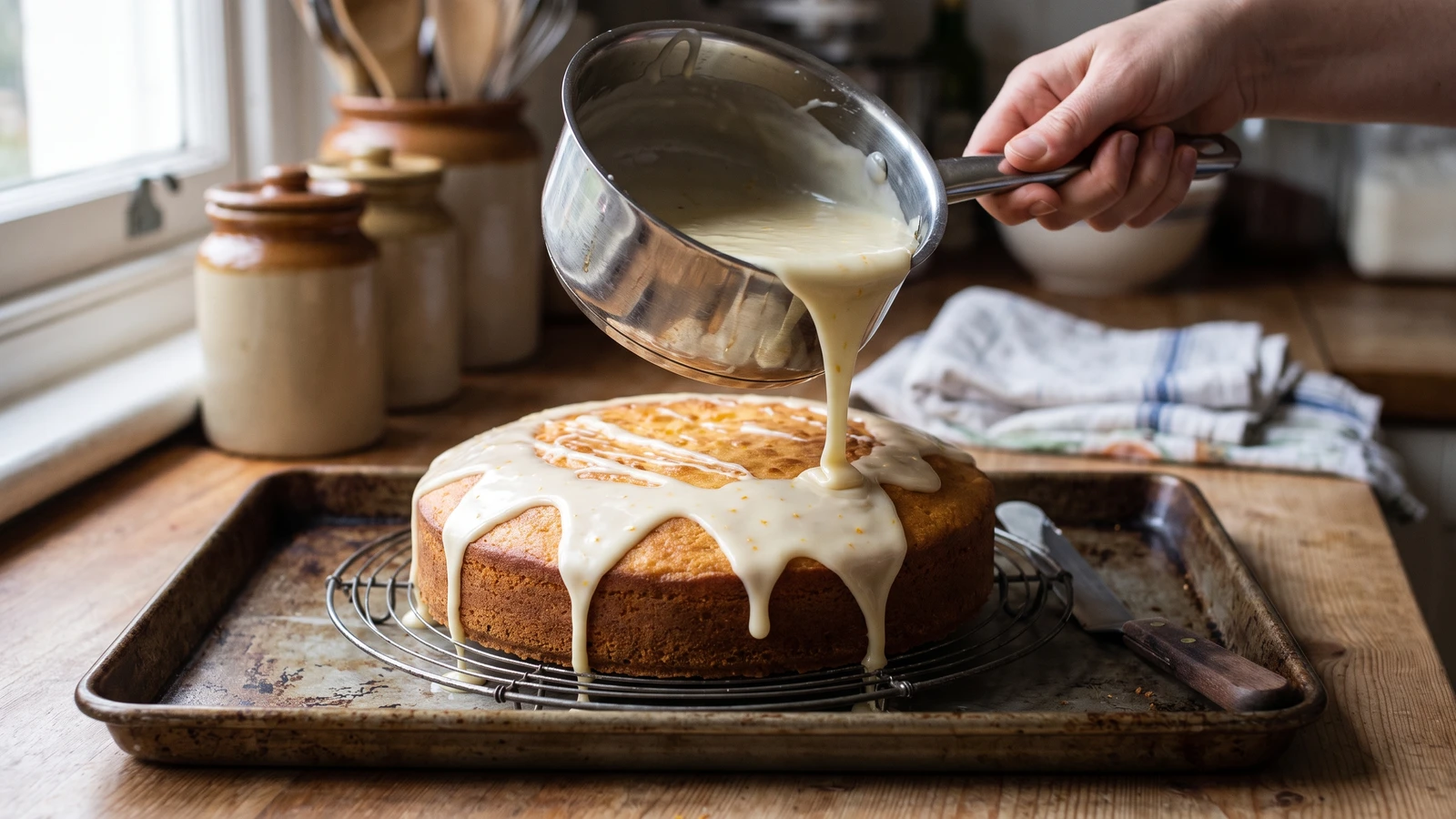
Pour the warm glaze immediately into the centre of the cake, letting it travel outward and fall naturally over the sides. Guide it once with a palette knife only where it needs help; repeated strokes leave ridges because the surface begins drying almost at once. If one patch stalls, warm the palette knife in hot water, dry it thoroughly, and use its flat side to ease the glaze toward the edge.
Leave the cake undisturbed on the rack for 20 to 30 minutes, until the glaze is dry to a light touch and has settled into a thin, satin shell. Lift the cake onto its serving plate only after the drips have firmed. One cook, one stove, one evening. À table!
1 serving (about 310g)
Culinary guides, cultural storytelling, and the editorial depth that makes cooking meaningful.
Discover Culinary ExplorerChef Juliette
Five almond preparations, one discipline: remove the skins cleanly, dry every kernel through, then cut, toast, or cloak it in pale caramel without letting its fragrant oils escape.

Chef Juliette
A pastry pantry lesson in one tray: filberts warmed only until their red skins release, rubbed clean, cooled, and chopped into a fragrant mise-en-place for cakes, creams, pralines, and petits fours.

Chef Juliette
The smallest pâtisserie discipline decides whether a cake leaves its mould intact: clarified butter in every corner, followed by the lightest veil of dry flour or fécule.

Chef Juliette
Four whites, one spotless bowl, and a patient change of speed: whisk gently until loosened, then briskly to glossy stiffness, with powdered sugar waiting if the foam begins to granulate.