Culinary Explorer

A cooking platform built around craft, culture, and the stories behind what we eat.
Discover Culinary Explorer
Tartelettes à la Vendome

Tartelettes à la Vendome

Created by Chef Juliette

Based on No. 2334, Tartelettes à la Vendome, from Le Guide Culinaire (1907) by Auguste Escoffier

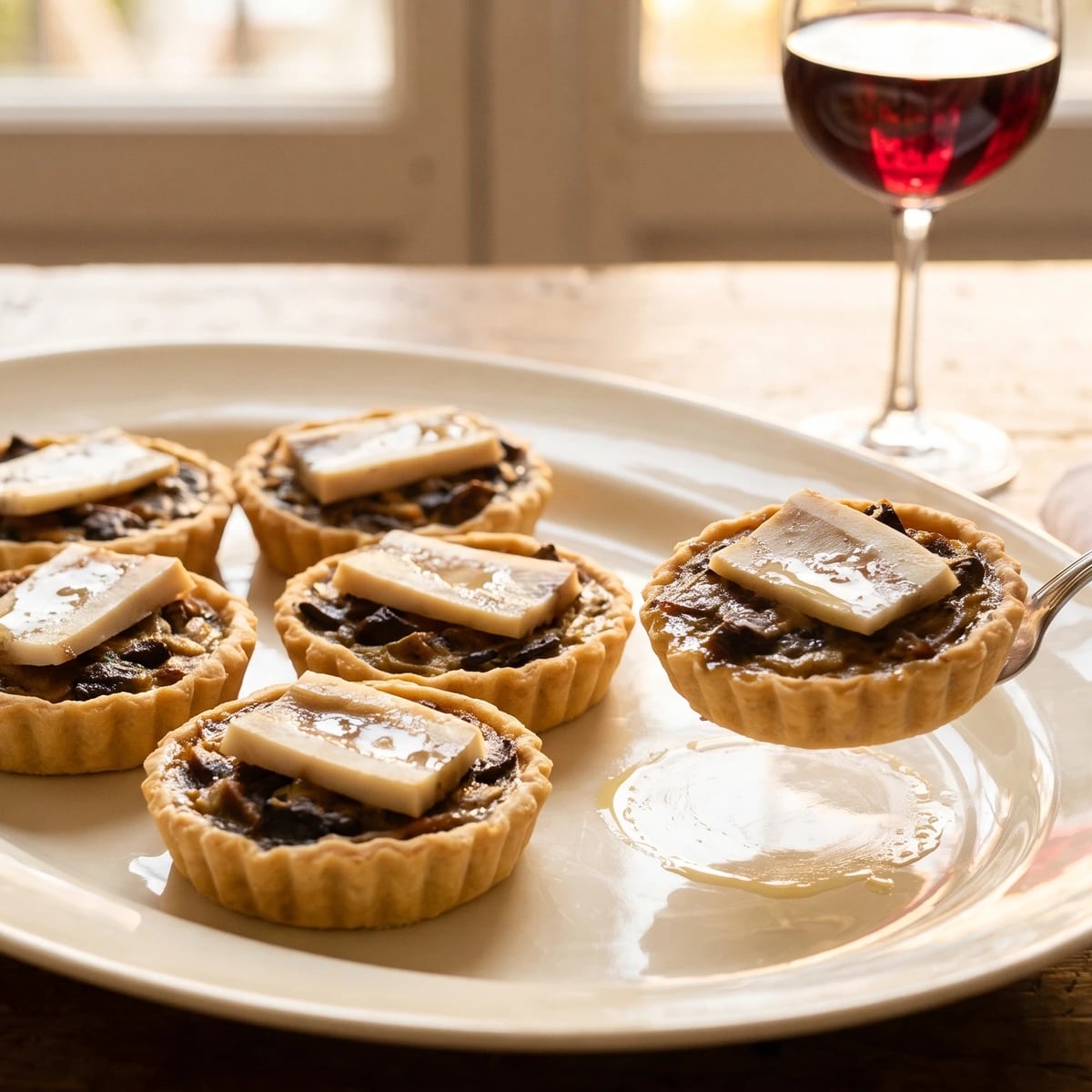
Tartelettes à la Vendôme turn cèpes, shallot, marrow, egg, crumbs, and glossy meat glaze into six rich bites, with the pastry crisp and the marrow cap barely set.

Appetizers & Snacks
French
Dinner Party
Special Occasion
45 min
Active Time
25 min cook1 hr 30 min total
Yield6 tartlets (4 to 6 appetizer servings)

Tartelettes à la Vendôme (small savory tartlets with porcini and bone marrow) teach one exact lesson: the marrow goes in cold, and the tartlets go into the oven only at the last moment. The diced marrow enriches the filling while the broad slice on top turns ivory and tender. Let either grow warm beforehand and it renders into grease instead of setting. Clear a cold shelf before touching the pan.

The original entry assumed individual tartlet moulds, good paste already resting, cèpes sautéed by a commis, and a saucier standing over a stock never off the fire, ready with melted glace de viande (meat glaze). At home, six shallow moulds, a small pâte brisée (buttery short pastry), and a good unsalted prepared meat glaze do the work honestly. No salamander is wanted here; a heavy sheet heated in a hot oven gives the pastry the strong bottom heat it needs. One cook, one stove, one evening.

The book made twelve tartlets. This version makes six by halving every measured filling quantity exactly; it supplies quantities only for the pastry and the broad marrow caps that the source left to the working kitchen. Pastry already on hand was brigade scaffolding. Shallot softened in butter, cèpes sautéed dry, raw marrow, chopped egg, breadcrumbs, lemon, cayenne, glace de viande, and that last-minute bake are the dish itself. Keep the filling cold, crown each tartlet only when the oven is ready, and cook them last.

Although Vendôme is a town in Loir-et-Cher, Tartelettes à la Vendôme belong to the classical Parisian catalog of named hors-d'oeuvre, where a place-name often identifies a composed garnish rather than a regional household specialty. Their combination of cèpes, marrow, chopped egg, breadcrumbs, and glace de viande shows the working larder of the grand service kitchen, with rich trimmings gathered into small pastry cases and baked to order. These are last-minute tartlets, not little pies meant to be baked and held.

The technique, the tradition, and the story behind every dish.

Discover Culinary Explorer

Ingredients

all-purpose flour

Quantity

1 cup (240 ml / 125 g)

fine salt for the pâte brisée

Quantity

¼ teaspoon (1.25 ml / 1.5 g)

cold unsalted butter

Quantity

4 tablespoons plus 1 teaspoon (65 ml / 60 g)

diced

ice water

Quantity

2 tablespoons (30 ml / 30 g), plus a few drops only if needed

unsalted butter for sautéing

Quantity

1 tablespoon (15 ml / 14 g)

divided

shallot

Quantity

3 tablespoons (45 ml / 21 g)

finely chopped

fresh or thawed frozen cèpes

Quantity

About 1 cup (240 ml / 70 g), to yield ⅓ cup (80 ml / 43 g) once sautéed

finely chopped after cooking

raw beef bone marrow

Quantity

About ¼ cup (60 ml / 56 g) total

thoroughly chilled; divide into 1½ tablespoons (22 ml / 21 g) small dice and 6 broad slices totaling about 35 g

hard-boiled egg

Quantity

1½ tablespoons (22 ml / 18 g), about ½ small egg

finely chopped

fine fresh breadcrumbs

Quantity

¼ cup (60 ml / 14 g)

fine salt for the filling

Quantity

⅛ teaspoon (0.6 ml / 0.75 g), or less if the meat glaze is seasoned

cayenne

Quantity

1 small pinch, about 1/32 teaspoon (0.15 ml / 0.05 g)

fresh lemon juice

Quantity

4 drops (about 0.2 ml / 0.2 g)

glace de viande (meat glaze)

Quantity

1½ tablespoons (22 ml / 30 g)

melted and cooled until merely lukewarm

Equipment Needed

  • Six shallow 2¾ to 3-inch (7 to 7.5 cm) metal tartlet moulds or a six-cavity tartlet pan
  • Heavy rimmed sheet pan for strong bottom heat
  • Small 8 to 10-inch (20 to 25 cm) skillet

Instructions

  1. 1

    Make the pâte brisée

    Mix the flour with the salt. Rub in the cold butter with your fingertips until most of it resembles coarse crumbs but a few flat, pea-sized pieces remain; those pieces give the baked shells their delicate layers. Add the ice water and press the mixture together without kneading. If it still crumbles when squeezed, add water a few drops at a time. If it turns sticky, don't add more flour. Ça se rattrape: flatten it into a disc and chill until firm, about 30 minutes.

    The dough needn't look perfectly smooth. Working it until polished develops gluten, and gluten makes a small tartlet stubborn under the teeth.
  2. 2

    Prepare the marrow

    While the dough rests, cut 21 g of thoroughly chilled marrow into 5 mm dice. Cut the remaining marrow across the plug into six broad slices about 6 mm thick, one for each tartlet. Lay the dice and slices separately on cold plates and refrigerate them; if the marrow begins to smear instead of cutting cleanly, put it in the freezer for 10 minutes before continuing. Cold marrow is the principle that decides this dish.

  3. 3

    Sauté the cèpes

    Melt half the sautéing butter in a small skillet over medium-low heat. Add the shallot and cook for 3 to 4 minutes, stirring, until soft and translucent but not browned; scrape it into a mixing bowl. Raise the heat, add the remaining butter and the cèpes, then sauté until their released liquid has evaporated and their edges take a little bronze, about 5 minutes. You need ⅓ cup (80 ml / 43 g) cooked cèpes. If liquid still gathers in the pan, keep cooking rather than draining it, because wet mushrooms make wet pastry. Chop the cèpes finely, combine them with the shallot, and cool completely.

  4. 4

    Line the tartlet moulds

    Set a rack in the lower third of the oven, place a heavy sheet pan on it, and heat the oven to 425°F (220°C). Roll the rested pâte brisée between two sheets of parchment to about 2 mm thick. Cut six circles large enough to line the tartlet moulds, press them gently into the corners, trim the rims, and prick each base several times with a fork. Chill the lined moulds for 15 minutes. If the dough tears, patch it with a thin scrap pressed over the gap; small pastry repairs disappear in the oven.

  5. 5

    Bind and fill

    Stir the lukewarm glace de viande into the cold shallot and cèpes mixture, followed by the chopped egg, breadcrumbs, salt, cayenne, and lemon juice. Fold in the diced raw marrow last. The filling should be cold, moist, and cohesive, not oily. If the bowl begins to shine with free fat, stop. Ça se rattrape: chill it for 10 minutes until the marrow firms again. Divide the filling among the six shells without packing it hard, then place one cold, broad slice of marrow on each.

  6. 6

    Bake at the last moment

    Set the filled moulds directly on the heated sheet pan and bake for 14 to 17 minutes. They are ready when the pastry rims are a deep butter-gold, the filling is hot through, and the marrow caps are ivory, glossy, and just set, with a slight quiver rather than a puddle. The marrow should reach 145°F (63°C) at its centre. If a little marrow runs into the filling, leave the tartlets in their moulds for 2 minutes after baking; the breadcrumbs and meat glaze will take it back up. Ça se rattrape.

  7. 7

    Unmould and serve

    Run the point of a small knife around any edge that caught, then lift the tartlets carefully from their moulds. Serve them immediately while the shells are crisp and the marrow caps remain tender. Don't hold them in a warm oven, where the marrow will continue rendering. À table!

Chef Tips

  • Fresh cèpes are magnificent when the season offers them, but good frozen cèpes are the honest pantry answer. Thaw them, press out excess moisture, and sauté until dry. Dried cèpes bring excellent flavor but not the fleshy texture this particular preparation requires.
  • Ask the butcher for clean beef marrow plugs removed from cross-cut bones, or enough cross-cut bones to provide about 56 g of marrow. Chill the plugs until very firm before slicing. A warm marrow plug behaves like butter left beside the stove, which is precisely what you don't want.
  • Glace de viande is not gravy. It should be a concentrated, lightly seasoned meat glaze that sets to a firm gel when cold and melts to a syrup. A good unsalted veal or beef demi-glace concentrate is the practical home equivalent to the saucier's stockpot.
  • Serve the tartlets with a fresh, lightly tannic Cabernet Franc from the Loire. The wine has enough edge for the marrow and enough earthiness for the cèpes without flattening either.
  • A leftover tartlet can be chilled for one day and reheated for about 5 minutes on a hot sheet at 400°F (200°C), but the marrow cap will be softer. These are at their best when cooked and passed at once.

Advance Preparation

  • The pâte brisée can be made up to two days ahead, wrapped well, and refrigerated. The moulds may be lined earlier on the day of serving and kept cold.
  • The sautéed shallot and cèpes base can be prepared one day ahead. Cool it promptly and refrigerate it covered, then bring it only to cool room temperature before adding the glace de viande.
  • Do not add the diced marrow or crown the tartlets until shortly before baking. The assembled tartlets may wait in the refrigerator for 30 minutes, but the final bake must remain the last piece of cooking before they reach the table.

Frequently Asked Questions

Nutrition Information

1 serving (about 65g)

Calories
260 calories
Total Fat
19 g
Saturated Fat
10 g
Trans Fat
1 g
Unsaturated Fat
7 g
Cholesterol
40 mg
Sodium
210 mg
Total Carbohydrates
18 g
Dietary Fiber
1 g
Sugars
1 g
Protein
5 g

Note: Chef personas and recipes are created with AI assistance. Cook with care: follow safe food-handling practices, check doneness with a thermometer when needed, and adapt for allergies and your kitchen.

Where cooking meets culture.

Culinary guides, cultural storytelling, and the editorial depth that makes cooking meaningful.

Discover Culinary Explorer

More from Savouries

Browse the full collection