
Chef Juliette
Smelt (Éperlans)
Tiny éperlans, lightly floured and fried until their tails stand crisp, arrive in a generous heap on a napkin with fried parsley and grooved lemon, a weeknight lesson in heat and restraint.
A cooking platform built around craft, culture, and the stories behind what we eat.
Created by Chef Juliette
Based on No. 2331, Tartelettes Marquise, from Le Guide Culinaire (1907) by Auguste Escoffier
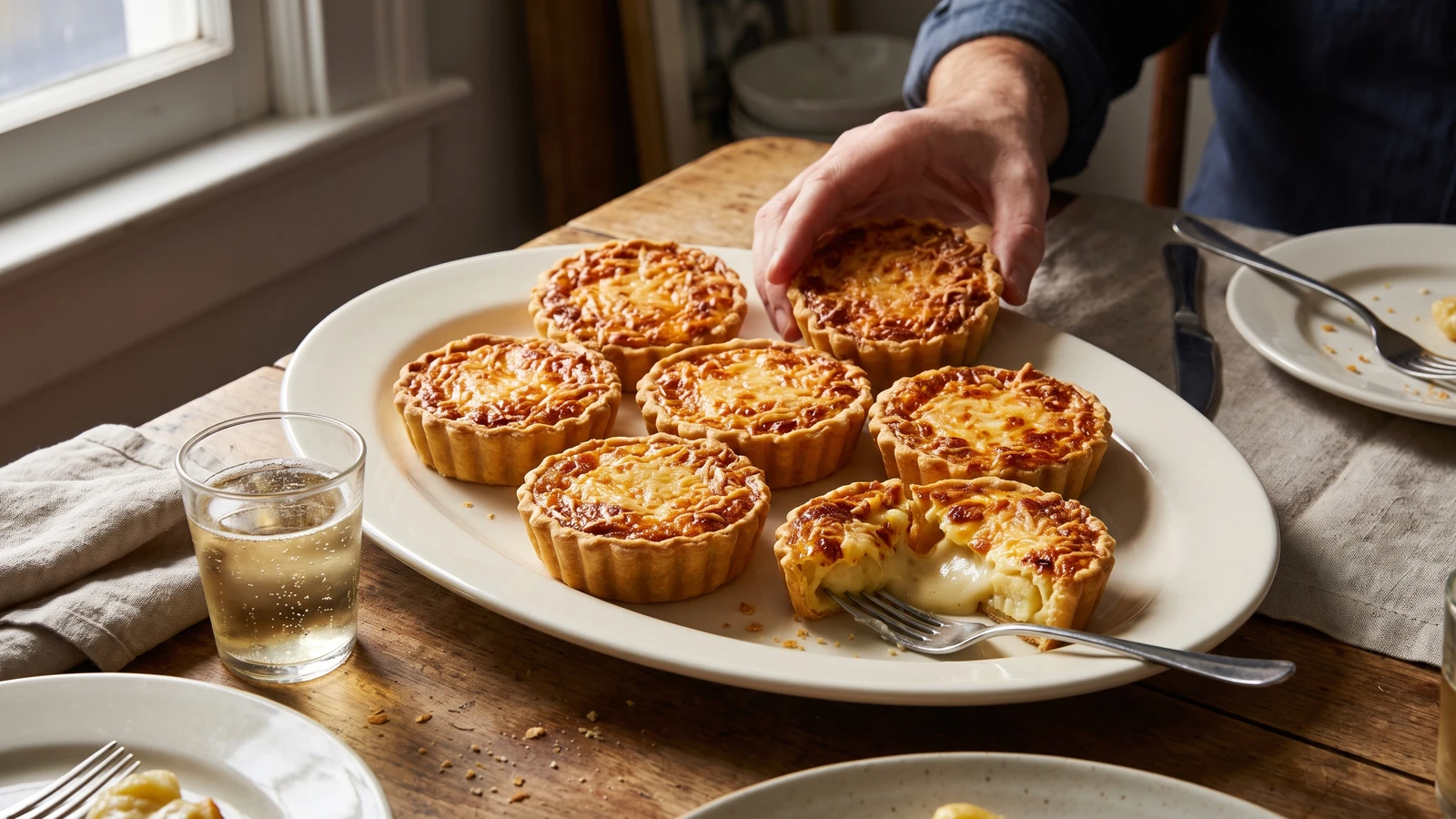
A crisp little pastry holding two classical preparations: a piped gnocchi lining and cayenne-pricked Mornay, finished with Gruyère and sent through a fierce oven until the top blisters bronze.
Tartelettes Marquise (Marquise tartlets) teach the discipline of contrast. Crisp pastry surrounds a fine thread of appareil à gnocchis (gnocchi paste) and a rich sauce Mornay (cheese-enriched béchamel) sharpened with cayenne. The one true thing to know before touching a pan is that the oven, not extra flour, protects that contrast. It must be fully heated and fierce before the tartlets go in.
The classical entry assumed a saucier with Mornay ready, a pastry station with appareil waiting in its piping bag, fluted molds by the tray, and an oven fierce enough to bake and color at once. At home, make the sauce and appareil in the same small saucepan, line eight molds with pâte brisée (short pastry), and set them on a thoroughly heated metal sheet. No stockpot belongs here because Mornay rests on milk and roux, and no salamander is required. Quantity and equipment have changed; the sequence has not. One cook, one stove, one evening.
Separate station labor and brigade portions are scaffolding, so they go. The macaroni-thick piping, cayenne in the Mornay, grated cheese, and fierce single bake are the dish, so they stay. Give the oven and sheet their full preheat; those first fierce minutes decide whether the pastry stays crisp or drinks the sauce.
Tartelettes Marquise belong to the Parisian classical repertory of petits hors-d'œuvre chauds, the small hot savories that brought pastry, sauce work, and precise oven cooking together at the opening of a meal. Marquise is an honorific menu name rather than a regional claim; the tartlets are distinguished by their unusual lining of appareil à gnocchis beneath cayenned Mornay, not by any noble household. The form passed naturally to bourgeois dinner tables, where small fluted molds and a strongly heated domestic oven preserved the grand-kitchen sequence at a sensible scale.
Quantity
1¼ cups (300 ml / 150 g)
Quantity
⅓ cup (80 ml / 75 g)
diced
Quantity
¼ teaspoon (1.25 ml / 1.5 g)
Quantity
1
Quantity
1½ to 2 tablespoons (22 to 30 ml / 22 to 30 g)
Quantity
1 teaspoon (5 ml / 5 g)
Quantity
2 tablespoons (30 ml / 16 g)
Quantity
¼ cup (60 ml / 62 g)
Quantity
2 tablespoons (30 ml / 28 g)
Quantity
⅓ cup (80 ml / 40 g)
Quantity
⅛ teaspoon (0.6 ml / 0.75 g)
Quantity
1⁄16 teaspoon (0.3 ml / 0.1 g)
Quantity
1
beaten
Quantity
¼ cup (60 ml / 25 g)
Quantity
1 tablespoon (15 ml / 14 g)
Quantity
1½ tablespoons (22 ml / 12 g)
Quantity
¾ cup (180 ml / 185 g)
divided
Quantity
2 tablespoons (30 ml / 30 g)
Quantity
⅔ cup (160 ml / 70 g)
divided
Quantity
2 tablespoons (30 ml / 10 g)
Quantity
⅛ teaspoon (0.6 ml / 0.2 g)
Quantity
⅛ teaspoon (0.6 ml / 0.75 g)
Quantity
1⁄16 teaspoon (0.3 ml / 0.1 g)
| Ingredient | Quantity |
|---|---|
| all-purpose flour, for the pâte brisée | 1¼ cups (300 ml / 150 g) |
| cold unsalted butter, for the pâte briséediced | ⅓ cup (80 ml / 75 g) |
| fine salt, for the pâte brisée | ¼ teaspoon (1.25 ml / 1.5 g) |
| large egg yolk, for the pâte brisée | 1 |
| ice water, for the pâte brisée | 1½ to 2 tablespoons (22 to 30 ml / 22 to 30 g) |
| softened unsalted butter, for the molds | 1 teaspoon (5 ml / 5 g) |
| all-purpose flour, for rolling | 2 tablespoons (30 ml / 16 g) |
| whole milk, for the appareil à gnocchis | ¼ cup (60 ml / 62 g) |
| unsalted butter, for the appareil à gnocchis | 2 tablespoons (30 ml / 28 g) |
| all-purpose flour, for the appareil à gnocchis | ⅓ cup (80 ml / 40 g) |
| fine salt, for the appareil à gnocchis | ⅛ teaspoon (0.6 ml / 0.75 g) |
| freshly grated nutmeg | 1⁄16 teaspoon (0.3 ml / 0.1 g) |
| large egg, for the appareil à gnocchisbeaten | 1 |
| finely grated Gruyère, for the appareil à gnocchis | ¼ cup (60 ml / 25 g) |
| unsalted butter, for the sauce Mornay | 1 tablespoon (15 ml / 14 g) |
| all-purpose flour, for the sauce Mornay | 1½ tablespoons (22 ml / 12 g) |
| whole milk, for the sauce Mornaydivided | ¾ cup (180 ml / 185 g) |
| heavy cream | 2 tablespoons (30 ml / 30 g) |
| finely grated Gruyère, for the sauce and toppingdivided | ⅔ cup (160 ml / 70 g) |
| finely grated Parmesan | 2 tablespoons (30 ml / 10 g) |
| ground cayenne | ⅛ teaspoon (0.6 ml / 0.2 g) |
| fine salt, for the sauce Mornay | ⅛ teaspoon (0.6 ml / 0.75 g) |
| ground white pepper | 1⁄16 teaspoon (0.3 ml / 0.1 g) |
Combine the flour and salt, then rub in the cold butter until the mixture holds broad flakes among the fine crumbs. Stir in the yolk and 1½ tablespoons of ice water, pressing rather than kneading, until the dough just holds together. If dry cracks remain, add the final water a teaspoon at a time; if the dough feels sticky, chill it instead of burying it in more flour. Flatten into a disc, wrap, and chill for 30 minutes.
Reserve 1 tablespoon of the milk. Melt the butter in a small saucepan, stir in the flour, and cook the pale roux for 90 seconds without coloring it. Take the pan off the heat and whisk in the remaining milk gradually, making each addition smooth before the next. Return to medium heat and simmer for 2 to 3 minutes, whisking, until the sauce coats the whisk heavily. Stir in the cream, then remove from the heat and add half the divided Gruyère, all the Parmesan, the cayenne, salt, and white pepper. If lumps appear, strain the sauce into a clean bowl. Ça se rattrape. Press parchment directly onto its surface and let it cool until barely warm.
Bring the milk, butter, salt, and nutmeg to a full boil in the cleaned saucepan. Remove it from the heat, add the flour all at once, and beat firmly with a wooden spoon. Return to medium heat and work the paste for 1 to 2 minutes, until it gathers into a ball and leaves a thin film on the pan. Cool for 2 minutes. Beat in the egg in three additions, stopping when the appareil is glossy, holds its shape, and falls from the spoon in a heavy point; it may not need every drop. Fold in the Gruyère. If it is too stiff to pipe, add another teaspoon of egg. If it has become slack, chill it for 10 minutes and do not add raw flour.
Butter eight 3-inch (7.5 cm) fluted metal tartlet molds lightly. Roll the pâte brisée on a floured surface to a scant ⅛ inch (2 mm), cut eight rounds about 4 inches (10 cm) wide, and settle them into the molds without stretching. Press the pastry into the flutes, trim the rims cleanly, and chill for 15 minutes. Meanwhile, place a heavy rimmed sheet pan on the lower-middle rack and heat the oven to 450°F (230°C), or 425°F (220°C) with convection, for a full 30 minutes. Do not blind-bake the shells; the source calls for one fierce bake, and the heated metal sheet is the home oven's answer.
Fit a piping bag with an even ⅓-inch (8 mm) plain tip, the domestic equivalent of a pipe whose opening is the diameter of macaroni. Fill it with the appareil. Pipe a continuous close spiral over the bottom of each pastry shell, then carry the thread around the sides in a single ring against the pastry. Whisk the cooled Mornay smooth; if it has tightened too much, loosen it with the reserved milk a teaspoon at a time. Spoon the sauce into the lined shells just below their rims and cover evenly with the remaining Gruyère.
Set the molds directly on the thoroughly heated sheet and bake without opening the oven for the first 10 minutes. Continue for 6 to 10 minutes more, until the pastry rims are deep butter-gold, the appareil has puffed, and the cheese is blistered bronze with the Mornay bubbling at the edges. If the tops color before the pastry is crisp, move the sheet one rack lower and lay foil loosely over the tartlets after the cheese has bronzed.
Rest the tartlets in their molds for 5 minutes, just long enough for the fillings to settle. Run the tip of a thin knife around any escaped cheese, lift the tartlets out, and serve two per person while the pastry is still crisp and the Mornay soft. À table!
1 serving (about 175g)
Culinary guides, cultural storytelling, and the editorial depth that makes cooking meaningful.
Discover Culinary ExplorerChef Juliette
Tiny éperlans, lightly floured and fried until their tails stand crisp, arrive in a generous heap on a napkin with fried parsley and grooved lemon, a weeknight lesson in heat and restraint.

Chef Juliette
Brandade de Morue turns salt cod, warm olive oil, and milk into a pale, silky emulsion: keep everything warm and add the oil slowly, then crown the generous dome with butter-fried bread.

Chef Juliette
Salt cod worked warm with cream, one patient spoonful at a time, until the rough flakes become a glossy Nîmes paste, domed generously and ringed with butter-fried croutons for the table.

Chef Juliette
Wine-poached char packed in its earthenware crock beneath butter gold: a make-ahead first course that turns careful cooling, thorough boning, and one unbroken seal into quiet abundance.