
Chef Juliette
Allumettes
Allumettes make one demand before the tray reaches the oven: reduce the Gruyère Béchamel until it holds on a knife, so the puff paste rises into butter-gold layers instead of soaking flat.
A cooking platform built around craft, culture, and the stories behind what we eat.
Created by Chef Juliette
Based on No. 2329, Tartelettes de Haddock, from Le Guide Culinaire (1907) by Auguste Escoffier
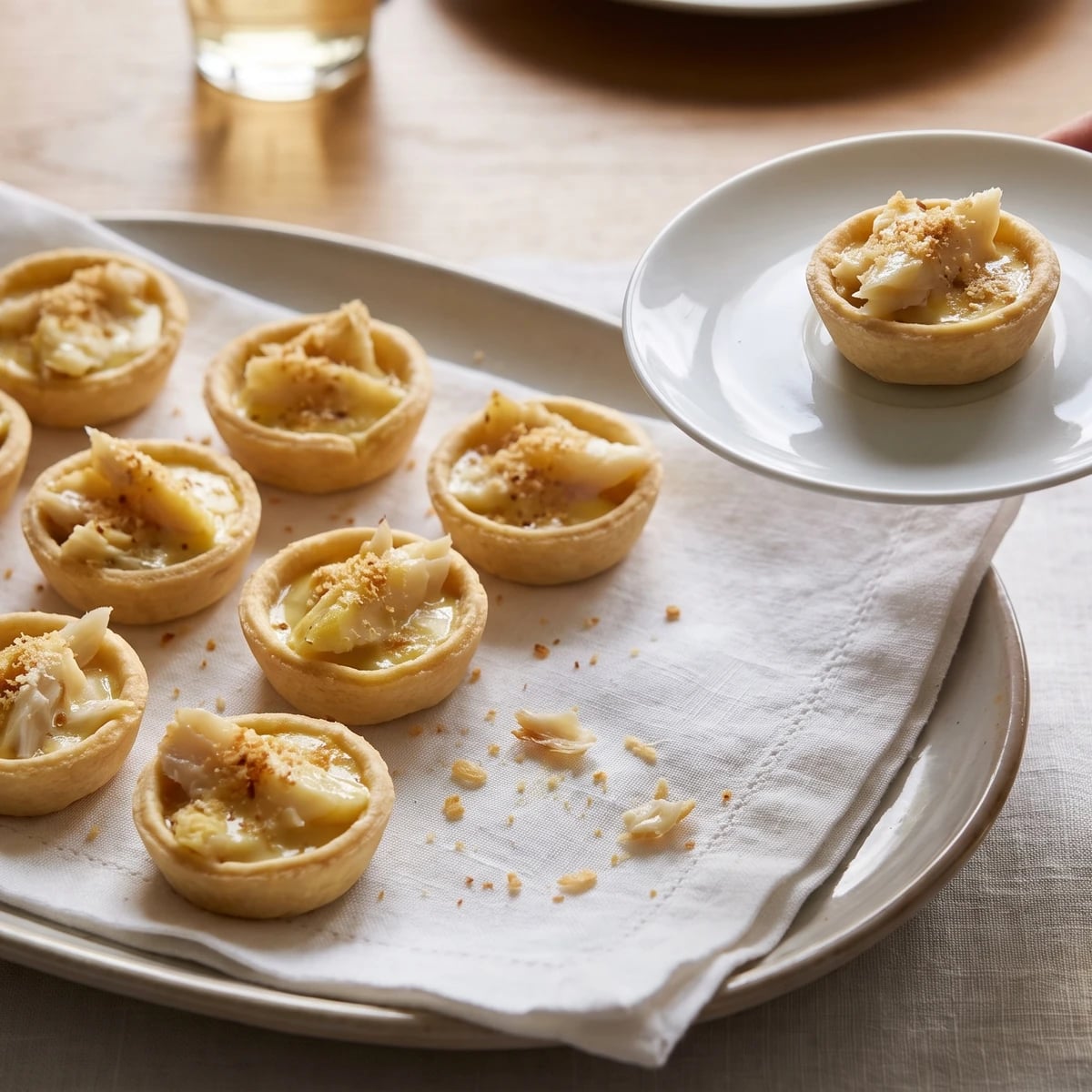
Pale shells, a firm smoked-haddock salpicon, and the quiet warmth of curry: twelve small tartlets that teach the essential discipline of keeping crisp pastry and moist filling apart until the last moment.
Tartelettes de Haddock (small smoked-haddock tartlets) teach one principle above all: crisp pastry and moist filling must meet as late as possible. The filling is a salpicon, small even dice cohered with sauce, and that sauce must cling to the fish rather than seep into the shell. Fill too early and the pastry softens. There is no flourish that can disguise it.
The brigade entry assumed colourlessly baked shells already waiting, poached haddock from one station, and curry sauce from the saucier. At home, the haddock's poaching milk becomes the liquid for a small roux-bound curry sauce, while twelve shallow tartlet moulds replace ranks of individual cases. The service quantity is cut to twelve and those separate jobs are arranged in sequence because they were brigade scaffolding. The pale shells, sauce-bound salpicon, fine raspings, and napkin service are the dish and remain. No stockpot or salamander is needed; the raspings are dusted on, not gratinated. One cook, one stove, one evening.
When the tartelettes are right, the shells are pale but crisp, the haddock stays in distinct smoky morsels, and the ivory sauce carries a quiet ochre warmth from the curry. The raspings give a final dry crunch under the teeth. Before you touch the first pan, remember the step that decides everything: make the filling thick, then fill the shells only at the last moment.
Tartelettes de Haddock belong to the Parisian grand-kitchen hors-d'oeuvre repertoire rather than to one French coastal region, using small pastry cases as edible vessels for a sauce-bound salpicon. In French culinary usage, haddock means smoked aiglefin, a northern fish brought through Channel and North Sea ports; curry powder entered the classical sauce cupboard and was softened with roux, milk, and cream. The folded napkin and fine raspings reflect formal service, but the late filling serves a practical purpose that matters just as much at home: it protects the pastry.
Quantity
1¼ cups (300 ml / 150 g)
Quantity
5 tablespoons plus 1 teaspoon (80 ml / 75 g)
diced
Quantity
¼ teaspoon (1.25 ml / 1.5 g)
Quantity
1
Quantity
2 tablespoons plus up to 1 teaspoon (35 ml / 35 g)
divided
Quantity
10½ ounces (300 g)
skinless and boneless
Quantity
1¼ cups (300 ml / 306 g)
Quantity
1 small (2 tablespoons / 30 ml / 30 g)
thinly sliced
Quantity
1
Quantity
2 tablespoons (30 ml / 28 g)
Quantity
3 tablespoons (45 ml / 24 g)
Quantity
1½ teaspoons (7.5 ml / 3 g)
Quantity
¼ cup (60 ml / 60 g)
Quantity
1 teaspoon (5 ml / 5 g)
Quantity
⅛ teaspoon (0.6 ml / 0.3 g)
Quantity
to taste
Quantity
¼ cup (60 ml / 18 g)
| Ingredient | Quantity |
|---|---|
| all-purpose flour | 1¼ cups (300 ml / 150 g) |
| cold unsalted butterdiced | 5 tablespoons plus 1 teaspoon (80 ml / 75 g) |
| fine sea salt | ¼ teaspoon (1.25 ml / 1.5 g) |
| large egg yolk | 1 |
| ice waterdivided | 2 tablespoons plus up to 1 teaspoon (35 ml / 35 g) |
| naturally smoked haddock filletskinless and boneless | 10½ ounces (300 g) |
| whole milk | 1¼ cups (300 ml / 306 g) |
| small shallotthinly sliced | 1 small (2 tablespoons / 30 ml / 30 g) |
| bay leaf | 1 |
| unsalted butter | 2 tablespoons (30 ml / 28 g) |
| all-purpose flour | 3 tablespoons (45 ml / 24 g) |
| mild curry powder | 1½ teaspoons (7.5 ml / 3 g) |
| heavy cream | ¼ cup (60 ml / 60 g) |
| fresh lemon juice | 1 teaspoon (5 ml / 5 g) |
| ground white pepper | ⅛ teaspoon (0.6 ml / 0.3 g) |
| fine sea salt | to taste |
| fine bread raspings, or very fine dry breadcrumbs | ¼ cup (60 ml / 18 g) |
Combine the flour and salt, then rub in the cold butter with your fingertips until the mixture resembles coarse sand with a few pea-sized flakes remaining. Add the yolk and 1½ tablespoons of the ice water, tossing rather than kneading; add the remaining water only until the dough holds when pressed. Give it one brief fraisage, smearing small portions forward with the heel of your hand to unite the butter and flour, then gather it into a disc. Wrap and chill for 30 minutes. If the dough crumbles after resting, work in cold water a few drops at a time. Ça se rattrape, but too much water makes a tough shell.
Heat the oven to 340°F (170°C). Roll the rested pâte brisée about ⅛ inch (3 mm) thick and cut twelve rounds large enough to line shallow 2½-inch (6 cm) tartlet moulds. Ease the pastry into the corners without stretching it, trim the rims, prick the bases lightly, and chill for 10 minutes. Line each shell with a small piece of parchment and dry rice or baking weights. Bake for 12 minutes, remove the weights, then bake for 4 to 6 minutes more, until the pastry is dry and pale straw rather than browned. Cool completely before unmoulding.
Put the milk, shallot, and bay leaf in a small heavy saucepan. Add the smoked haddock and bring the milk slowly to the barest tremble over medium-low heat. Cover, remove from the heat, and leave for 6 to 8 minutes, until the fish is opaque, flakes under gentle pressure, and reaches 145°F (63°C) at its thickest point. Lift out the haddock and let it cool on a plate. Strain the milk and reserve 1 cup (240 ml); this seasoned poaching milk is the home kitchen's foundation for the curry sauce.
Pass the bread raspings through a fine sieve, returning any coarse pieces to the grinder or grater. They should resemble a dry, fine dust rather than panko or fresh crumbs. Set them aside in a dry bowl; their job is to give the moist filling a crisp final surface without sending the tartlets back into the oven.
Melt the butter over low heat, add the curry powder, and stir for 30 seconds until fragrant without letting it darken. Add the flour and cook this pale roux for 2 minutes, stirring constantly. Whisk in the reserved poaching milk a little at a time, letting each addition become smooth before the next. Simmer gently for 4 to 5 minutes, then add the cream and cook until a spatula drawn across the pan leaves a path for two seconds. Remove from the heat and season with lemon juice and white pepper. Taste before adding salt because smoked haddock varies enormously. If the sauce lumps, take it off the heat, whisk in a spoonful of cold milk, and strain it. Ça se rattrape. If it runs from the spoon, simmer longer now; pastry must never be asked to thicken a loose sauce.
Cut the cooled haddock into roughly ⅓-inch (8 mm) dice, keeping the pieces as distinct as the fish allows. Fold them gently into the warm curry sauce so every morsel is coated without being crushed. The salpicon is ready when it mounds on a spoon and leaves no watery rim. If liquid appears, lift the fish out with a slotted spoon, reduce the sauce alone for a minute or two, then fold the fish back in. Let the filling stand for 5 minutes so it is warm rather than fiercely hot.
Set the cold, crisp shells on the serving platter and spoon the warm salpicon into them only when the guests are ready, dividing it evenly and mounding it just above each rim. Sprinkle every surface lightly with the fine raspings. Do not put the filled tartlets under a broiler or back into the oven; the source calls for a dusting, not a gratin, and further heat would soften the shells.
Arrange the tartelettes on a clean, lint-free linen napkin folded over a platter, which steadies the small shells and preserves the source's service. Bring them to the table within 10 minutes, while the pastry remains crisp and the filling warm. À table!
1 serving (about 230g)
Culinary guides, cultural storytelling, and the editorial depth that makes cooking meaningful.
Discover Culinary Explorer
Chef Juliette
Allumettes make one demand before the tray reaches the oven: reduce the Gruyère Béchamel until it holds on a knife, so the puff paste rises into butter-gold layers instead of soaking flat.

Chef Juliette
Beignets soufflés teach the discipline of moderate frying: tiny Gruyère-studded choux nubs must swell into airy hollows before their thin shells colour, giving a dinner party one crisp, generous mouthful after another.

Chef Juliette
Golden, crumbed cigars with a thick Béchamel and Gruyère heart, sealed in fine pâte à nouilles and fried at the last moment: a lesson in cold filling, close wrapping, and fearless heat.

Chef Juliette
Choux au fromage teach the discipline of drying pâte à choux: golden shells that sound hollow, filled with cayenne-warmed fondue au fromage and crowned with Parmesan Chantilly for a generous celebration tray.