Culinary Explorer

A cooking platform built around craft, culture, and the stories behind what we eat.
Discover Culinary Explorer
Tartelettes à l’Écossaise

Tartelettes à l’Écossaise

Created by Chef Juliette

Based on No. 2328, Tartelettes à l’Écossaise, from Le Guide Culinaire (1907) by Auguste Escoffier

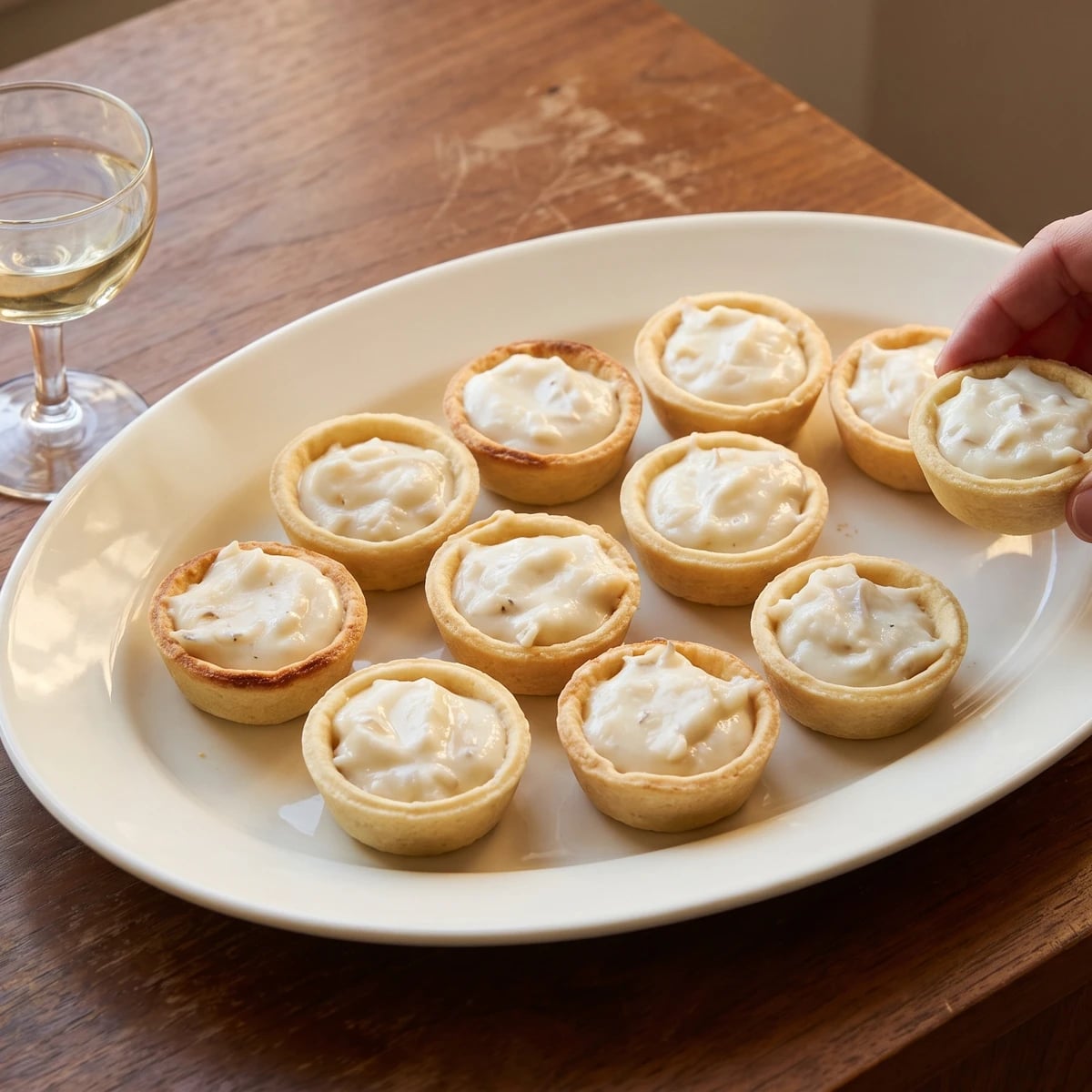
Blond pastry, smoky fish, and Béchamel in one composed bite: these tartlets teach the discipline of stopping the bake before color and filling only when the guests are ready.

Appetizers & Snacks
French
Dinner Party
Make Ahead
45 min
Active Time
35 min cook1 hr 50 min total
Yield12 small tartlets (4 appetizer servings)

Tartelettes à l’Écossaise (blond tartlets filled with smoked haddock purée) teach the discipline of pale pastry. The one true thing to know before touching a pan is this: the shells must become dry and crisp without becoming golden. Once the butter and flour begin to toast, they overpower the smoked fish, and darker edges soon taste bitter.

The original entry assumes tartlet cases from the pastry station, haddock purée passed through a mortar and tamis, and finished Béchamel waiting beside the saucier. It needs neither a perpetual stockpot nor a salamander, so a home cook shouldn't invent work for them. A small saucepan, a food processor, and twelve tartlet molds are the honest equivalents. I have changed the division of labor and scaled the service to twelve bites, not altered the dish's intent: smoked haddock remains the body, while Béchamel, the milk sauce built on a white roux, binds rather than buries it. One cook, one stove, one evening.

The separate brigade stations are scaffolding and can go. The pale shells, smooth haddock purée, measured Béchamel, and last-moment filling are the dish and must stay. Watch the shells closely once their weights come out; pull them when the bases feel dry and smell faintly of biscuit, before they take color.

Tartelettes à l’Écossaise belong to the French grand-kitchen hors-d’œuvre repertoire, particularly the formal dining rooms of Paris where small pastry cases carried warm, finely worked garnishes. French culinary nomenclature often uses national adjectives as shorthand, and Écossaise here points to smoked haddock associated with Scotland rather than claiming the tartlet as a Scottish household dish. The preparation passed readily to domestic dinner parties because its shells and filling could be made separately, then joined at the final moment without losing their contrast.

The technique, the tradition, and the story behind every dish.

Discover Culinary Explorer

Ingredients

all-purpose flour for the pastry

Quantity

1½ cups (360 ml / 180 g)

fine sea salt

Quantity

½ teaspoon (2.5 ml / 3 g)

cold unsalted butter

Quantity

6 tablespoons plus 1 teaspoon (95 ml / 90 g)

diced

large egg yolk

Quantity

1

ice water

Quantity

2 to 3 tablespoons (30 to 45 ml / 30 to 45 g)

softened unsalted butter

Quantity

1 teaspoon (5 ml / 5 g)

for the molds

undyed smoked haddock fillet

Quantity

9 ounces (250 g)

skin on and checked for bones

whole milk

Quantity

1¼ cups (300 ml / 310 g)

unsalted butter for the Béchamel

Quantity

1 tablespoon (15 ml / 15 g)

all-purpose flour for the Béchamel

Quantity

2 tablespoons (30 ml / 16 g)

ground white pepper

Quantity

⅛ teaspoon (0.6 ml / 0.3 g)

freshly grated nutmeg

Quantity

1 small pinch

fine sea salt (optional)

Quantity

only if needed

Equipment Needed

  • Twelve 6 cm or 2½-inch fluted tartlet molds
  • Rolling pin
  • Parchment or foil and baking beans
  • Small heavy-bottomed saucepan
  • Food processor
  • Fine-mesh sieve

Instructions

  1. 1

    Make the pâte brisée

    Combine the flour and salt, then work in the cold butter by sablage, rubbing it into the flour until the mixture resembles coarse sand with a few small flakes remaining. Stir in the yolk and 2 tablespoons of ice water. Press a handful together; if it crumbles, add the remaining water a teaspoon at a time. Gather the dough without kneading, flatten it into a disc, cover, and chill for 30 minutes. If it becomes greasy, stop and chill it before continuing. Ça se rattrape: cold restores the butter and prevents a tough, shrinking shell.

    Handle the dough only until it holds together. Kneading develops gluten, and gluten pulls a delicate tartlet down the sides of its mold.
  2. 2

    Line the molds

    Lightly butter twelve 6 cm or 2½-inch tartlet molds. Roll the chilled dough 2 to 3 mm thick and cut rounds wide enough to cover the bases and sides. Ease the pastry into each mold without stretching it, press it into the corners, and trim the rims cleanly. Prick each base twice with a fork, then chill the lined molds for 15 minutes while the oven heats to 170°C or 340°F.

  3. 3

    Bake without color

    Line each shell with a small piece of parchment or foil and add baking beans. Bake for 12 to 14 minutes, until the sides are set but still ivory. Remove the weights and liners, then bake for another 3 to 5 minutes, watching without distraction. The bases should feel dry and smell faintly of biscuit, not toasted butter. If the rims begin turning gold, cover them with narrow strips of foil and lower the oven by 10°C or 20°F; the shells can finish drying without darkening. Cool completely in their molds before lifting them out.

    Blond does not mean underbaked. A properly baked shell is dry underneath and releases cleanly, but remains pale enough to let the smoked haddock lead.
  4. 4

    Poach the haddock

    Put the smoked haddock in a shallow saucepan and pour over the milk. Bring the milk just to a tremble over medium-low heat, then cover, remove from the heat, and leave for 7 to 9 minutes. The fish is ready when its flakes separate under gentle pressure. Lift it out and strain the poaching milk through a fine sieve. Remove the skin and any remaining bones while the fish is warm. Do not boil it hard; boiling tightens the haddock and can catch the milk against the pan.

  5. 5

    Build the Béchamel

    Measure ⅔ cup (160 ml / 165 g) of the warm poaching milk, adding fresh milk if evaporation has left you short. Melt the butter in a small saucepan, stir in the flour, and cook this roux blanc, or white roux, for 2 minutes over low heat without allowing it to color. Add the warm milk gradually, whisking smooth after each addition. Simmer gently for 3 to 4 minutes, until the Béchamel is thick enough to hold a clear trail from the whisk. Season with white pepper and nutmeg. If it lumps, don't discard it. Ça se rattrape: whisk vigorously off the heat or pass it through the fine sieve. If it tightens too far, loosen it with a spoonful of poaching milk.

  6. 6

    Purée and bind

    Put the warm haddock in a food processor and pulse until finely broken down. Add the warm Béchamel a few spoonfuls at a time, processing briefly after each addition, until the purée is smooth, moist, and firm enough to hold a soft mound. You may not need every spoonful. The Béchamel coheres the haddock; it must not turn the filling into sauce. Taste before adding salt because smoked haddock varies enormously. If the purée seems dry or grainy, work in another spoonful of Béchamel. If it becomes loose, return it to low heat for a minute, stirring continuously, until it regains its body.

  7. 7

    Fill at service

    Keep the shells dry at room temperature and hold the purée warm over the gentlest heat. At the last moment, spoon or pipe a rounded tablespoon of haddock purée into each shell, allowing the filling to sit generously above the rim. Do not broil, glaze, or garnish them; the contrast of pale crisp pastry and soft smoked haddock is complete. Arrange on a platter and serve immediately. À table!

Chef Tips

  • Choose undyed smoked haddock. Its flesh should be naturally cream-colored rather than brilliant yellow, with a clean smoke aroma and enough firmness to flake after poaching.
  • Salt belongs at the very end. Some smoked haddock is gently cured and some could season the North Sea; taste the finished purée before reaching for the salt cellar.
  • Fill only when the platter is ready to leave the kitchen. Ten quiet minutes of waiting softens a small shell surprisingly quickly, while separate shells and filling remain obligingly stable.
  • Serve with a dry, mineral white such as Muscadet Sèvre-et-Maine or Chablis. The wine should clear the richness and respect the smoke, not compete with it.

Advance Preparation

  • The pâte brisée can be mixed up to two days ahead and kept covered in the cold. Let it soften only until it rolls without cracking.
  • Bake the shells up to eight hours ahead. Once completely cool, keep them airtight at room temperature. If they soften, return them to a 150°C or 300°F oven for 2 to 3 minutes, watching closely so they remain blond.
  • The haddock purée can be prepared one day ahead, covered, and refrigerated. Reheat it slowly with a spoonful of milk, stirring often. Keep the shells separate and fill them only as the platter goes to the table.

Frequently Asked Questions

Nutrition Information

1 serving (about 200g)

Calories
505 calories
Total Fat
27 g
Saturated Fat
16 g
Trans Fat
1 g
Unsaturated Fat
9 g
Cholesterol
160 mg
Sodium
780 mg
Total Carbohydrates
41 g
Dietary Fiber
1 g
Sugars
4 g
Protein
23 g

Note: Chef personas and recipes are created with AI assistance. Cook with care: follow safe food-handling practices, check doneness with a thermometer when needed, and adapt for allergies and your kitchen.

Where cooking meets culture.

Culinary guides, cultural storytelling, and the editorial depth that makes cooking meaningful.

Discover Culinary Explorer

More from Savouries

Browse the full collection