
Chef Juliette
Allumettes
Allumettes make one demand before the tray reaches the oven: reduce the Gruyère Béchamel until it holds on a knife, so the puff paste rises into butter-gold layers instead of soaking flat.
A cooking platform built around craft, culture, and the stories behind what we eat.
Created by Chef Juliette
Based on No. 2326, Scotch Woodcock, from Le Guide Culinaire (1907) by Auguste Escoffier
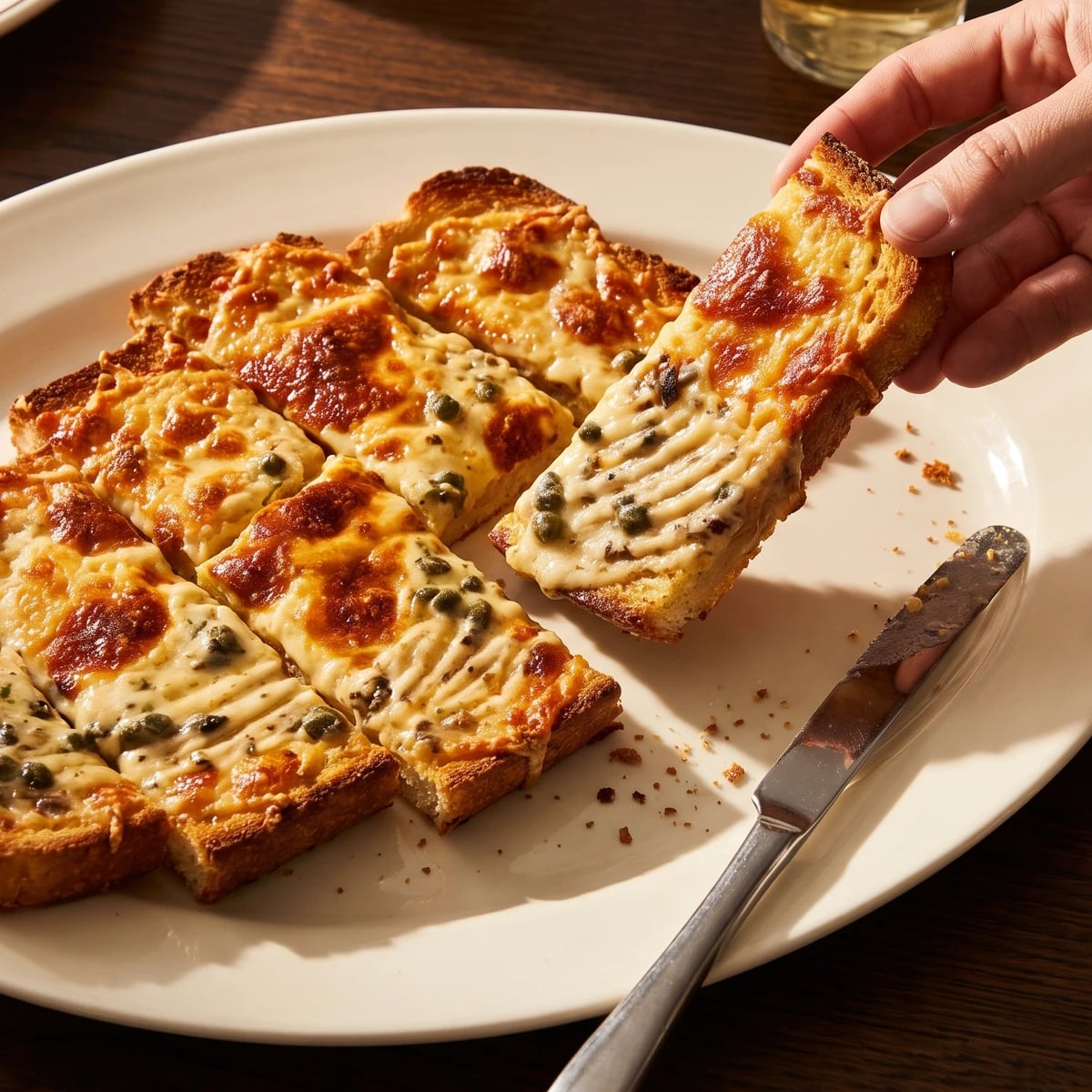
Thick English butter sauce sharpened with anchovy and capers, spread over crisp toast, buried under Parmesan, then glazed hard: a five-minute lesson in why the hottest finish must also be the fastest.
Bécasse à l’Écossaise (Scotch Woodcock, anchovy-and-caper toast) teaches the discipline of the glaze. The topping must be finished before it meets the bread, because the fierce final heat is there to bronze the Parmesan, not to thicken a loose sauce. Get that one truth into your hands and the dish becomes wonderfully direct.
The grand kitchen assumed a saucier with Sauce au Beurre à l’Anglaise (English butter sauce) already made, a stockpot never off the fire for the sauces that required it, and a salamander glowing above the finishing station. This particular sauce needs water, not stock, and tonight its honest equivalents are one small saucepan and your grill or broiler on its top shelf. The prepared sauce and dedicated station were brigade scaffolding, so they go. What stays, because it is the dish, is toast cut one-third inch thick, very thick butter sauce, plenty of capers and anchovy purée, Parmesan, a rapid glaze, and immediate cutting. Only the quantity and equipment have changed.
When it is right, each rectangle has a dry, crisp base under a thick ivory layer, salty with anchovy, bright with capers, and blistered bronze on top. Before you switch from saucepan to grill, make certain the sauce holds a clean ridge from the whisk. That thickness is the step that matters most. One cook, one stove, one evening.
Scotch Woodcock belongs to the English savoury course, the small, salty hot dish served after the main course or offered with drinks, not to Scottish game cookery. French grand kitchens absorbed such British savouries into their international repertoire, and this entry preserves a less familiar form made with very thick English butter sauce, capers, anchovy purée, and a Parmesan glaze. The name is culinary mischief, since no woodcock appears, and the familiar scrambled-egg version is a cousin rather than the preparation given here.
Quantity
4 large slices (about 7 oz / 200 g)
each 1/3 inch (8 mm) thick
Quantity
8 tablespoons (120 ml / 113 g)
divide into 3 tablespoons softened and 5 tablespoons cold and diced
Quantity
1/4 cup (60 ml / 30 g)
Quantity
3/4 cup (180 ml / 180 g), plus up to 2 tablespoons (30 ml / 30 g)
keep the additional water hot for loosening or rescuing the sauce
Quantity
1 teaspoon (5 ml / 5 g)
Quantity
3 tablespoons (45 ml / 30 g)
rinsed, drained very well, and roughly chopped
Quantity
2 tablespoons (30 ml / 30 g)
Quantity
1/2 cup (120 ml / 45 g)
finely grated
| Ingredient | Quantity |
|---|---|
| day-old white country breadeach 1/3 inch (8 mm) thick | 4 large slices (about 7 oz / 200 g) |
| unsalted butterdivide into 3 tablespoons softened and 5 tablespoons cold and diced | 8 tablespoons (120 ml / 113 g) |
| all-purpose flour | 1/4 cup (60 ml / 30 g) |
| boiling water (optional)keep the additional water hot for loosening or rescuing the sauce | 3/4 cup (180 ml / 180 g), plus up to 2 tablespoons (30 ml / 30 g) |
| fresh lemon juice | 1 teaspoon (5 ml / 5 g) |
| capers in brinerinsed, drained very well, and roughly chopped | 3 tablespoons (45 ml / 30 g) |
| anchovy purée | 2 tablespoons (30 ml / 30 g) |
| Parmesanfinely grated | 1/2 cup (120 ml / 45 g) |
Set the grill or broiler rack 3 to 4 inches (8 to 10 cm) below the element and heat it fully for at least 10 minutes. This is your salamander, and the top shelf matters: glacer, to glaze quickly under fierce overhead heat, should take less than two minutes. Line a rimmed baking sheet with foil, not parchment, which can scorch so close to the element. Grate the Parmesan finely, chop the well-dried capers, and keep the extra boiling water beside the stove.
Lay the bread on the prepared sheet and toast it under the grill until deep gold on the first side, about 60 to 90 seconds. Turn and toast the second side until dry and crisp at the surface but not burned, another 45 to 75 seconds. Watch continuously, since overhead heat moves from gold to black with very little ceremony. Set the toast aside on the sheet while you make the sauce.
Work the softened 3 tablespoons of butter and the flour together until completely smooth. This is a beurre manié, flour kneaded into butter, and any dry pockets left now become lumps later. Bring the 3/4 cup boiling water to a full simmer in a small heavy saucepan, then whisk in the beurre manié a little at a time. Simmer gently for 2 minutes, whisking, until the flour tastes cooked and the sauce is thick enough that a whisk drawn through it leaves a furrow that closes slowly. If it lumps, take it off the heat and whisk hard; if stubborn specks remain, press it through a fine sieve. Ça se rattrape.
Whisk the lemon juice, chopped capers, and anchovy purée into the thickened base and let it bubble gently for 30 seconds. Do not add salt, since the anchovy, capers, and Parmesan carry plenty. If the sauce is loose, reduce it now, before adding the remaining butter. Take the pan completely off the heat and whisk in the 5 tablespoons of cold diced butter, one piece at a time, until the sauce is glossy, very thick, and fully emulsified. Do not boil it again. If it turns greasy, stop adding butter, whisk 1 tablespoon of the reserved boiling water in a clean warm bowl, then whisk the broken sauce into it one spoonful at a time. Ça se rattrape. If the finished sauce becomes too stiff to spread, loosen it with reserved hot water one teaspoon at a time.
Divide the hot sauce among the four toast slices and spread it right to the edges in a generous layer about 1/4 inch (6 mm) thick. Sprinkle the Parmesan evenly over every bit of sauce. Slide the sheet onto the top rack and glacer for 45 to 90 seconds, just until the cheese melts, bubbles at the edges, and takes dark golden spots. Do not step away. The sauce is already cooked and the bread already crisp, so lingering under the heat only splits the butter and burns the toast.
Move each glazed toast swiftly to a board and cut it crosswise into three small rectangles with a sharp knife, using clean downward strokes so the topping stays in place. Arrange the pieces immediately on a warmed platter and carry them straight to the table. Scotch Woodcock waits for nobody, and waiting is the only reliable way to spoil it. À table!
1 serving (about 145g)
Culinary guides, cultural storytelling, and the editorial depth that makes cooking meaningful.
Discover Culinary Explorer
Chef Juliette
Allumettes make one demand before the tray reaches the oven: reduce the Gruyère Béchamel until it holds on a knife, so the puff paste rises into butter-gold layers instead of soaking flat.

Chef Juliette
Beignets soufflés teach the discipline of moderate frying: tiny Gruyère-studded choux nubs must swell into airy hollows before their thin shells colour, giving a dinner party one crisp, generous mouthful after another.

Chef Juliette
Golden, crumbed cigars with a thick Béchamel and Gruyère heart, sealed in fine pâte à nouilles and fried at the last moment: a lesson in cold filling, close wrapping, and fearless heat.

Chef Juliette
Choux au fromage teach the discipline of drying pâte à choux: golden shells that sound hollow, filled with cayenne-warmed fondue au fromage and crowned with Parmesan Chantilly for a generous celebration tray.