
Chef Juliette
Smelt (Éperlans)
Tiny éperlans, lightly floured and fried until their tails stand crisp, arrive in a generous heap on a napkin with fried parsley and grooved lemon, a weeknight lesson in heat and restraint.
A cooking platform built around craft, culture, and the stories behind what we eat.
Created by Chef Juliette
Based on No. 2314, Delices de Foie Gras, from Le Guide Culinaire (1907) by Auguste Escoffier
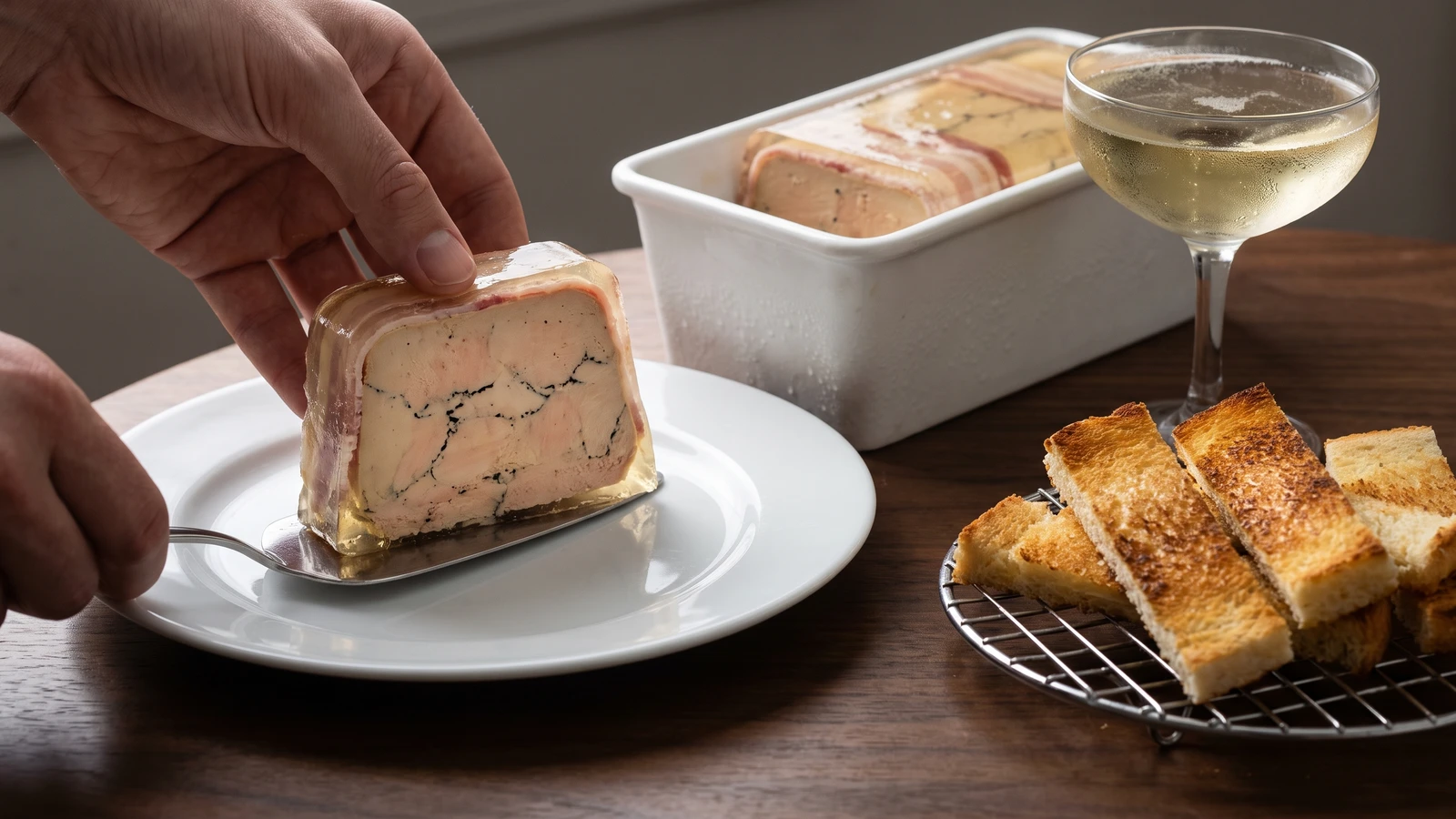
Foie gras studded with Périgord truffle, gently poached in dry Champagne aspic, then served very cold beside fiercely hot toast. Master the temperature, and this formal dish becomes perfectly possible at home.
Délices de Foie Gras (foie gras set in Champagne aspic) teaches the discipline of temperature. The foie must poach, never boil, and the finished slice must arrive very cold while the toast arrives fiercely hot. That contrast is not decoration. It is the dish.
The original entry assumed a saucier making spotless aspic from a stockpot never off the fire, a larding needle for the truffle, a basin sized for service, and a salamander waiting to color the bread. At home, clear chicken stock reinforced with gelatin, a thin skewer, a small porcelain terrine, and the broiler do the same honest work. The full consommé clarification and brigade volume are scaffolding and can go. The bacon barding, truffle, Champagne aspic, long cold rest, and last-minute toast stay because they are the dish. One cook, one stove, one evening of work, then the cold does the rest.
Once set, the pale foie carries black seams of truffle beneath clear amber jelly, with just enough dry wine to cut its richness. Watch the center temperature rather than the clock. A quiet bain-marie keeps the foie whole and supple; boiling renders its fat into the jelly and takes away the clean contrast you came for.
Délices de foie gras belongs to the formal French table, built from the foie gras of Gascony and Périgord and the black truffles of Périgord rather than from one village recipe. The Champagne aspic is grand-kitchen technique laid over southwestern ingredients, using clear, wine-scented jelly to preserve the foie and sharpen its richness. It is not a pâté: the seasoned liver remains whole, visibly truffled and bacon-barded, then is poached and chilled in its cooking jelly.
Quantity
1 large lobe (about 12 oz / 340 g)
cold and gently deveined
Quantity
1 small (about ½ oz / 15 g)
drained and cut into slender batons
Quantity
1½ teaspoons (7.5 ml / 9 g)
divided
Quantity
¼ teaspoon (1.25 ml / 0.5 g)
Quantity
4 thin slices (about 3 oz / 85 g)
Quantity
1½ cups (360 ml / 360 g)
cold
Quantity
½ cup (120 ml / 120 g)
Quantity
1 tablespoon plus 2 teaspoons (25 ml / 15 g)
Quantity
8 thin slices (about 7 oz / 200 g)
crusts removed
Quantity
6 cups (1.4 L / 1.4 kg), plus more if needed
for the bain-marie
| Ingredient | Quantity |
|---|---|
| fresh duck or goose foie grascold and gently deveined | 1 large lobe (about 12 oz / 340 g) |
| black Périgord truffle, fresh or whole preserveddrained and cut into slender batons | 1 small (about ½ oz / 15 g) |
| fine sea saltdivided | 1½ teaspoons (7.5 ml / 9 g) |
| finely ground white pepper | ¼ teaspoon (1.25 ml / 0.5 g) |
| unsmoked fatty bacon or fresh pork fatback | 4 thin slices (about 3 oz / 85 g) |
| very clear unsalted chicken stockcold | 1½ cups (360 ml / 360 g) |
| brut Champagne | ½ cup (120 ml / 120 g) |
| powdered gelatin | 1 tablespoon plus 2 teaspoons (25 ml / 15 g) |
| pain de mie, fine white sandwich loafcrusts removed | 8 thin slices (about 7 oz / 200 g) |
| boiling waterfor the bain-marie | 6 cups (1.4 L / 1.4 kg), plus more if needed |
Let the cold foie stand for about 15 minutes, just until it bends without cracking. Ease the lobe open along its natural seams and draw out the large veins with the tip of a small knife, disturbing the flesh as little as possible. If it tears, press the pieces back together firmly; its own fat and the bacon will bind them during cooking. Rub every surface with ¾ teaspoon of the salt and all the white pepper. Make slender channels through the thickest parts with a metal skewer, slide in the truffle batons, then reform the lobe, cover, and chill for 30 minutes.
If the stock carries visible fat or sediment, chill it, lift off the fat, and pass it through a damp coffee filter before measuring. Put ½ cup of the cold stock in a small saucepan, scatter the gelatin evenly over it, and leave it for 10 minutes to swell. Add the remaining stock, the Champagne, and the remaining ¾ teaspoon salt. Warm gently, stirring, until the gelatin disappears completely and the liquid reaches about 60°C / 140°F. Never boil it. If beads of gelatin remain, take the pan off the heat for five minutes, warm it again, and strain; ça se rattrape. A spoonful chilled on a cold saucer should set firmly enough to hold a clean edge.
Set the seasoned foie snugly in a 1-quart porcelain terrine or small loaf pan. Cover the lobe with the slices of unsmoked bacon, overlapping them so no foie is exposed. Pour the warm Champagne aspic slowly down the side of the mold until it rises about ½ inch above the bacon. Reserve any excess aspic, covered and barely warm, in case the level needs topping up after cooking. Cover the terrine with its lid or a tight double layer of foil.
Heat the oven to 275°F / 135°C. Set the terrine in a deep roasting pan and pour in enough hot water to come halfway up its sides, making a bain-marie, or water bath. Cook for 20 minutes, then begin checking the center with a digital probe. Remove the terrine when the foie reaches 63°C / 145°F, usually after 25 to 35 minutes, and let it stand covered for three minutes. The surrounding aspic should barely quiver. If the water begins bubbling, replace a cup of it with cool water at once. If the foie runs hotter and sheds more fat, don't discard it; the result will be firmer, but the fat can be cleared after chilling.
Lift the terrine from the bain-marie and uncover it. If the foie is no longer fully covered, add enough reserved warm aspic to restore the layer above it. Let the mold stand for 15 minutes, then set it in ice water reaching halfway up the sides, taking care that none enters the dish. Once the mold no longer feels warm, dry it, cover it tightly, and refrigerate for a full 24 hours. This rest is not brigade scaffolding. It sets the aspic, firms the foie for clean slicing, and lets the truffle perfume move through the liver.
Keep the terrine cold while you clear its surface. First lift away the solidified foie fat with the edge of a chilled teaspoon, taking shallow passes so you don't gouge the aspic. Fill a heatproof jug with boiling water, warm a broad metal spoon in it, dry the spoon, and sweep it lightly over the last thin veil of grease. Wipe and rewarm the spoon between passes. Do not pour boiling water into the cold terrine. If the spoon marks the jelly, one final warm pass will level it; refrigerate for 20 minutes until glassy again.
Put the cold terrine on a chilled serving plate and keep it refrigerated while the broiler heats fully. Arrange the pain de mie on a tray and broil close to the heat until deep gold and crisp, about 45 to 90 seconds per side. Watch continuously; this is the home salamander, and it works quickly. Bring the Délices de Foie Gras to the table in its basin, exactly as it set, with a knife dipped in hot water and dried for clean slices. Pass the toast at once, crisp and fiercely hot against the very cold foie and aspic. À table!
1 serving (about 250g)
Culinary guides, cultural storytelling, and the editorial depth that makes cooking meaningful.
Discover Culinary ExplorerChef Juliette
Tiny éperlans, lightly floured and fried until their tails stand crisp, arrive in a generous heap on a napkin with fried parsley and grooved lemon, a weeknight lesson in heat and restraint.

Chef Juliette
Brandade de Morue turns salt cod, warm olive oil, and milk into a pale, silky emulsion: keep everything warm and add the oil slowly, then crown the generous dome with butter-fried bread.

Chef Juliette
Salt cod worked warm with cream, one patient spoonful at a time, until the rough flakes become a glossy Nîmes paste, domed generously and ringed with butter-fried croutons for the table.

Chef Juliette
Wine-poached char packed in its earthenware crock beneath butter gold: a make-ahead first course that turns careful cooling, thorough boning, and one unbroken seal into quiet abundance.