
Chef Juliette
Smelt (Éperlans)
Tiny éperlans, lightly floured and fried until their tails stand crisp, arrive in a generous heap on a napkin with fried parsley and grooved lemon, a weeknight lesson in heat and restraint.
A cooking platform built around craft, culture, and the stories behind what we eat.
Created by Chef Juliette
Based on No. 2300, Beignets Soufflés with Cheese, from Le Guide Culinaire (1907) by Auguste Escoffier
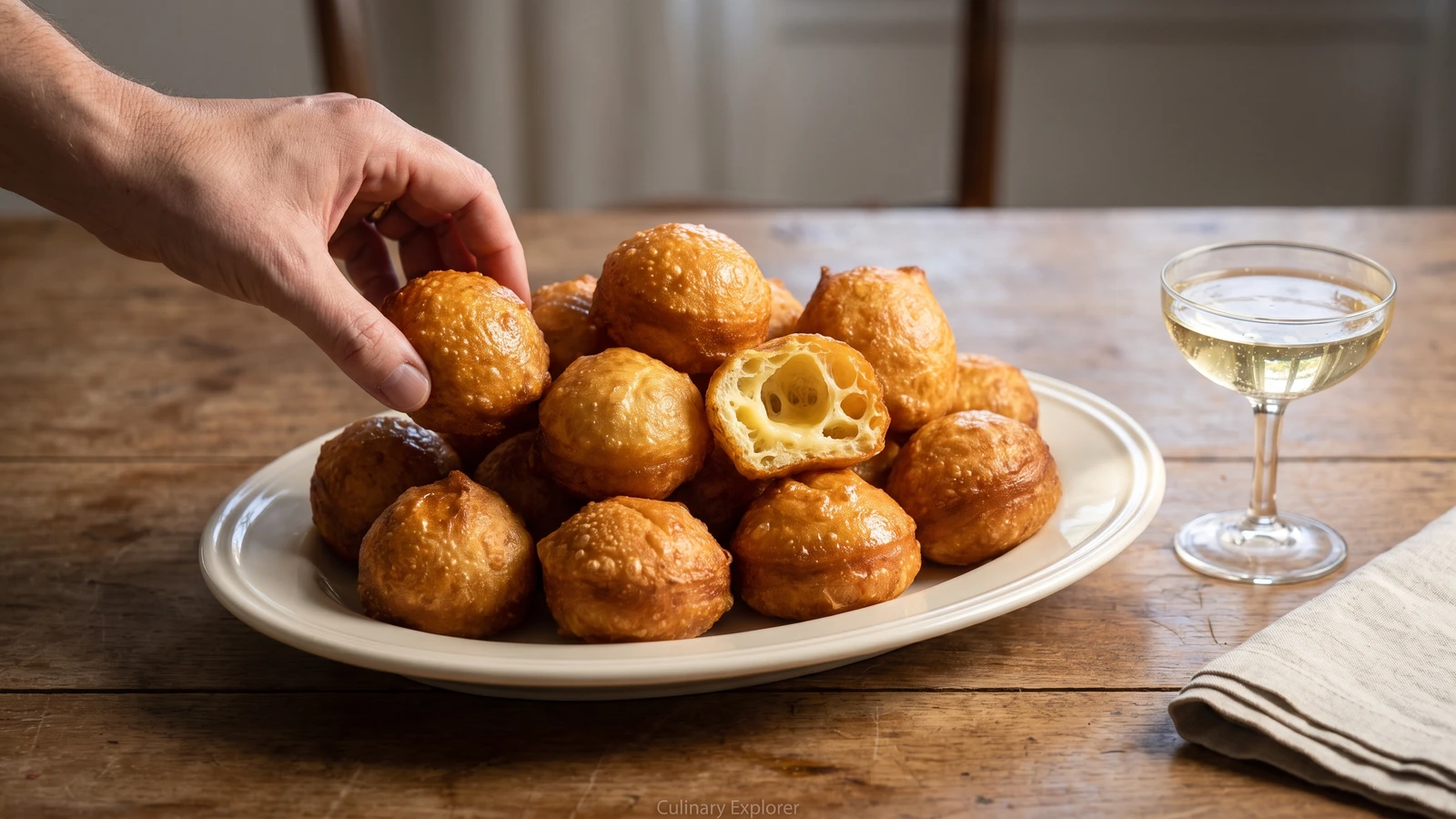
Beignets soufflés teach the discipline of moderate frying: tiny Gruyère-studded choux nubs must swell into airy hollows before their thin shells colour, giving a dinner party one crisp, generous mouthful after another.
Beignets soufflés au fromage (cheese-puffed fritters) teach one true thing: the frying fat must be moderate. Too hot and the shell colours before the pâte à choux can swell hollow; too cool and the paste drinks fat instead of rising. Soufflé here names that generous swelling. No separately whisked egg whites are involved.
The source worked by the pound, with a deep pan of frying fat already holding its temperature and spare hands shaping each batch. There is no saucier, permanent stockpot, or salamander to replace here. Its real brigade assumptions were scale and constant service. For one cook, one stove, one evening, half a pound of paste becomes 227 grams, and its five-ounce cheese addition becomes 71 grams, preserving the original 5:16 ratio exactly. An 18 cm saucepan and two teaspoons do the rest. The broad frying pan and brigade quantity were scaffolding; the brunoise, nut-sized portions, cheese ratio, and patient frying are the dish.
Watch the first beignet before committing the batch. It should float, turn, and swell while still pale, then colour only after its center has opened. If the crust races ahead, lower the temperature before adding another. Ça se rattrape.
Beignets soufflés belong to the Parisian grand-kitchen hors-d'oeuvre repertory, where unsweetened pâte à choux crossed from the pastry bench into savory frying. Their kinship with Burgundy's gougères is real but incomplete: gougères are baked, while these beignets depend on moderate frying fat to inflate a hollow center before the shell colours. The hazelnut-sized portion and brunoise of Gruyère turned a large working paste into a hot bite meant to travel directly from pan to table.
Quantity
1 cup (240 ml / 227 g)
held at its unsweetened pâte à choux stage before the usual Gruyère addition
Quantity
1/2 cup (120 ml / 71 g)
cut into 3 mm brunoise
Quantity
5 cups (1.2 L / 1.1 kg)
enough for a 5 cm depth
| Ingredient | Quantity |
|---|---|
| Ramequins and Gougère Paste (No. 2375)held at its unsweetened pâte à choux stage before the usual Gruyère addition | 1 cup (240 ml / 227 g) |
| fresh Gruyèrecut into 3 mm brunoise | 1/2 cup (120 ml / 71 g) |
| neutral frying oilenough for a 5 cm depth | 5 cups (1.2 L / 1.1 kg) |
Cut the cold Gruyère into a 3 mm brunoise, meaning very small, even dice. Keep the pieces distinct rather than grated or crushed; these little cubes soften inside the beignets without disappearing into the paste. If they are much larger, they weigh down the rise and can burst through the shell. Return the diced cheese to the cold while you arrange the frying station.
Put the Ramequins and Gougère Paste (No. 2375) into a bowl at its completed unsweetened pâte à choux stage, before that formula's usual Gruyère addition. Fold in the measured brunoise just until evenly dispersed, preserving this entry's ratio of 71 grams cheese to 227 grams paste. The mixture should sit in a soft mound on a spoon. If it slumps flat and cannot hold a hazelnut-sized nub, chill it for 10 to 15 minutes. Don't add flour, which would make the beignets heavy. Ça se rattrape.
Pour the oil into an 18 cm heavy, high-sided saucepan to a depth of about 5 cm, making certain the pan is no more than half full. Heat it to 160°C. Keep the thermometer clear of the pan floor so it reads the oil, not the metal. Moderate fat is the principle inside the method: the paste needs time to expand before its shell sets and colours.
Lightly dip two teaspoons in the warm oil, then use them to shape one scant teaspoon of paste into a rough 1.5 cm nub, about the size of a hazelnut. Ease it into the oil away from you. It should sink briefly, float, rotate, and swell to several times its size over 4 to 5 minutes, remaining pale for most of that time before turning an even light gold. Drain it for a minute and split it: the center should be hollow and lightly webbed, with no wet paste. If it browns before swelling, lower the oil to 155°C; if it stays leaden and greasy, restore the oil to 160°C before continuing.
Shape and fry 6 to 8 beignets at a time, never more, because crowding drops the temperature. Turn any stubborn ones gently with a wire skimmer so every side meets the fat. Hold the oil between 155°C and 165°C and allow each batch 4 to 5 minutes. Let the temperature recover fully between batches. Lift the beignets onto a wire rack rather than piling them on paper, which traps moisture against their crisp undersides.
Serve the beignets as soon as the last batch drains, heaped generously on a warm platter with no garnish required. If the first batch must wait, keep it uncovered on its rack in a 95°C oven for no more than 10 minutes. Covering them softens the shells, and a long wait steals the proud hollow rise you worked for. À table!
1 serving (about 75g)
Culinary guides, cultural storytelling, and the editorial depth that makes cooking meaningful.
Discover Culinary ExplorerChef Juliette
Tiny éperlans, lightly floured and fried until their tails stand crisp, arrive in a generous heap on a napkin with fried parsley and grooved lemon, a weeknight lesson in heat and restraint.

Chef Juliette
Brandade de Morue turns salt cod, warm olive oil, and milk into a pale, silky emulsion: keep everything warm and add the oil slowly, then crown the generous dome with butter-fried bread.

Chef Juliette
Salt cod worked warm with cream, one patient spoonful at a time, until the rough flakes become a glossy Nîmes paste, domed generously and ringed with butter-fried croutons for the table.

Chef Juliette
Wine-poached char packed in its earthenware crock beneath butter gold: a make-ahead first course that turns careful cooling, thorough boning, and one unbroken seal into quiet abundance.