Chef Juliette
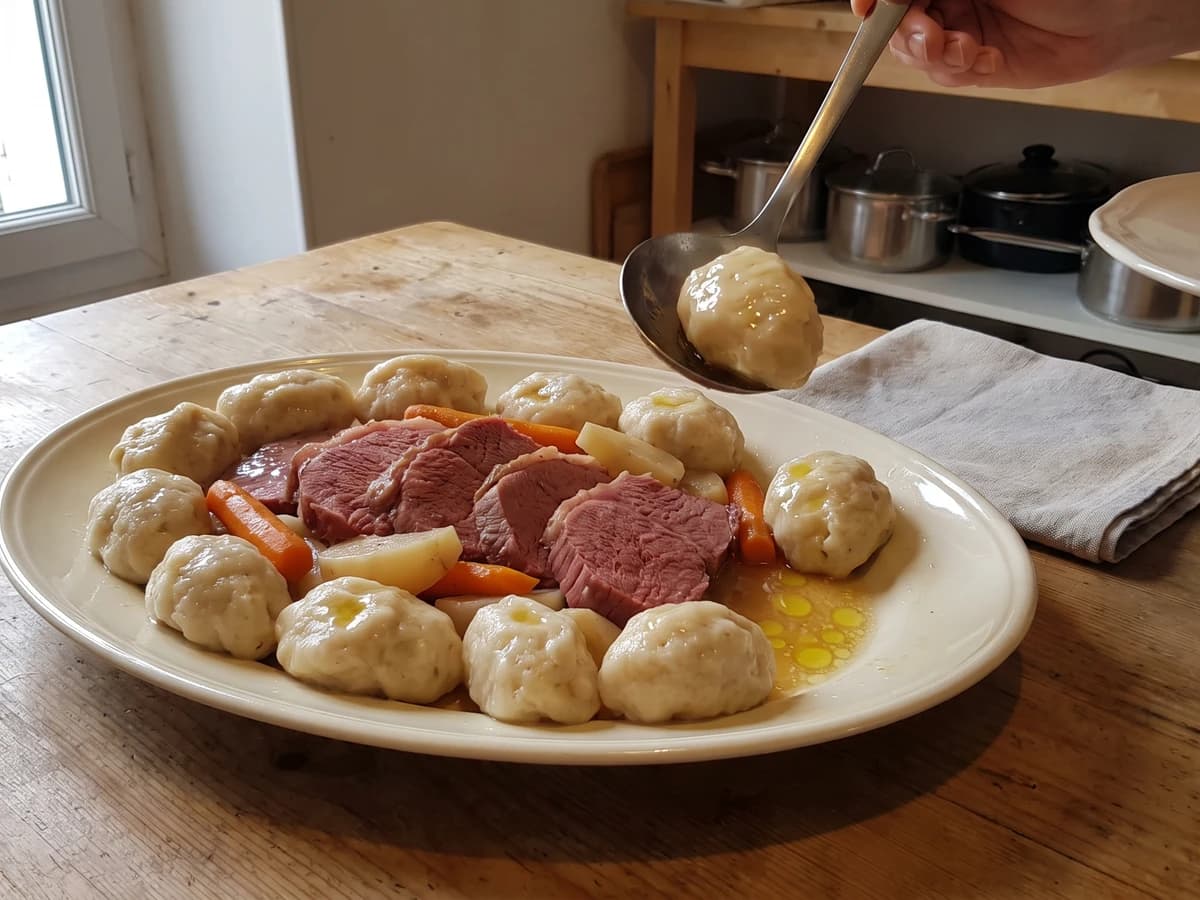
Suet Dumpling
Boulettes au suif, poached beside salt beef, turn equal weights of flour and finely chopped suet into tender, rich dumplings. Keep the beef liquor at a bare tremble and the old garnish works beautifully at home.
A cooking platform built around craft, culture, and the stories behind what we eat.

Created by Chef Juliette
Based on No. 2171, Soufflé de Maïs au Paprika, from Le Guide Culinaire (1907) by Auguste Escoffier
Soufflé de Maïs au Paprika turns a buttered corn purée into six light, bronzed cassolettes, with sweet onion and paprika carried through every spoonful beside a generous poached bird.
Soufflé de Maïs au Paprika (paprika corn soufflé) teaches the one rule behind every hot soufflé: flavor lives in the base, lift lives in the whites, and once they meet, the oven must already be waiting. Here the base is sweet maize sharpened by onion fried in butter and a generous pinch of paprika, then passed fine enough that each spoonful feels light rather than husky.
The source assumed a tammy, a firm professional oven, and enough brigade hands to fry the onion, dry the purée, beat the whites, and fill the moulds without pause. This isn't a sauce-driven dish: it asks for no saucier, no stockpot kept simmering, and no salamander. At home, a fine-mesh sieve replaces the tammy, an electric mixer supplies the second pair of hands, and six cassolettes (small straight-sided baking dishes) turn a service garnish into six generous portions. The linked Soufflé de Maïs à la Crème (No. 2170) remains whole and keeps its one-pound purée ratio; only the equipment and batch size have changed. The brigade's division of labor was scaffolding. Butter-frying the onion, adding the paprika before sieving, drying the purée, folding the whites, and baking at once are the dish.
When they are right, the tops stand butter-gold and lightly coppered by paprika, while the interiors remain tender, savory, and unmistakably maize. If the purée is loose enough to flow back across the pan, don't fold the whites into it. Dry it until a spoon leaves a clean trail, because that concentration is the one step that decides the rise.
Soufflé de Maïs au Paprika belongs to the Parisian classical garnish repertoire rather than to one French region, a small hot accompaniment built to sit beside a large poached fowl. Maize may call the southwest of France to mind, but passing its purée through a tammy, enriching it with cream and yolks, then lifting it with whites is the grammar of the grand kitchen. Paprika shows the canon borrowing intelligently from Central European larders, and the choice of a timbale or individual cassolettes confirms that this was conceived as a savory garnish, not a sweet corn pudding.
Quantity
1 home-scale batch Soufflé de Maïs à la Crème (No. 2170), scaled on 2 cups (475 ml / 454 g) sieved maize purée and prepared only through cooking the maize
Quantity
2 tablespoons (30 ml / 20 g)
finely chopped
Quantity
2 tablespoons (30 ml / 28 g)
softened and divided
Quantity
1/4 teaspoon (1.25 ml / 0.6 g)
Quantity
Up to 1 tablespoon (15 ml / 15 g)
only if needed for sieving
| Ingredient | Quantity |
|---|---|
| Soufflé de Maïs à la Crème base | 1 home-scale batch Soufflé de Maïs à la Crème (No. 2170), scaled on 2 cups (475 ml / 454 g) sieved maize purée and prepared only through cooking the maize |
| yellow onionfinely chopped | 2 tablespoons (30 ml / 20 g) |
| unsalted buttersoftened and divided | 2 tablespoons (30 ml / 28 g) |
| sweet paprika | 1/4 teaspoon (1.25 ml / 0.6 g) |
| water (optional)only if needed for sieving | Up to 1 tablespoon (15 ml / 15 g) |
Heat the oven to 400°F (200°C conventional, 180°C fan), allowing it to come fully to temperature. Use half the softened butter to coat six 6-ounce (180 ml) cassolettes, brushing from the base upward so the mixture has a clean path to climb. Arrange them on a rimmed baking sheet and keep the oven door closed.
Begin the Soufflé de Maïs à la Crème (No. 2170), scaled on its one-pound purée ratio, and stop once the maize is cooked and still hot, before it reaches the tammy. Set a fine-mesh sieve over a bowl and have a flexible scraper ready. The tammy was the brigade's tool; the sieve performs the same work at home, only in smaller batches.
Melt the remaining butter in a small skillet over medium-low heat. Add the chopped onion and fry gently for 6 to 8 minutes, stirring often, until completely soft and translucent but not browned. Pull the skillet from the heat, stir in the paprika for about 10 seconds, then scrape the onion, butter, and every trace of paprika into the hot cooked maize. Warm butter opens the paprika's aroma; hard heat makes it bitter.
Work the maize, onion, and paprika through the fine sieve in small batches while the mixture remains hot. Press firmly with the scraper and collect the smooth purée from the underside, leaving the fibrous skins behind. Weigh out 1 pound (454 g). If the mixture cools and refuses to pass, warm it gently with no more than the optional tablespoon of water, then try again. Ça se rattrape: the added moisture will leave during the drying step.
Return the sieved purée to the sequence in Soufflé de Maïs à la Crème (No. 2170) and complete that preparation from its drying step onward, leaving every linked proportion unchanged. Dry the purée until a spoon drawn across the pan exposes the bottom for a full second and the mixture gathers into a soft mound. If it flows back immediately, keep stirring over gentle heat before enriching it. If it becomes crumbly, loosen it with a teaspoon of the cream allotted by Soufflé de Maïs à la Crème (No. 2170). Once the egg whites have been folded in, don't whisk, stir, or wait.
Divide the finished mixture among the buttered cassolettes, filling each about three-quarters full. Level the tops lightly without pressing out the air, then run a clean fingertip around each inner rim. Bake immediately for 16 to 20 minutes without opening the door during the first 14 minutes. They are ready when the crowns stand high and deep gold, the edges are set, and the centers yield softly without a liquid shine. If the centers prove wet and sink as the tray comes out, return them at once for 2 to 3 minutes; they will regain enough lift to serve proudly.
Carry the cassolettes directly to the table and serve them beside a large poached fowl. A hot soufflé will ease down as it waits, which is its nature, not a failure. Bring the bird first, then the cassolettes. One cook, one stove, one evening. À table!
1 serving (about 115g)
Culinary guides, cultural storytelling, and the editorial depth that makes cooking meaningful.
Discover Culinary ExplorerChef Juliette
Boulettes au suif, poached beside salt beef, turn equal weights of flour and finely chopped suet into tender, rich dumplings. Keep the beef liquor at a bare tremble and the old garnish works beautifully at home.

Chef Juliette
Bread, flour, frangipane, and rice become four cool, supple panades for binding forcemeats, each changing body and flavor while preserving tenderness. The finest Mousselines need none, and knowing that distinction is the lesson.

Chef Juliette
Panade au pain is bread, milk, salt, heat, and attention: stir until the paste releases cleanly, butter it against a skin, and you have the quiet binder behind tender French farces.

Chef Juliette
Panade de farine teaches the drying stroke behind pâte à choux: flour meets boiling buttered water, then stays over the fire until the paste gathers, smooths, and quits the pan cleanly.