
Chef Juliette
Haricots Blancs à l’Américaine (Lima Beans)
Lima beans, lean bacon, and tomato sauce show the quiet discipline of binding: cook the beans gently, drain them thoroughly, and coat each one until glossy, never soupy.
A cooking platform built around craft, culture, and the stories behind what we eat.
Created by Chef Juliette
Based on No. 2170, Soufflé de Maïs à la Crème, from Le Guide Culinaire (1907) by Auguste Escoffier
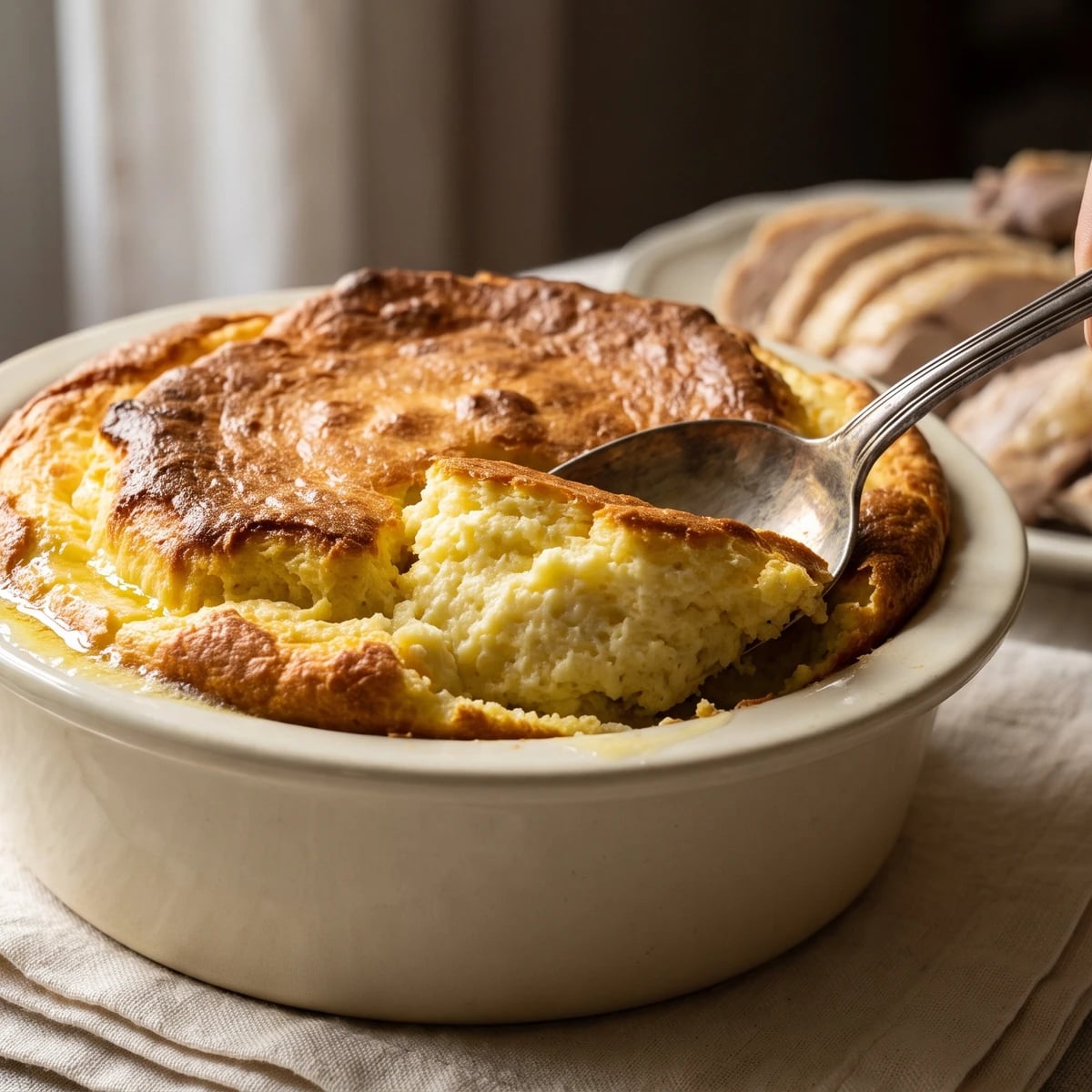
A savory corn soufflé with a fine, creamy crumb and bronzed crown, built on dried maize purée and four whites: the classical poultry garnish that proves moisture control makes the rise.
Soufflé de Maïs à la Crème (creamed maize soufflé) teaches one true thing before you touch a pan: a soufflé rises only when its base has enough body to hold air. Here the maize must be cooked, passed fine, and dried in butter before the cream goes near it. Leave water in the purée and the four whites can lift nothing.
The grand kitchen around the original entry assumed a saucier on staff, stock never off the fire, and a salamander at hand, though this spare preparation calls on none of them. It did assume a tammy, a fine drum sieve, and a cook ready to send the moulded soufflé beside poached fowl at its precise moment. A food processor followed by a sturdy fine-mesh sieve is the honest home equivalent, and an ordinary oven supplies both lift and color. The tammy is brigade scaffolding. Fine sieving, quick drying, and the ratio of three yolks to four whites for each pound of purée are the dish, so those stay.
Done well, the Soufflé de Maïs à la Crème arrives butter-gold and high, with a tender center that tastes clearly of maize and fresh cream rather than egg. Dry the purée until the spatula leaves a clean track. That is the step that decides the rise; after it, you need only calm folding and prompt service. One cook, one stove, one evening.
Soufflé de Maïs à la Crème belongs to the Parisian grand-kitchen repertory of vegetable garnishes, where it was sent beside poached fowl rather than offered as a sweet course. French cooks absorbed maize, a crop from the Americas, into the classical system by sieving it to a fine purée, drying it in butter, and enriching it with cream and eggs. The useful correction is in the name: soufflé describes a family of light preparations, with hot versions usually lifted by egg whites and cold versions by whipped cream, not a category reserved for dessert.
Quantity
4 cups (950 ml / 660 g), to yield 1 pound (454 g) cooked, sieved purée
Quantity
2 tablespoons (30 ml / 28 g)
softened and divided
Quantity
⅓ to ½ cup (80 to 120 ml / 80 to 120 g)
Quantity
4
separated, using 3 yolks and all 4 whites
Quantity
½ teaspoon (2.5 ml / 3 g)
| Ingredient | Quantity |
|---|---|
| fresh or frozen sweet corn kernels | 4 cups (950 ml / 660 g), to yield 1 pound (454 g) cooked, sieved purée |
| unsalted buttersoftened and divided | 2 tablespoons (30 ml / 28 g) |
| fresh heavy cream | ⅓ to ½ cup (80 to 120 ml / 80 to 120 g) |
| large eggsseparated, using 3 yolks and all 4 whites | 4 |
| fine salt | ½ teaspoon (2.5 ml / 3 g) |
Set a rack in the lower third of the oven and heat it to 400°F (200°C), or 375°F (190°C) with a fan. Put a rimmed baking sheet inside to heat. Brush the bottom and straight sides of a 1½-quart (1.4-liter) soufflé dish generously with 1 tablespoon of the butter, carrying each stroke upward so the batter has a clean path to rise. Chill the buttered dish while you make the base.
Steam the maize over simmering water until completely tender, about 8 minutes for fresh kernels or 6 minutes for frozen. While it is still warm, process it to a thick purée, then press it firmly through a sturdy fine-mesh sieve with a flexible scraper. Scrape the smooth purée from the underside and weigh exactly 1 pound (454 g). If you are short, sieve more maize rather than compensating with cream; the cream adjusts softness, but it cannot replace the body of the maize.
Put the measured purée into a wide saucepan with the remaining tablespoon of butter and the salt. Cook over medium-low heat, stirring and turning constantly, until the butter disappears into the maize and the purée becomes a dense paste that leaves a clean, dry track behind the spatula, about 6 to 10 minutes. This drying is the dish. If the purée begins to catch or color, take it off the heat immediately and transfer the clean upper portion to another pan, leaving the stuck layer behind. Ça se rattrape. Dry it thoroughly, but never brown it.
Lower the heat and work in ⅓ cup (80 ml / 80 g) of the cream in three additions. Add only enough of the remaining cream to make a somewhat soft paste that falls heavily from the spoon but never pours. If it becomes loose, keep stirring over gentle heat before adding the yolks until the spatula once again leaves a track. Remove the pan from the heat and let it stand for 5 minutes, then beat in 3 yolks one at a time. The base should be warm, not fierce enough to scramble them. If a few yolk flecks appear, press the base through the clean sieve once more while it is still warm.
Put all 4 whites into a spotless, grease-free bowl and beat them until they form a stiff, glossy froth. The peaks should stand when the whisk lifts, but the whites must remain smooth rather than dry and cottony. If they begin to look grainy, whisk in 1 teaspoon of the reserved cream just until they come together again, then stop.
Stir one quarter of the whites firmly into the maize base to lighten it. Fold in the remaining whites in two additions, cutting down through the center with a broad spatula, sweeping along the bottom, and turning the mixture over itself as you rotate the bowl. Stop when no broad white streaks remain; a few fine wisps do less harm than another minute of folding. Scrape the mixture into the chilled mould, smooth the top lightly, and run a clean thumb around the inner rim to free the edge. Bake at once.
Set the dish on the heated baking sheet and bake without opening the oven for the first 22 minutes. At 27 to 32 minutes, the soufflé should stand well above the rim with a deep butter-gold crown, while the center retains a slight quiver and reaches at least 160°F (71°C). If the center still moves like liquid, close the door and give it another 3 to 5 minutes; it will recover much of its lift. Bring it straight to the table beside poached fowl and serve within 2 minutes. À table!
1 serving (about 175g)
Culinary guides, cultural storytelling, and the editorial depth that makes cooking meaningful.
Discover Culinary Explorer
Chef Juliette
Lima beans, lean bacon, and tomato sauce show the quiet discipline of binding: cook the beans gently, drain them thoroughly, and coat each one until glossy, never soupy.

Chef Juliette
Haricots blancs au beurre proves that restraint has technique behind it: well-drained white beans, precisely seasoned, bound with their proper measure of butter, and brightened with parsley for the weeknight table.

Chef Juliette
Haricots Blancs à la Bretonne turn tender white beans into a composed side dish, bound in glossy onion, white wine, and tomato sauce, then brightened with chopped parsley at the table.

Chef Juliette
White beans pass from humble pot to satin purée through three exact moves: sieve them hot, beat in butter by weight, then dry them hard before milk ever touches the pan.