Chef Juliette
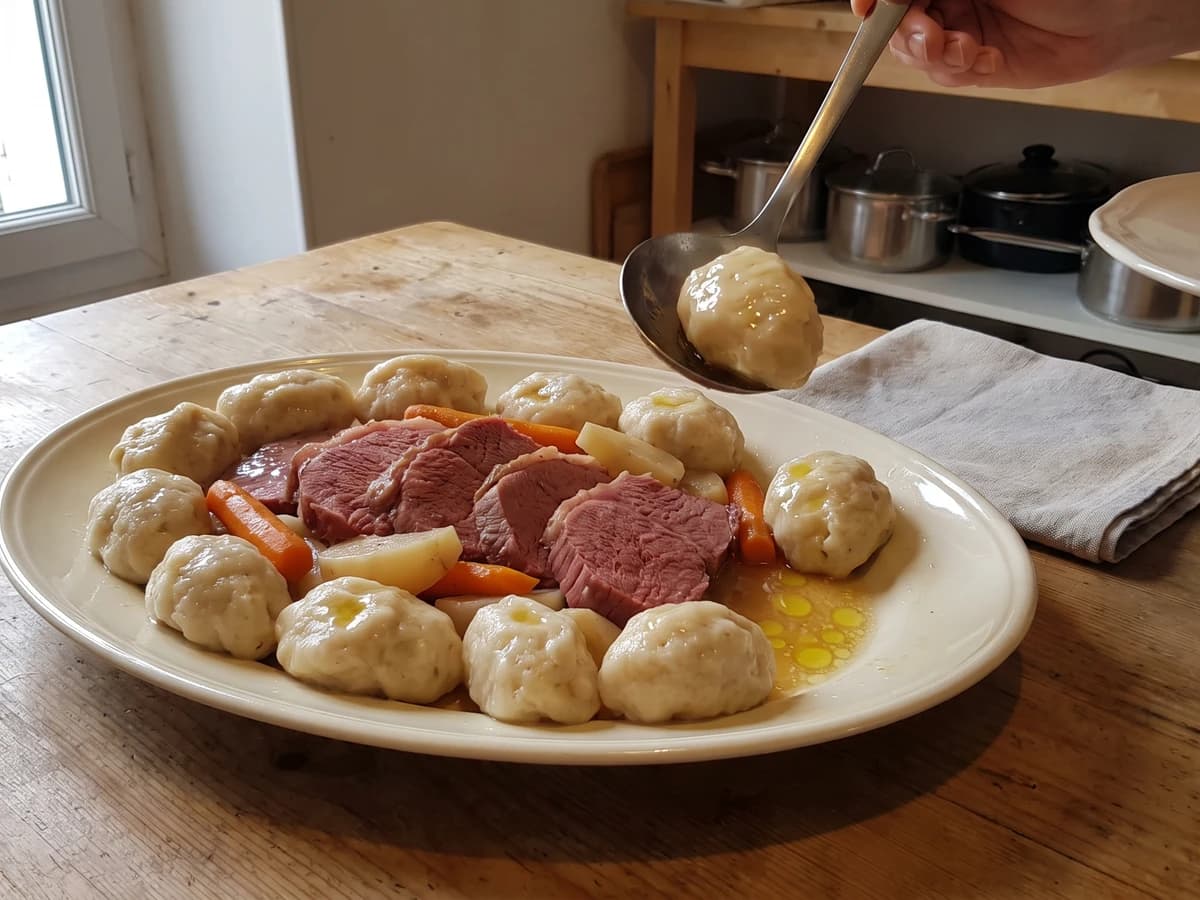
Suet Dumpling
Boulettes au suif, poached beside salt beef, turn equal weights of flour and finely chopped suet into tender, rich dumplings. Keep the beef liquor at a bare tremble and the old garnish works beautifully at home.
A cooking platform built around craft, culture, and the stories behind what we eat.

Created by Chef Juliette
Based on No. 2156, Red Beans (Haricots Rouges), from Le Guide Culinaire (1907) by Auguste Escoffier
Red wine, lean bacon, and a clove-stuck onion turn modest red beans into a proper French side, while Manied Butter (No. 151) teaches the quiet art of binding without boiling.
Haricots Rouges (red beans) teach one clean lesson in liaison (binding): tender beans first, liaison last. The beans must be creamy all the way through before beurre manié (kneaded butter), given in the book as Manied Butter (No. 151), touches the pot, and once it does, the sauce must never boil. That final restraint turns the wine-dark cooking liquor glossy without smothering the beans.
The source formula assumed a quart of dried beans, brigade portions, an overnight mise en place nobody bothered to write down, and a saucier free to bind the pot at service. For four side portions, the scalable quantities are quartered; a one-hour hot soak replaces that unspoken staging, and the source's tied herb bundle becomes a petit bouquet garni (small herb bundle). The brigade's scale and spare pair of hands are scaffolding, so they go. The red-wine simmer, removal of the bacon as soon as it is cooked, its butter frizzle, and the last-minute liaison are the dish, so they stay. One cook, one stove, one evening.
Expect brick-red beans with creamy centers, little bronze cubes of bacon, and enough garnet sauce to cling rather than puddle. The step that matters most comes at the end: warm the liaison gently, watch for its first gloss, and deny it the boil.
Haricots rouges in this wine-and-bacon form belong to the cuisine bourgeoise table across France rather than to one province: dried beans were served as a proper vegetable course or beside roasted and braised meats. Red wine, lean bacon, a clove-stuck onion, and a tied herb bundle show the household bean pot passing intact into the classical repertoire, with only its final liaison refined for formal service. The binder is not a long-cooked roux but a last-minute addition, which is why the finished pot must remain below a boil.
Quantity
1 cup (240 ml / 200 g)
sorted and rinsed
Quantity
9 cups (2.16 L / 2.16 kg), divided, plus more as needed
Quantity
1/2 cup (120 ml / 120 g)
Quantity
about 1/4 cup after dicing (60 ml / 38 g)
kept in one piece for simmering
Quantity
2 tablespoons (30 ml / 18 g)
cut as one thick piece
Quantity
3 tablespoons (45 ml / 40 g)
cut as a wedge
Quantity
1/4 clove
cut from a full clove and pressed into the onion wedge
Quantity
1
made with 1 parsley stem, 1 small thyme sprig, and 1/4 bay leaf
Quantity
1 teaspoon (5 ml / 6 g), plus more only if needed
Quantity
1 tablespoon (15 ml / 14 g)
| Ingredient | Quantity |
|---|---|
| dried red beanssorted and rinsed | 1 cup (240 ml / 200 g) |
| water | 9 cups (2.16 L / 2.16 kg), divided, plus more as needed |
| dry, light-bodied red wine | 1/2 cup (120 ml / 120 g) |
| lean unsmoked slab baconkept in one piece for simmering | about 1/4 cup after dicing (60 ml / 38 g) |
| carrotcut as one thick piece | 2 tablespoons (30 ml / 18 g) |
| yellow onioncut as a wedge | 3 tablespoons (45 ml / 40 g) |
| whole clovecut from a full clove and pressed into the onion wedge | 1/4 clove |
| petit bouquet garnimade with 1 parsley stem, 1 small thyme sprig, and 1/4 bay leaf | 1 |
| fine sea salt | 1 teaspoon (5 ml / 6 g), plus more only if needed |
| unsalted butter | 1 tablespoon (15 ml / 14 g) |
| Manied Butter (No. 151)freshly prepared | 2 tablespoons (30 ml / 28 g) |
Put the sorted beans in a heavy saucepan with 6 cups of the water. Bring them to a full boil for 2 minutes, cover, remove from the heat, and leave them for 1 hour. Drain and rinse. This hot soak replaces the brigade's unspoken overnight preparation without changing the bean or its cooking liquor.
Return the drained beans to the saucepan. Add the remaining 3 cups water, the red wine, salt, whole piece of bacon, carrot, clove-stuck onion, and bouquet garni. Bring everything to a rolling boil and keep it there, uncovered, for 10 full minutes. This hard boil is essential when cooking dried red kidney beans. Lower the heat until the liquid barely trembles, then partially cover the pan.
After 25 minutes at the gentle simmer, test the bacon. Lift it out as soon as it is opaque through the center and tender enough to dice, usually within 25 to 35 minutes, then set it aside. Continue simmering the beans until one crushes into a smooth cream between your tongue and palate with no pale, chalky core, usually another 45 to 75 minutes. If the beans rise above the liquid while still firm, add boiling water 1/2 cup at a time. Ça se rattrape: dry beans need more water and patience, not fiercer heat.
Remove and discard the carrot, clove-stuck onion, and bouquet garni. Drain the beans over a bowl, reserving every drop of their wine-dark cooking liquor. Return the beans to the saucepan with 3/4 cup of that liquor. If you have less, make up the difference with hot water; if you have more, keep it nearby for loosening the liaison.
Cut the cooked bacon into small dice. Melt the unsalted butter in a skillet over medium heat and add the bacon when the foam subsides. Frizzle it until the edges turn bronze and the butter smells nutty, about 3 to 5 minutes. Take the skillet off the heat, keeping both bacon and butter ready for the finish. Butter, not margarine. The flavor of this final frizzle is part of the dish.
Warm the beans and their measured liquor over low heat until the surface only trembles. Take the pan off the heat and add the freshly prepared Manied Butter (No. 151) in small pieces, stirring each one through before adding the next. Return the pan to the lowest heat for 2 to 3 minutes, stirring gently, until the sauce gleams and coats the beans. Never let it boil. If the liaison clumps, lift the beans out with a slotted spoon and whisk the liquor off the heat until smooth. Ça se rattrape. If it becomes too tight or catches its first bubble, remove it immediately and stir in reserved cooking liquor one spoonful at a time.
Fold the frizzled bacon and its browned butter through the bound beans without breaking them. Taste before adding any more salt, since the bacon has concentrated during frizzling. Spoon the Haricots Rouges into a warm serving bowl and bring them straight to the table, glossy, generous, and ready for a roast or braise. À table!
1 serving (about 200g)
Culinary guides, cultural storytelling, and the editorial depth that makes cooking meaningful.
Discover Culinary ExplorerChef Juliette
Boulettes au suif, poached beside salt beef, turn equal weights of flour and finely chopped suet into tender, rich dumplings. Keep the beef liquor at a bare tremble and the old garnish works beautifully at home.

Chef Juliette
Bread, flour, frangipane, and rice become four cool, supple panades for binding forcemeats, each changing body and flavor while preserving tenderness. The finest Mousselines need none, and knowing that distinction is the lesson.

Chef Juliette
Panade au pain is bread, milk, salt, heat, and attention: stir until the paste releases cleanly, butter it against a skin, and you have the quiet binder behind tender French farces.

Chef Juliette
Panade de farine teaches the drying stroke behind pâte à choux: flour meets boiling buttered water, then stays over the fire until the paste gathers, smooths, and quits the pan cleanly.