
Chef Juliette
Smelt (Éperlans)
Tiny éperlans, lightly floured and fried until their tails stand crisp, arrive in a generous heap on a napkin with fried parsley and grooved lemon, a weeknight lesson in heat and restraint.
A cooking platform built around craft, culture, and the stories behind what we eat.
Created by Chef Juliette
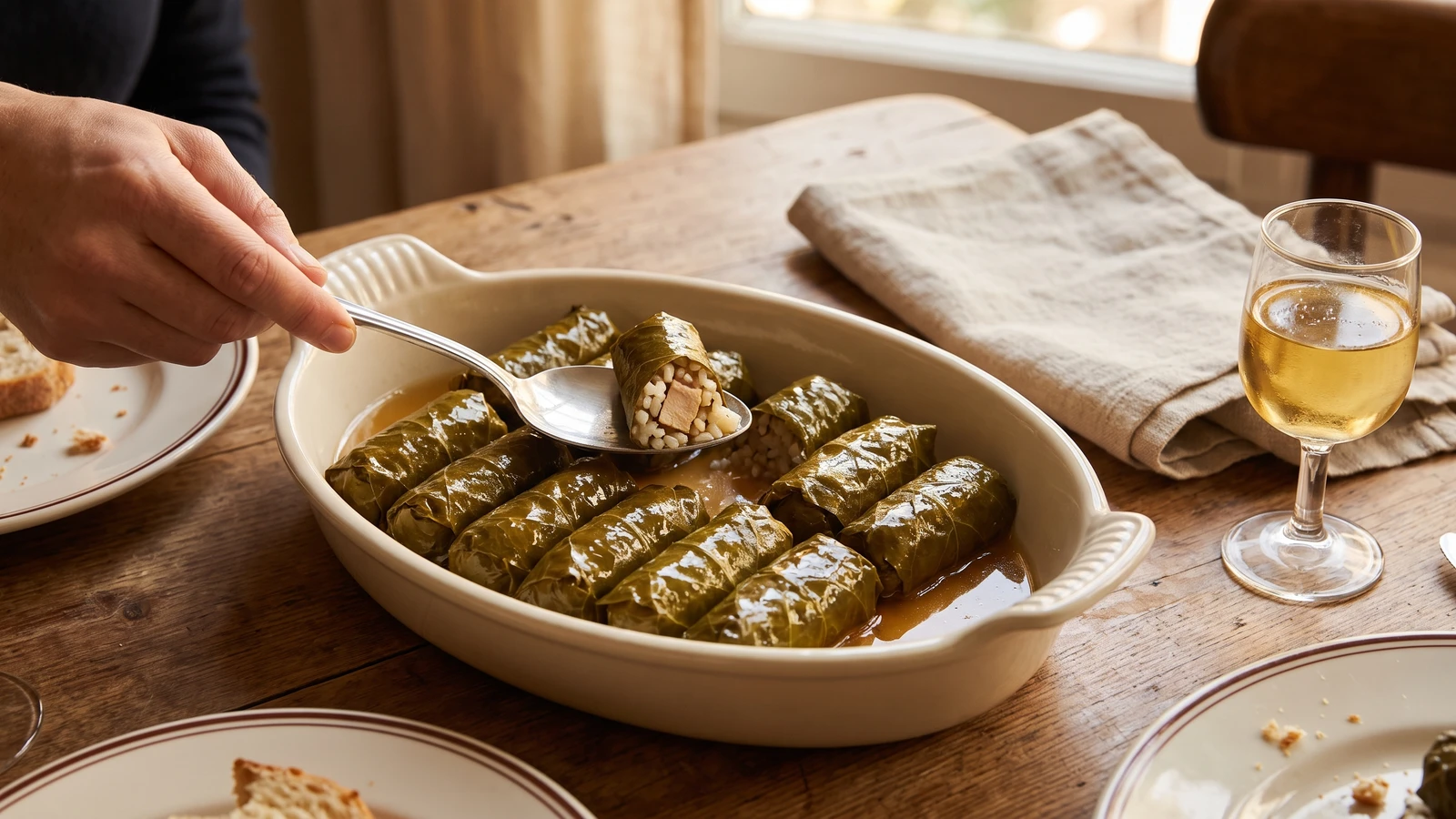
Based on No. 2141, Feuilles de Vigne Farcies ou Dolmas (Stuffed Vine Leaves), from Le Guide Culinaire (1907) by Auguste Escoffier
Tender vine leaves, pilaff rice, foie gras, bacon, and consommé meet in a small braise that teaches the discipline of wrapped cooking: supple leaves, snug shaping, and heat gentle enough to preserve both.
Feuilles de Vigne Farcies ou Dolmas (stuffed vine leaves) is a lesson in the discipline of a wrapped braise: the leaf must already be tender before it is filled, because consommé can soften a young leaf but cannot make an old one young. Three or four overlapping leaves form each little parcel, then close around foie-gras-enriched pilaff so the filling stays plump and the outside cooks to a supple, savory gloss.
The source recipe assumed a brigade with a saucier nearby, pilaff and foie-gras purée already waiting, and a stockpot of good consommé never off the fire. Your home equivalent is twelve parcels, measured prepared components, a lidded sauté pan, and an ordinary oven. Keeping those preparations waiting in brigade quantities was scaffolding and can go; the method cannot. Bacon stays below and above, and consommé still covers the parcels before the gentle braise. One cook, one stove, one evening.
The one step that decides the dish comes before the filling: parboil a leaf, cool it, and bend its thick centre vein. It should fold without snapping. If it cracks, use it to patch another parcel and choose a more tender wrapper. Ça se rattrape. Start with young leaves and the rest is calm, close work.
Feuilles de vigne farcies belong to Anatolia and the eastern Mediterranean, where Turkish, Greek, Armenian, Balkan, and Levantine tables maintain distinct versions; they are not a regional French invention. The French classical kitchen brought the wrapped form into its garnish repertoire, replacing the customary herb-scented or meat fillings with pilaff rice, foie gras, bacon, and consommé. In Turkish usage, sarma is the more exact word for food that is wrapped, while dolma properly names something filled, though dolma became the broader traveling name.
Quantity
40 to 52 leaves
stalks removed; if brined, thoroughly rinsed
Quantity
⅔ cup (160 ml / 120 g)
cooled
Quantity
2 tablespoons (30 ml / 30 g)
Quantity
12 thin slices
divided
Quantity
3½ to 4 cups (840 to 960 ml / 840 to 960 g)
kept hot
| Ingredient | Quantity |
|---|---|
| very young, tender vine leavesstalks removed; if brined, thoroughly rinsed | 40 to 52 leaves |
| cooked pilaff ricecooled | ⅔ cup (160 ml / 120 g) |
| smooth foie-gras purée | 2 tablespoons (30 ml / 30 g) |
| unsmoked streaky bacondivided | 12 thin slices |
| good prepared consommékept hot | 3½ to 4 cups (840 to 960 ml / 840 to 960 g) |
Bring a wide pan of water to a gentle boil. Cut each stalk away flush with the leaf without piercing the blade. Parboil fresh leaves in small batches for 60 to 90 seconds, just until their green softens to olive and the thick centre vein bends easily; well-rinsed brined leaves need only 15 to 30 seconds. Lift them into cold water, then drain thoroughly and spread vein-side up on clean towels. Test one by folding it around a finger. If it cracks, reserve it for patching and choose another wrapper. Ça se rattrape. A leathery leaf that remains rigid must be discarded, because longer cooking cannot give youth back to it.
Fold the foie-gras purée gently through the cooled pilaff rice until every grain is lightly coated but still distinct. Do not mash it into a paste. Divide the filling into twelve level tablespoon portions. If it becomes oily or too loose to hold a mound, chill it for ten minutes so the foie-gras fat firms again.
For each dolma, arrange three leaves vein-side up with their stem ends meeting in the centre and their broad ends fanning outward, overlapping them to form a circular tray without gaps. Use four leaves when they are especially small. Set one portion of filling in the centre, then draw the leaves over it one after another, enclosing the rice completely and shaping a compact ball. Keep the parcels equal so they braise at the same rate. If filling shows through a split, place a spare leaf over the opening and fold again; never discard a parcel for one small tear.
Heat the oven to 325°F (165°C). Line the bottom of a 10-inch (25 cm) lidded ovenproof sauté pan with half the bacon, trimming the slices only as needed to cover the base. Arrange the dolmas seam-side down in one tight layer, pressed shoulder to shoulder so they support one another. Cover them with the remaining bacon, then pour in enough hot consommé to cover them completely. If the measured consommé does not cover them, move everything to a smaller pan rather than diluting the broth. If the bacon floats, hold it in place with a small heatproof plate.
Set the covered pan over medium heat and bring the consommé just to its first full boil. Immediately cover and transfer it to the oven. Braise for 35 to 45 minutes, until a parcel yields easily to the edge of a spoon and its leaves are supple through the centre. The liquid should barely move. If it churns, lower the oven by 25°F (15°C); hard boiling loosens the seams and makes the rice swell unevenly. Add a little reserved hot consommé if evaporation exposes the parcels.
Let the dolmas rest, covered and in their consommé, for ten minutes. Lift away the upper bacon and transfer the parcels carefully with a slotted spoon to a warm shallow serving dish. Spoon over only enough clear braising liquor to leave them glossy, not swimming. Serve three per person while warm. The bacon has done its work in the pan; it is not the garnish. À table!
1 serving (about 240g)
Culinary guides, cultural storytelling, and the editorial depth that makes cooking meaningful.
Discover Culinary ExplorerChef Juliette
Tiny éperlans, lightly floured and fried until their tails stand crisp, arrive in a generous heap on a napkin with fried parsley and grooved lemon, a weeknight lesson in heat and restraint.

Chef Juliette
Brandade de Morue turns salt cod, warm olive oil, and milk into a pale, silky emulsion: keep everything warm and add the oil slowly, then crown the generous dome with butter-fried bread.

Chef Juliette
Salt cod worked warm with cream, one patient spoonful at a time, until the rough flakes become a glossy Nîmes paste, domed generously and ringed with butter-fried croutons for the table.

Chef Juliette
Wine-poached char packed in its earthenware crock beneath butter gold: a make-ahead first course that turns careful cooling, thorough boning, and one unbroken seal into quiet abundance.