
Chef Juliette
Smelt (Éperlans)
Tiny éperlans, lightly floured and fried until their tails stand crisp, arrive in a generous heap on a napkin with fried parsley and grooved lemon, a weeknight lesson in heat and restraint.
A cooking platform built around craft, culture, and the stories behind what we eat.
Created by Chef Juliette
Based on No. 2125, Concombres Farcis.—B, from Le Guide Culinaire (1907) by Auguste Escoffier
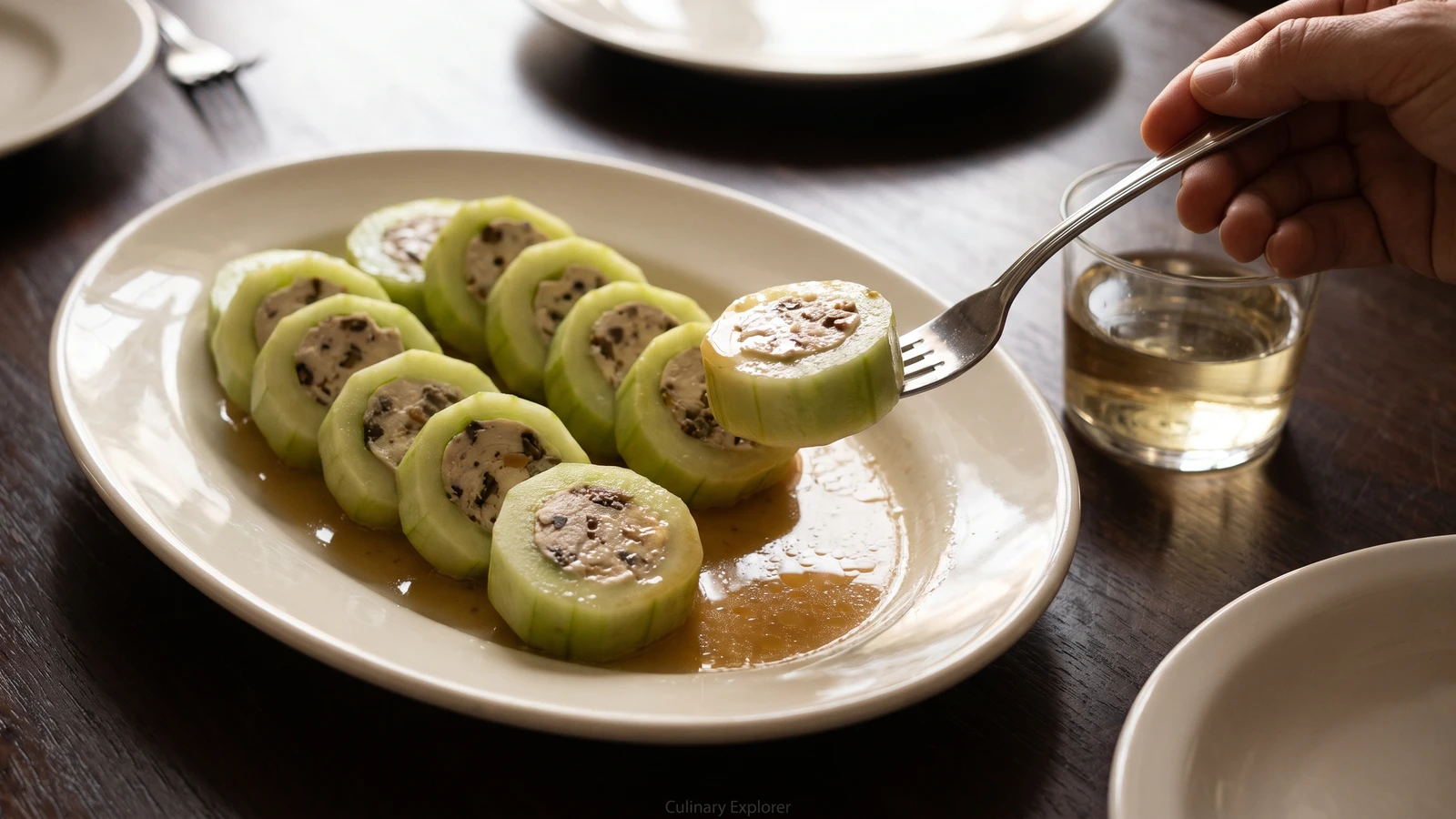
Concombres Farcis cradle chicken forcemeat and Duxelles inside tender cucumber, wrapped and gently braised before slicing: a classical garnish translated into a generous first course for one cook and one stove.
Concombres Farcis B (braised cucumbers stuffed with chicken and Duxelles) teach one uncompromising lesson: containment begins with a cold, dry forcemeat spread level with the cut edges. Mound it, warm it, or leave the Duxelles wet, and the halves slide apart before the braise has a chance to set them. Keep the filling cold and exact, and every slice holds a pale green ring around a savory center.
The original assumed a brigade with Chicken Forcemeat prepared with Frangipan and Duxelles already cold, a stockpot never off the fire, a root-spoon, lengths of muslin, and a braising pan made for service. At home, two straight seedless cucumbers, a teaspoon or melon baller, double-layer cheesecloth, prepared components measured at the book's exact three-to-one weight ratio, and a covered casserole do the same honest work. The root-spoon and oversized pan were scaffolding; parboiling without cooling, reconstructing the halves, wrapping them, and braising them whole are the dish. One cook, one stove, one evening.
The reward is not a stuffed cucumber boat. It is a whole braised cylinder, bacon-scented and tender, cut into roundels according to what they will accompany, just as the source directs. For a first course, cut them 3/4 inch thick. The moment that matters is assembly: fill only to the edges, close the matching halves without pressure, and let the cheesecloth hold the shape until the forcemeat sets.
Concombres farcis belong to the Parisian grand-kitchen repertory of légumes farcis, stuffed vegetables shaped and cooked as composed garnishes for roasts and other large pieces. The letter B marks a formula variant, not a regional style; chicken forcemeat bound with frangipan, Duxelles, bacon, and a covered braise distinguish it from the olive-oil petits farcis of Provence. The direction to size the roundels according to the piece they accompany reveals their original purpose, while the same slices make a generous first course at a home table.
Quantity
2 (about 2 lb / 900 g total)
peeled and ends trimmed
Quantity
4 quarts (3.8 L / 3.8 kg)
for parboiling
Quantity
2 tablespoons (30 ml / 36 g)
for the parboiling water
Quantity
1 1/4 cups (300 ml / 300 g)
well chilled
Quantity
1/2 cup (120 ml / 100 g)
well chilled and dry
Quantity
1/4 teaspoon (1.25 ml / 0.6 g)
Quantity
8 long, thin slices (about 5 1/2 oz / 160 g)
Quantity
2 tablespoons (30 ml / 28 g)
divided
Quantity
1/2 cup (120 ml / 80 g)
thinly sliced
Quantity
1/2 cup (120 ml / 65 g)
thinly sliced
Quantity
1 1/2 cups (360 ml / 360 g)
divided
Quantity
1
| Ingredient | Quantity |
|---|---|
| large straight seedless cucumberspeeled and ends trimmed | 2 (about 2 lb / 900 g total) |
| waterfor parboiling | 4 quarts (3.8 L / 3.8 kg) |
| fine sea saltfor the parboiling water | 2 tablespoons (30 ml / 36 g) |
| Chicken Forcemeat prepared with Frangipanwell chilled | 1 1/4 cups (300 ml / 300 g) |
| Duxelleswell chilled and dry | 1/2 cup (120 ml / 100 g) |
| finely ground white pepper | 1/4 teaspoon (1.25 ml / 0.6 g) |
| unsmoked streaky bacon | 8 long, thin slices (about 5 1/2 oz / 160 g) |
| unsalted butterdivided | 2 tablespoons (30 ml / 28 g) |
| yellow onionthinly sliced | 1/2 cup (120 ml / 80 g) |
| carrotthinly sliced | 1/2 cup (120 ml / 65 g) |
| unsalted chicken stockdivided | 1 1/2 cups (360 ml / 360 g) |
| bouquet garni | 1 |
Peel the cucumbers completely and trim only enough from the ends to make them even. Split each one precisely in half lengthwise. With a melon baller or sturdy teaspoon, the root-spoon's honest home equivalent, remove the wet seed core while leaving a shell about 3/8 inch (1 cm) thick along the base and sides. Keep each pair together so its halves will meet properly when reconstructed.
Bring the water and salt to a full boil in a vessel long enough to hold the cucumber halves. Lower them in and parboil for 3 minutes, just until they bend slightly without becoming limp. Lift them carefully and drain cut-side down on a clean cloth without rinsing or cooling them. Pat the cavities dry. If a half begins to split, remove it immediately and keep the split facing upward; the bacon and cheesecloth will contain it later.
Fold the cold Duxelles into the cold Chicken Forcemeat prepared with Frangipan. The source requires Duxelles equal to one-third the forcemeat's weight, so the 300 g to 100 g ratio governs, whatever the volume measures suggest. Work gently and stop as soon as the mushrooms are evenly dispersed. If the mixture grows slack or the bowl loses its chill, refrigerate it for 10 to 15 minutes. Ça se rattrape. Sprinkle the cucumber cavities lightly with white pepper, then divide the filling among all four halves and smooth it exactly level with the edges. Any surplus should be poached separately, never mounded onto the cucumbers.
Place each cucumber's matching halves together without squeezing. Wrap four bacon slices around each reconstructed cucumber in a close spiral, overlapping the edges so no cucumber is exposed. Roll each bundle tightly in two layers of dampened cheesecloth, tuck in the ends, and tie at 2-inch (5 cm) intervals with kitchen string. The cloth should support the shape without cutting into it. If the seam slips, untie the bundle and chill it for 10 minutes rather than tightening the string harder.
Heat the oven to 325°F (165°C). Melt half the butter in a snug oval casserole over medium-low heat. Add the onion and carrot and cook for 5 to 6 minutes, stirring, until supple but not browned. Add the bouquet garni and lay the wrapped cucumbers over the vegetables. Pour in enough chicken stock to come about one-third of the way up the bundles, reserving at least 1/4 cup (60 ml / 60 g). Dot the bundles with the remaining butter. Cover with a cartouche, a sheet of parchment pressed close to the surface, then put on the lid.
Bring the liquid just to a bare simmer on the stove, then transfer the covered casserole to the oven. Braise for 35 to 45 minutes, turning the bundles carefully after 20 minutes. The liquid should barely tremble. If it begins bubbling hard, remove the casserole for 2 minutes, lower the oven by 25°F (15°C), and add the reserved cool stock around the sides. Continue until a thin knife enters the cucumber easily but the cylinder remains intact, and the center of the forcemeat reaches 165°F (74°C). Insert the thermometer through an end so the round cut faces remain unmarked.
Lift the bundles onto a tray and let them rest for 8 to 10 minutes so the forcemeat settles. Snip away the string and remove the cheesecloth and bacon, which were cooking wrappers rather than part of the presentation. If the cloth clings, wet it with a spoonful of hot braising liquor and peel it back slowly. Strain the liquor and keep it warm. With a thin, sharp knife, cut the cucumbers into 3/4-inch (2 cm) roundels for a first course, wiping the blade after every cut. If the filling smears, wait another 5 minutes before continuing. Arrange the roundels on a warm platter and spoon 2 to 3 tablespoons of strained braising liquor around them for moisture and gloss. À table!
1 serving (about 390g)
Culinary guides, cultural storytelling, and the editorial depth that makes cooking meaningful.
Discover Culinary ExplorerChef Juliette
Tiny éperlans, lightly floured and fried until their tails stand crisp, arrive in a generous heap on a napkin with fried parsley and grooved lemon, a weeknight lesson in heat and restraint.

Chef Juliette
Brandade de Morue turns salt cod, warm olive oil, and milk into a pale, silky emulsion: keep everything warm and add the oil slowly, then crown the generous dome with butter-fried bread.

Chef Juliette
Salt cod worked warm with cream, one patient spoonful at a time, until the rough flakes become a glossy Nîmes paste, domed generously and ringed with butter-fried croutons for the table.

Chef Juliette
Wine-poached char packed in its earthenware crock beneath butter gold: a make-ahead first course that turns careful cooling, thorough boning, and one unbroken seal into quiet abundance.