
Chef Juliette
Choux Rouges à la Flamande
Fine-cut red cabbage, russet apples, butter, sugar, nutmeg, and vinegar share one covered cocotte, cooking gently until the leaves gleam garnet and the apples soften without disappearing.
A cooking platform built around craft, culture, and the stories behind what we eat.
Created by Chef Juliette
Based on No. 2124, Concombres Farcis.—A, from Le Guide Culinaire (1907) by Auguste Escoffier
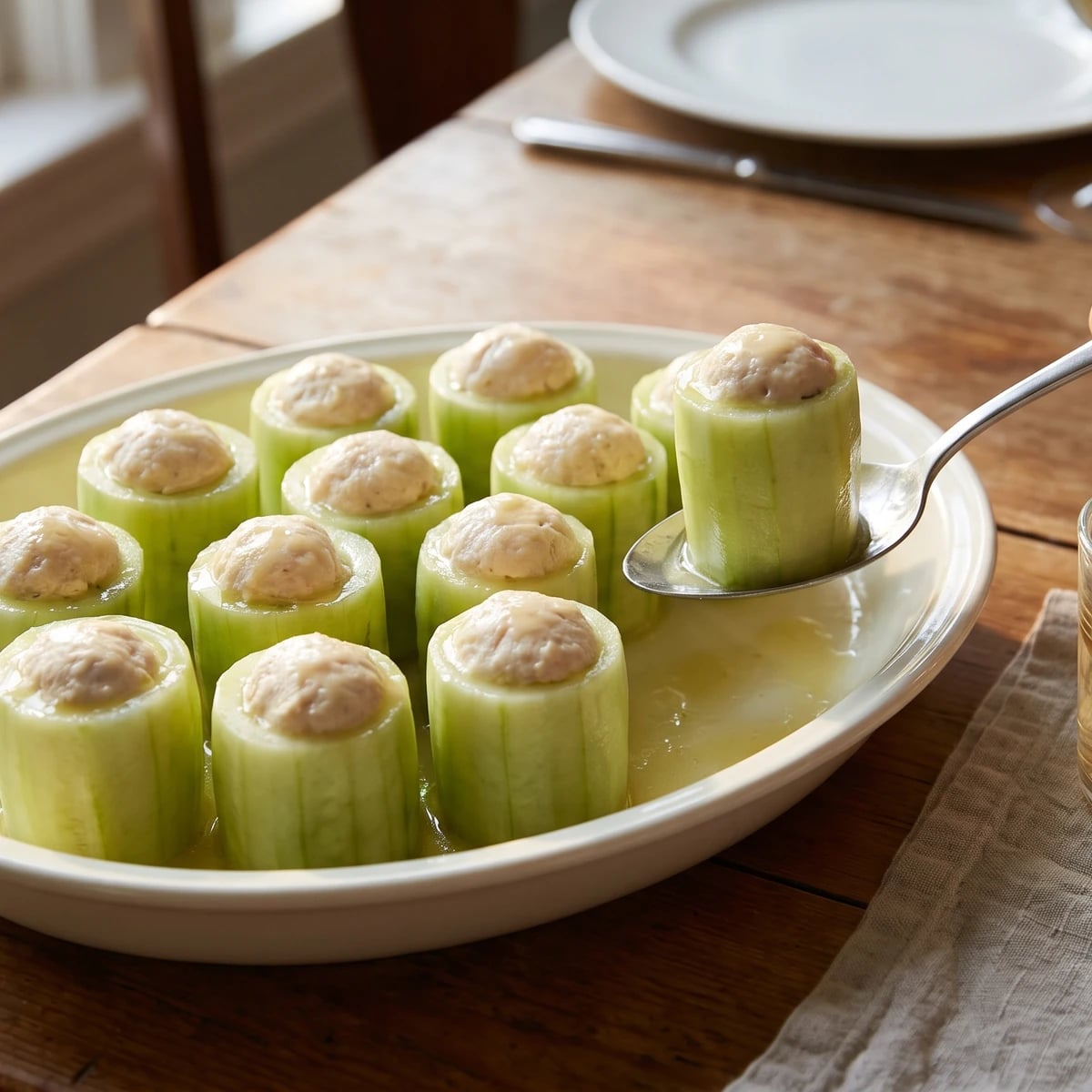
Two-inch cucumber cases, butter-tender but still upright, carry a delicate dome of chicken forcemeat. Gentle heat finishes vegetable and filling together, which is the small, exact lesson of the dish.
Concombres Farcis, A (butter-cooked cucumber cases with fine chicken forcemeat) teaches coordination. The cucumber must yield beneath the knife, yet remain firm enough to hold its filling while the raw chicken poaches. The one true thing is timing: fill too early and the cucumber remains rigid when the chicken is done; fill too late and the cases slump before the centre is safely cooked.
This formula calls for neither a saucier, a stock kept simmering, nor a salamander. Its brigade luxury was quieter: a finished forcemeat waiting cold and a sauté cook free to watch the pan. At home, a food processor replaces the mortar and tamis (fine sieve), while one lidded sauté pan supplies the close, gentle heat. This version changes only equipment and scale, producing twelve cases for four. The tamis and separate stations were scaffolding; cutting, peeling, parboiling, hollowing, butter-cooking, filling at three-parts, and poaching must stay because that sequence is the dish. One cook, one stove, one evening.
Keep the forcemeat cold and stand the cases shoulder to shoulder so they support one another. The moment that matters is the butter-cook: pipe the filling only when a knife enters the cucumber with gentle resistance and each wall still stands cleanly.
Concombres farcis belongs less to a single province than to the Parisian classical repertoire of carefully shaped vegetable preparations, which traveled readily from grand kitchens to bourgeois dining rooms. Its quiet surprise is the cucumber itself: French cooks have long treated cucumber as a vegetable for butter-cooking and braising, not solely as something raw and crisp. The letter A identifies this particular treatment among related versions, defined by raw chicken forcemeat piped into the cases only after they are three-parts cooked.
Quantity
2, about 12 inches (30 cm) each and 1¾ pounds (800 g) total
choose straight cucumbers of even width
Quantity
1 tablespoon (15 ml / 18 g)
Quantity
7 ounces (200 g)
kept very cold and cut into ½-inch (1.25 cm) cubes
Quantity
1 teaspoon (5 ml / 6 g)
Quantity
¼ teaspoon (1.25 ml / 0.5 g)
Quantity
1, about 2 tablespoons (30 ml / 30 g)
kept very cold
Quantity
½ cup (120 ml / 120 g)
kept very cold
Quantity
3 tablespoons (45 ml / 42 g)
Quantity
3 tablespoons (45 ml / 45 g)
kept hot
| Ingredient | Quantity |
|---|---|
| long seedless cucumberschoose straight cucumbers of even width | 2, about 12 inches (30 cm) each and 1¾ pounds (800 g) total |
| fine sea salt for blanching | 1 tablespoon (15 ml / 18 g) |
| boneless, skinless chicken breastkept very cold and cut into ½-inch (1.25 cm) cubes | 7 ounces (200 g) |
| fine sea salt for the forcemeat | 1 teaspoon (5 ml / 6 g) |
| finely ground white pepper | ¼ teaspoon (1.25 ml / 0.5 g) |
| large egg whitekept very cold | 1, about 2 tablespoons (30 ml / 30 g) |
| heavy creamkept very cold | ½ cup (120 ml / 120 g) |
| unsalted butter | 3 tablespoons (45 ml / 42 g) |
| reserved cucumber blanching waterkept hot | 3 tablespoons (45 ml / 45 g) |
Chill the food processor bowl and blade for 10 minutes. Pulse the cold chicken with the forcemeat salt and white pepper until it forms a smooth, tacky paste, stopping twice to scrape the bowl. Add the egg white and process only until absorbed. Reserve 1 tablespoon (15 ml / 15 g) of the cream, then add the remainder in three small additions, pulsing just until the mixture looks pale, glossy, and cohesive. Add the reserved cream with one final pulse. If the forcemeat turns dull, oily, or grainy, it has become too warm. Stop immediately, spread it over a cold plate, refrigerate for 15 minutes, then return it to the rechilled processor and pulse briefly until smooth. Ça se rattrape. Poach a teaspoonful in barely trembling water until its centre reaches 165°F (74°C), then taste for seasoning. Transfer the raw forcemeat to a piping bag and refrigerate it at 40°F (4°C) or colder.
Bring a wide saucepan of water to a boil and add the blanching salt. Trim the cucumber ends, cut the cucumbers into twelve level 2-inch (5 cm) lengths, and peel each piece completely. Parboil them for 3 minutes, just until their raw stiffness begins to relax. Drain them upright on a clean towel and let the surface moisture escape for 5 minutes. Using a melon baller or narrow spoon, hollow each piece from one end, leaving a ¼-inch (6 mm) base and walls. If you pierce a base, press a thin coin cut from the cucumber core over the hole as a patch; the close arrangement in the pan will hold it in place.
Melt the butter over medium-low heat in a wide lidded sauté pan. Stand the cucumber cases side by side in one snug layer, spooning a little butter over their sides and into the cavities. Cover and cook gently for 7 to 9 minutes, basting once. They are three-parts cooked when the outer flesh looks faintly translucent and a small knife enters with gentle resistance, but the cases still stand straight. The butter should foam softly without turning brown. If it begins to colour, lower the heat and add 1 tablespoon (15 ml / 15 g) of the reserved blanching water.
Take the pan off the heat. Fit the piping bag with a ½-inch (1.25 cm) plain opening, insert it nearly to the bottom of each case, and pipe while slowly withdrawing the tip. This fills the cavity without hidden air pockets. Mould the forcemeat into a modest dome about ¼ inch (6 mm) above the rim, as the source directs, and wipe any raw filling from the cucumber sides. If one case has split, brace it between two sound cases and fill it last.
Return the pan to the lowest heat. Pour the remaining hot blanching water around the cases, never over their domed tops, and cover tightly. Cook for 8 to 12 minutes with the liquid barely trembling. The forcemeat is ready when it is opaque, springs softly beneath a fingertip, and reaches 165°F (74°C) at the centre; insert the thermometer through the side of a dome so its shape remains intact. The cucumber should now be tender but upright. If the filling swells, cracks, or beads liquid, the heat is too fierce. Pull the covered pan off the burner for 1 minute, then finish over the gentlest heat you own.
Lift the concombres farcis carefully onto a warmed oval platter. Let the pan liquid bubble for 30 seconds, then remove it from the heat and swirl until the butter and cucumber juices form a light, glossy glaze. If the glaze separates, whisk in 1 teaspoon (5 ml / 5 g) of cold water. Spoon it around the bases without covering the pale domes. Rest for 2 minutes and serve three cases to each guest while warm. À table!
1 serving (about 235g)
Culinary guides, cultural storytelling, and the editorial depth that makes cooking meaningful.
Discover Culinary Explorer
Chef Juliette
Fine-cut red cabbage, russet apples, butter, sugar, nutmeg, and vinegar share one covered cocotte, cooking gently until the leaves gleam garnet and the apples soften without disappearing.

Chef Juliette
A cold-larder lesson in patience: fine red cabbage salted for two days until crisp-tender, then steeped with vinegar, garlic, peppercorns, and bay for the sharp spoonful boiled beef needs.

Chef Juliette
Parboiled cabbage settles between bacon and aromatic vegetables, then braises for two quiet hours in consommé until sweet, tender, and glossy, with none of the rankness that hurried cabbage brings.

Chef Juliette
Plain cabbage, cooked tender, pressed absolutely dry, and cut into lozenges: a strict little classical lesson in water control that protects every sauce sharing the plate.