Chef Juliette
Mayonnaise de Volaille
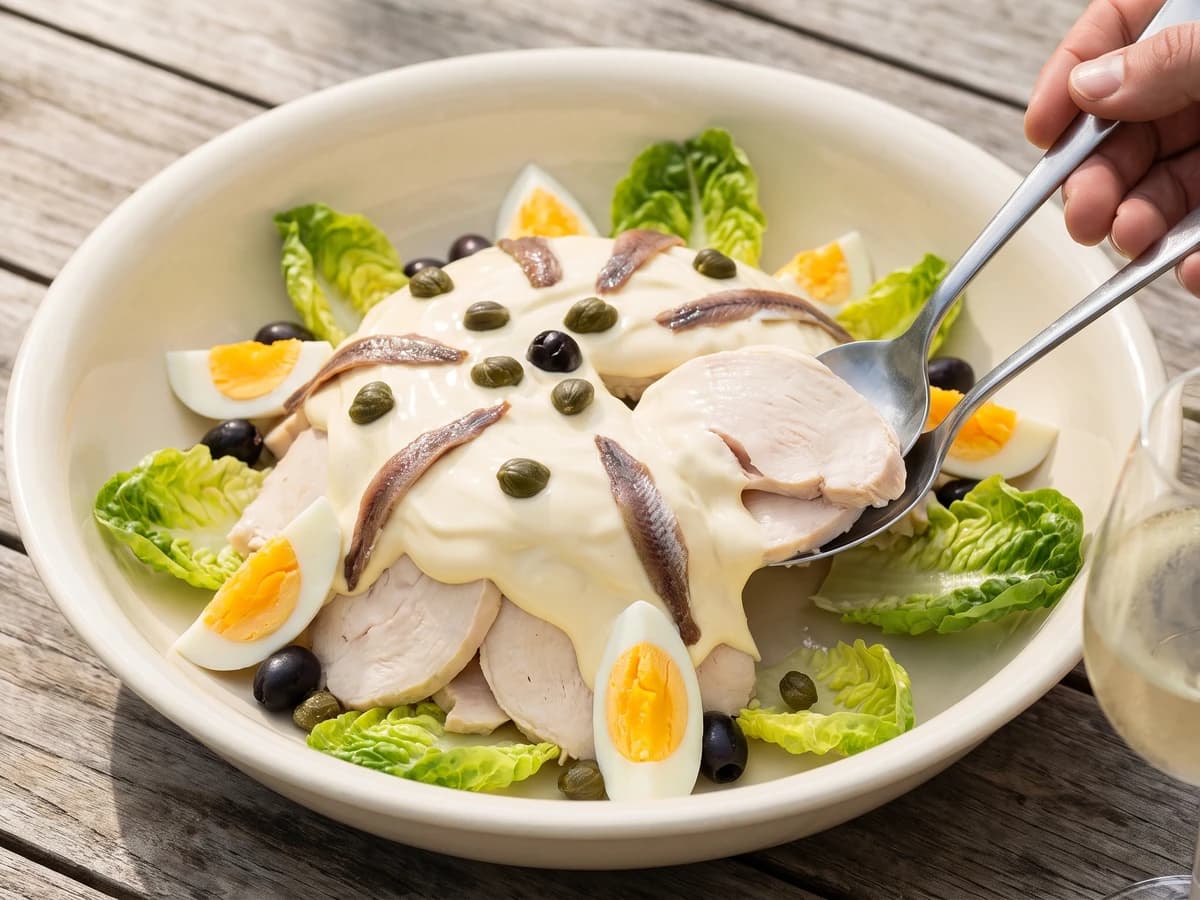
Cold roast chicken, ciseled lettuce, and a shining coat of homemade mayonnaise, arranged with capers, olives, anchovies, eggs, and lettuce hearts, then tossed at the table as the canon intends.
A cooking platform built around craft, culture, and the stories behind what we eat.

Created by Chef Juliette
Based on No. 2016, Salade Opéra, from Le Guide Culinaire (1907) by Auguste Escoffier
White chicken, scarlet tongue, celery, and black truffle stand in disciplined heaps around green asparagus, with a barely-there mayonnaise that seasons the salad without dimming its Parisian colour.
Salade Opéra (an arranged Parisian salad of chicken, tongue, truffle, and asparagus) teaches one true thing: distinction is flavour. Its ingredients share the platter but never lose themselves in it. The julienne must be regular, the heaps separate, and the mayonnaise thin enough to season every mouthful without painting the whole affair white.
The brigade formula assumed a cold larder holding cooked chicken and vivid cured tongue, asparagus trimmed by another pair of hands, cocks’ kidneys ready for garnish, and a saucier on staff to send the mayonnaise at precisely the right consistency. A stockpot and salamander had other work that night; this salad needs neither. At home, one saucepan cooks the chicken, asparagus, and quail eggs in sequence, while a small bowl and whisk replace the sauce station. One cook, one stove, one evening.
Here cocks’ kidneys become quail-egg roundels because an ordinary home market does not supply the original garnish. The flavour is not identical, and we won't pretend it is, but the eggs preserve its small, pale, rich counterpoint and regular alternating border. Brigade mise en place is scaffolding and can go. Equal finished weights, clean julienne-fashion cutting, distinct heaps, and very thin mayonnaise are the dish and must stay. Before you begin, sharpen the knife and chill every component thoroughly; the exact cut is the step that matters most.
Salade Opéra belongs to the Parisian classical repertoire of salades composées, arranged salads made for formal cold tables rather than tossed in a bowl. It traveled from banquet and hotel cold rooms to celebration tables with its visual grammar intact: pale chicken, red cured tongue, green celery and asparagus, black truffle, and a precise alternating border. The order is not plating theater; regular heaps and thin mayonnaise keep every ingredient distinct in flavour as well as colour.
Quantity
1 small, about 6 oz (170 g), yielding ¾ cup (180 ml / 100 g) cooked white meat
Quantity
6 cups (1.4 L / 1.4 kg), plus more for chilling
divided
Quantity
1 tablespoon plus ¼ teaspoon (16 ml / 20 g)
divided
Quantity
1 large bunch, about 12 oz (340 g), yielding 1½ cups (350 ml / 180 g)
tips and tender upper stems trimmed
Quantity
¾ cup loosely packed (180 ml / 100 g)
chilled in one piece
Quantity
1 cup loosely packed (240 ml / 100 g)
trimmed
Quantity
¾ cup loosely packed (180 ml / 100 g)
drained well if preserved
Quantity
8
Quantity
8, about ⅓ cup (80 ml / 60 g)
drained
Quantity
1
Quantity
1 teaspoon (5 ml / 5 g)
Quantity
2 teaspoons (10 ml / 10 g)
divided
Quantity
½ cup (120 ml / 110 g)
Quantity
⅛ teaspoon (0.6 ml / 0.3 g)
| Ingredient | Quantity |
|---|---|
| skinless, boneless chicken breast | 1 small, about 6 oz (170 g), yielding ¾ cup (180 ml / 100 g) cooked white meat |
| cold waterdivided | 6 cups (1.4 L / 1.4 kg), plus more for chilling |
| fine sea saltdivided | 1 tablespoon plus ¼ teaspoon (16 ml / 20 g) |
| asparagustips and tender upper stems trimmed | 1 large bunch, about 12 oz (340 g), yielding 1½ cups (350 ml / 180 g) |
| cooked very red cured beef tonguechilled in one piece | ¾ cup loosely packed (180 ml / 100 g) |
| celery stickstrimmed | 1 cup loosely packed (240 ml / 100 g) |
| fresh or whole preserved black truffledrained well if preserved | ¾ cup loosely packed (180 ml / 100 g) |
| quail eggs, the home equivalent for cocks’ kidneys | 8 |
| small cornichonsdrained | 8, about ⅓ cup (80 ml / 60 g) |
| large pasteurized egg yolk | 1 |
| Dijon mustard | 1 teaspoon (5 ml / 5 g) |
| white wine vinegardivided | 2 teaspoons (10 ml / 10 g) |
| grapeseed or sunflower oil | ½ cup (120 ml / 110 g) |
| ground white pepper | ⅛ teaspoon (0.6 ml / 0.3 g) |
Put the chicken breast in a 2-quart (2 L) saucepan with 3 cups (700 ml) of the cold water and 2 teaspoons of the salt. Bring it slowly to the barest simmer, then lower the heat so the surface only trembles. Poach for 10 to 14 minutes, turning once, until the thickest part reaches 165°F (74°C). A hard boil tightens the fibres and makes the finished julienne fray, so keep the water calm. Lift out the breast, pat it dry, cool it promptly, and chill it for at least 30 minutes.
Refresh the saucepan with the remaining 3 cups (700 ml) water and 1 teaspoon salt, then bring it to a full boil. Add the asparagus tips and tender upper stems and cook for 2 to 4 minutes, until brilliantly green and just tender when pierced. Reserve ½ cup (120 ml) of the cooking water and chill it. Move the asparagus straight into ice water, then drain and dry it thoroughly. Return the cooking water to the boil, lower in the quail eggs, and cook for 4 minutes. Chill, peel, and refrigerate them whole.
Whisk the egg yolk, Dijon mustard, 1 teaspoon of the vinegar, the remaining ¼ teaspoon salt, and the white pepper in a small heavy bowl. Add the oil first by drops, whisking each addition fully into the yolk; once the emulsion has body, pour the oil in a slender stream while whisking steadily. If oil gathers in beads or the sauce separates, stop. Ça se rattrape: whisk 1 teaspoon cold water in a clean bowl, then beat the broken mayonnaise into it one teaspoon at a time until smooth before continuing more slowly. Finish with the remaining vinegar and 3 tablespoons of the chilled asparagus water, adding more water by the teaspoon until the sauce falls from the whisk in a narrow ribbon and leaves only a light veil on a spoon.
Pat every component dry and keep four bowls beside the board. Weigh 100 g each of cooked chicken, tongue, celery, and truffle after trimming so the original equal proportions remain exact. Cut each julienne-fashion, into match-shaped rods about 2 inches long and ⅛ inch thick (5 cm by 3 mm), and keep each ingredient separate. Slice the chicken and tongue across their grain before cutting the rods. Precision matters here because even pieces dress evenly and form clean heaps; this is structure, not fuss.
Stir the mayonnaise and check its fall once more. Fold about 2 teaspoons through each bowl of julienne and 1 tablespoon through the asparagus, using just enough to give the surfaces a soft gloss. The white chicken must remain white, the tongue red, the celery pale green, and the truffle black. If the mayonnaise sits in opaque ridges, it is too thick; whisk another teaspoon of chilled asparagus water into the sauce, lift any excess coating from the ingredients, and dress them again lightly.
Set a chilled oval platter before you. Place the asparagus in one compact, generous heap at the centre. Arrange the chicken, tongue, celery, and truffle in four equally regular heaps around it, leaving a narrow line of platter between them so the colours remain distinct. If any component has released water, drain it and blot gently before it reaches the plate; liquid underneath will loosen the arrangement and dilute the mayonnaise.
Cut the quail eggs crosswise into neat ¼-inch (6 mm) centre roundels, reserving the rounded ends for another plate, and slice the cornichons into roundels of the same thickness. Lay egg and gherkin roundels alternately around the outer border. Spoon one narrow ribbon of mayonnaise over the central asparagus and pass the remainder separately. Let the salad lose its deepest refrigerator chill for 10 minutes, then serve it promptly. À table!
1 serving (about 215g)
Culinary guides, cultural storytelling, and the editorial depth that makes cooking meaningful.
Discover Culinary ExplorerChef Juliette
Cold roast chicken, ciseled lettuce, and a shining coat of homemade mayonnaise, arranged with capers, olives, anchovies, eggs, and lettuce hearts, then tossed at the table as the canon intends.

Chef Juliette
Cold roast or poached chicken with fine ribbons of lettuce, dressed at the final moment with oil and vinegar: a composed salad whose freshness depends entirely on timing.

Chef Juliette
Five leaves, one living rule: laitue, romaine, chicorée, mâche, or pissenlit must be washed, dried, and dressed only as they go to the table, while every leaf still carries its light vinaigrette.

Chef Juliette
Salade de Betteraves proves that baking, not boiling, is the whole argument: concentrated garnet sweetness, tender baked onion, sharp mustard, and herbs cut into a weeknight salad worth making ahead.