
Chef Juliette
Smelt (Éperlans)
Tiny éperlans, lightly floured and fried until their tails stand crisp, arrive in a generous heap on a napkin with fried parsley and grooved lemon, a weeknight lesson in heat and restraint.
A cooking platform built around craft, culture, and the stories behind what we eat.
Created by Chef Juliette
Based on No. 201, Game Forcemeat for Pies and Terrines, from Le Guide Culinaire (1907) by Auguste Escoffier
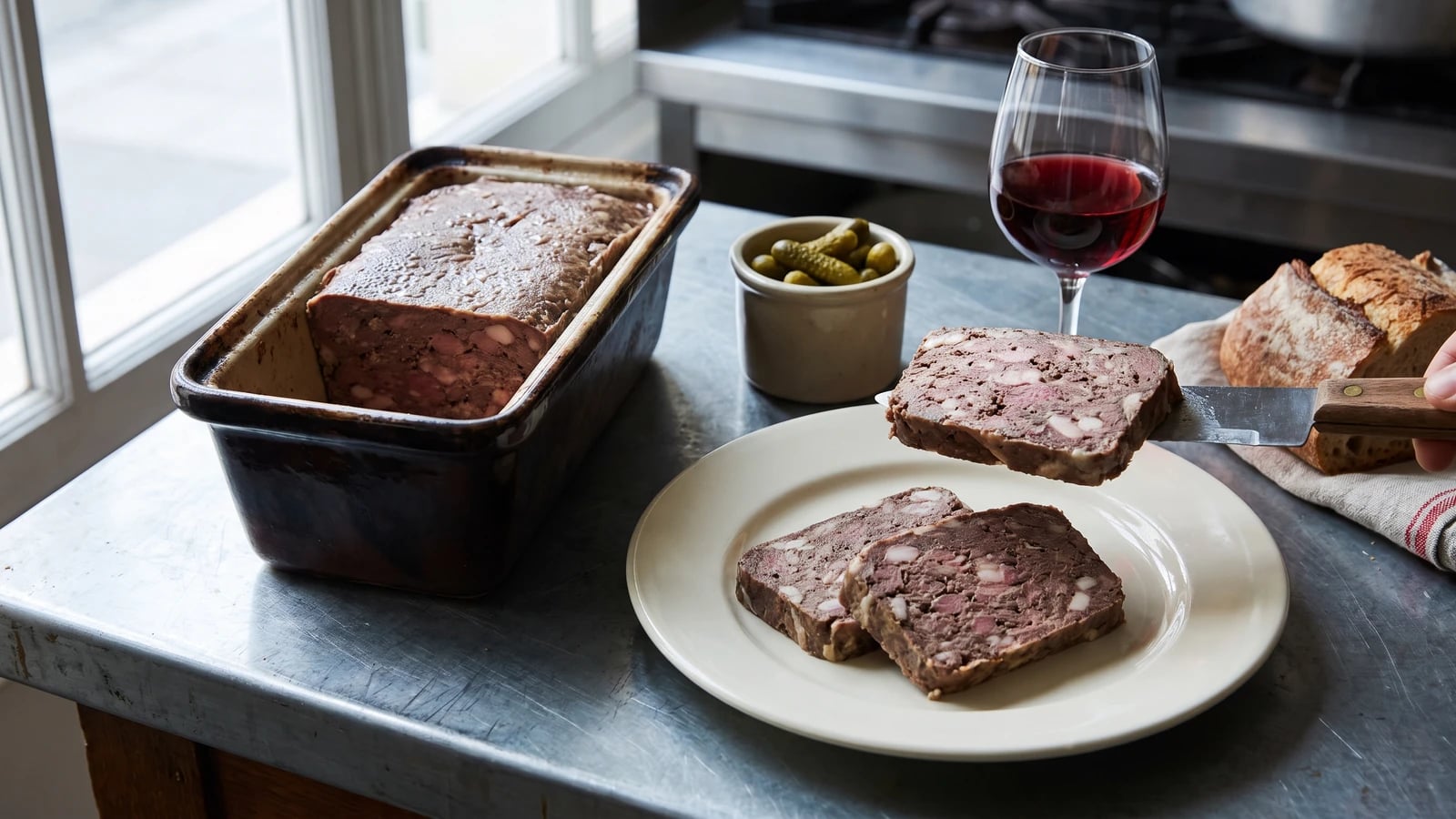
Farce de gibier turns lean hare or grouse into a supple, sliceable filling by balancing it with veal, pork, and fat bacon, kept fiercely cold from grinder to mold.
Farce de gibier pour pâtés et terrines (game forcemeat for pies and terrines) teaches the arithmetic of charcuterie: the cleaned game is weighed first, and that weight rules the veal, pork, fat bacon, and seasoning that follow. Game gives the farce its character, veal supplies a gentle bind, pork rounds the flavor, and fat bacon keeps the cooked filling succulent. Before a pan comes out, know the one true thing: cold is part of the technique.
The original formula assumed brigade quantities, a cold larder, a mincing machine, and enough hands to chop, pound, and mix without letting the meat grow warm. For one cook, one stove, one evening, a chilled grinder or food processor does the same honest work, and the formula becomes 2 parts game, 1 part veal, 1 part pork, and 2 parts fresh fat bacon. Repeated hand-mincing was brigade scaffolding and can go. The proportions, bold seasoning, cold handling, and tacky bind are the dish itself, and they stay.
When it is right, the farce feels cohesive rather than greasy, smells distinctly of game, and bakes into a close slice that holds together without becoming rubbery. Keep the bowl, blade, meat, and fat cold from the first cube through the final mixing. That is the step that decides everything.
Farce de gibier belongs to the game-rich hunting tables of Sologne, Burgundy, and other French districts where hare, partridge, and grouse moved from the day's bag into raised pies and lidded terrines. Charcutiers and grand kitchens turned household arithmetic into a formal rule: weigh the cleaned game first, then let that weight determine the supporting meats, fat, and seasoning. What can look like dilution is precisely how lean, strongly flavored game becomes succulent, cohesive, and cleanly sliceable.
Quantity
8.8 ounces (250 g)
all skin, bone, sinew, and shot removed; cut into ¾-inch (2 cm) cubes
Quantity
4.4 ounces (125 g)
well trimmed and cut into ¾-inch (2 cm) cubes
Quantity
4.4 ounces (125 g)
well trimmed and cut into ¾-inch (2 cm) cubes
Quantity
8.8 ounces (250 g)
skin removed and cut into ¾-inch (2 cm) cubes
Quantity
2¼ teaspoons (11 ml / 13.5 g)
Quantity
½ teaspoon (2.5 ml / 1.5 g)
Quantity
⅓ teaspoon (1.7 ml / 0.75 g)
| Ingredient | Quantity |
|---|---|
| trimmed boneless hare or grouse meatall skin, bone, sinew, and shot removed; cut into ¾-inch (2 cm) cubes | 8.8 ounces (250 g) |
| lean veal shoulderwell trimmed and cut into ¾-inch (2 cm) cubes | 4.4 ounces (125 g) |
| lean boneless pork shoulderwell trimmed and cut into ¾-inch (2 cm) cubes | 4.4 ounces (125 g) |
| fresh fat bacon or unsmoked, uncured pork fatbackskin removed and cut into ¾-inch (2 cm) cubes | 8.8 ounces (250 g) |
| fine sea salt | 2¼ teaspoons (11 ml / 13.5 g) |
| finely ground white pepper | ½ teaspoon (2.5 ml / 1.5 g) |
| quatre-épices | ⅓ teaspoon (1.7 ml / 0.75 g) |
Trim the game completely before weighing it. Remove skin, bone, tough silver skin, bruised flesh, and every trace of shot; only the usable meat governs the formula. For 250 g game, weigh 125 g veal, 125 g pork, and 250 g fresh fat bacon. Keep this ratio if scaling the batch, because the arithmetic is the structure of the farce.
Spread the cubed meats and fat bacon on separate trays and chill them until very firm, about 30 minutes in the freezer. Chill the grinder parts or food processor bowl and blade at the same time. The cubes should be stiff at their edges but not frozen solid. Warm fat smears instead of cutting cleanly, leaving the cooked farce greasy around the edges and dry within.
Pass the game, veal, pork, and fat bacon separately through a 6 mm grinder plate, catching everything in a bowl set over ice. Combine them, then pass the mixture once through a 4.5 mm plate for a fine, even farce. If using a food processor, work each component in small batches with short pulses, stopping when it resembles fine, distinct granules rather than a smooth paste. If the fat begins to shine or smear, stop immediately. Ça se rattrape: spread the mixture thinly on a cold tray, chill it for 20 minutes, then continue.
Combine the ground mixture with the salt, white pepper, and quatre-épices in the chilled bowl. Mix firmly with a cold paddle or gloved hand for 2 to 3 minutes, lifting and folding until the farce becomes tacky, holds together, and clings briefly to your palm. This mixing develops the natural protein bind that lets a slice remain whole. If the bowl loses its chill or liquid fat appears, stop and refrigerate the mixture before continuing; forcing a warm farce only breaks its texture.
Flatten 1 tablespoon (15 ml / about 20 g) of farce into a small patty and cook it gently in a dry skillet until fully done, with no raw center. Let a bite cool for a minute before tasting, because the finished pie or terrine will mute salt and spice when cold. Adjust carefully. If it tastes flat, add salt by the pinch; if it is too assertive, grind a small unseasoned batch in the same 2:1:1:2 ratio and mix it through. Never guess at terrine seasoning when a tasting takes five minutes.
Press parchment or reusable wrap directly against the surface and refrigerate the farce for 2 hours so the seasoning distributes and the bind settles. Pack it firmly into the prepared pie or terrine, working into the corners and pressing out air pockets. Cook according to the chosen pie or terrine preparation, verifying that the center reaches at least 160°F (71°C). Cool cooked terrines promptly, then chill them under light pressure before slicing. If the farce will not be used immediately, keep it below 40°F (4°C) and use it within 24 hours.
1 serving (about 94g)
Culinary guides, cultural storytelling, and the editorial depth that makes cooking meaningful.
Discover Culinary ExplorerChef Juliette
Tiny éperlans, lightly floured and fried until their tails stand crisp, arrive in a generous heap on a napkin with fried parsley and grooved lemon, a weeknight lesson in heat and restraint.

Chef Juliette
Brandade de Morue turns salt cod, warm olive oil, and milk into a pale, silky emulsion: keep everything warm and add the oil slowly, then crown the generous dome with butter-fried bread.

Chef Juliette
Salt cod worked warm with cream, one patient spoonful at a time, until the rough flakes become a glossy Nîmes paste, domed generously and ringed with butter-fried croutons for the table.

Chef Juliette
Wine-poached char packed in its earthenware crock beneath butter gold: a make-ahead first course that turns careful cooling, thorough boning, and one unbroken seal into quiet abundance.