Chef Juliette
Mayonnaise de Volaille
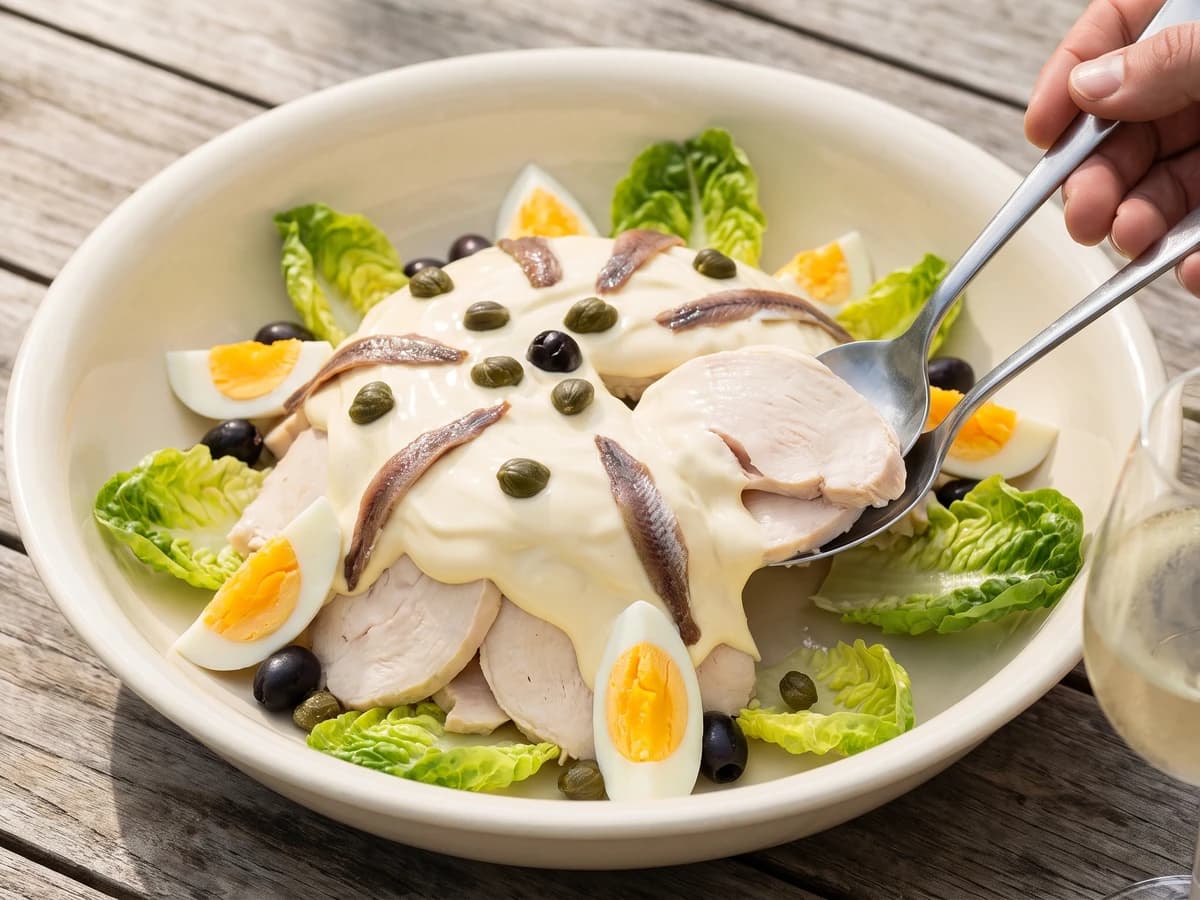
Cold roast chicken, ciseled lettuce, and a shining coat of homemade mayonnaise, arranged with capers, olives, anchovies, eggs, and lettuce hearts, then tossed at the table as the canon intends.
A cooking platform built around craft, culture, and the stories behind what we eat.
Created by Chef Juliette
Based on No. 2003, Salade Danicheff, from Le Guide Culinaire (1907) by Auguste Escoffier
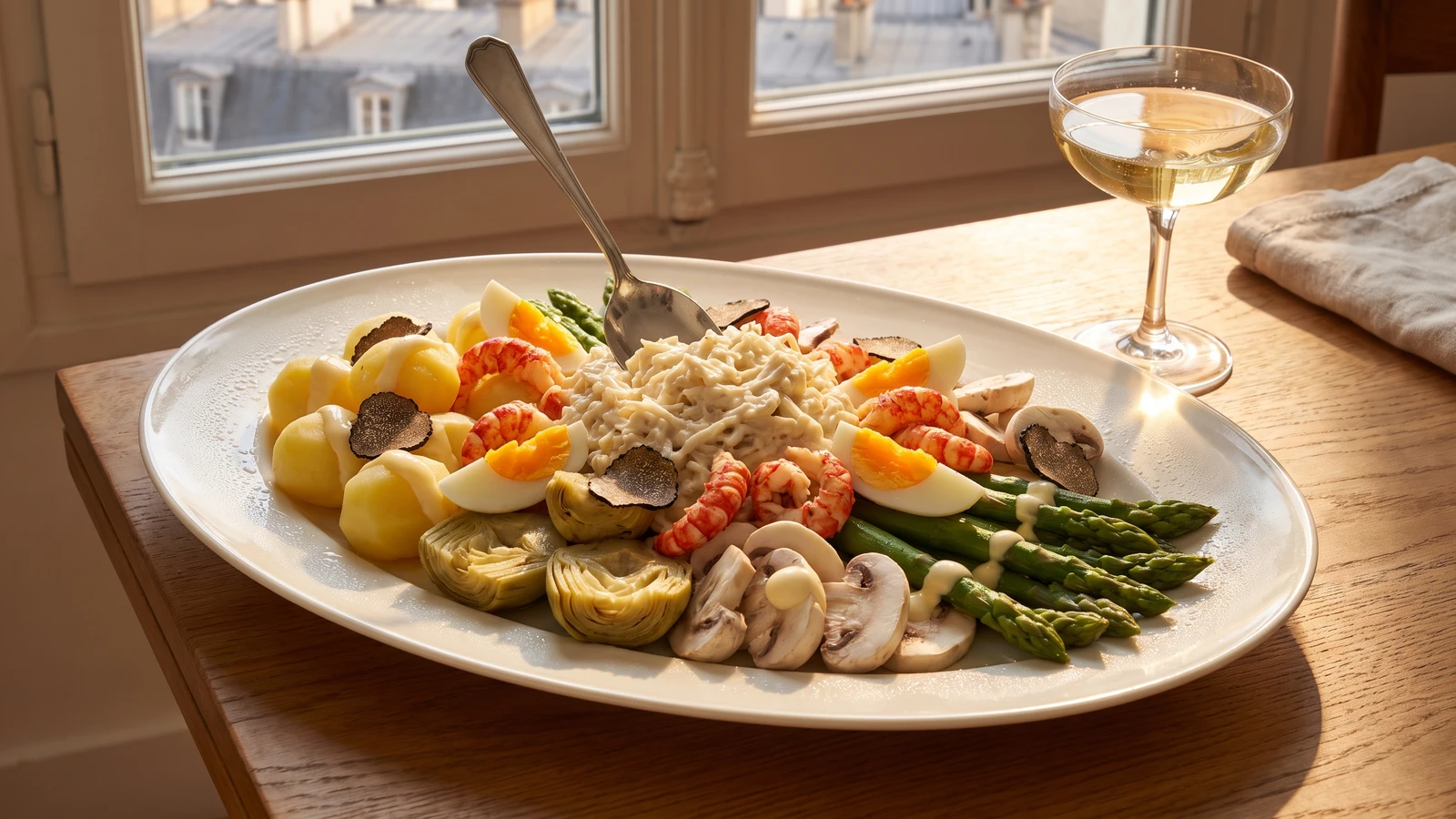
Five vegetables held in distinct, mayonnaise-dressed heaps, crowned with crayfish tails, hard-boiled egg, and black truffle: a composed salad whose discipline is separation, contrast, and a light hand.
Salade Danicheff (a composed vegetable salad with crayfish and truffle) teaches one true thing before you touch a pan: a composed salad is built on distinction, not mixture. Five vegetables appear in equal measure, each keeping its own shape and character, while mayonnaise links them without turning them into one anonymous mass. The heaps must remain legible. That is the dish.
The original formula assumed a garde-manger (cold-larder cook) with blanched celeriac, cooked artichoke bottoms, crayfish tails, and truffle already waiting, plus enough pans and hands to prepare every vegetable separately. At home, use one saucepan in sequence, plain cooked artichoke bottoms from a jar or freezer, and unseasoned frozen crayfish tails when fresh ones are scarce. The service machinery and brigade quantity change, not the intent: 100 grams of each vegetable preserves the exact equality for four people. Separate cauldrons and whole-crayfish shelling are scaffolding; equal heaps, the celeriac's blanching, and the three garnishes are the dish. One cook, one stove, one evening.
Dry every cooked vegetable as though the mayonnaise depended on it, because it does. Water thins the emulsion, blurs the heaps, and makes the platter weary before it reaches the table; if trouble comes, the rescue is waiting in the method. Get the vegetables dry, cool, and distinct, and Salade Danicheff will arrive generous, bright, and properly grand without a trace of fuss.
Salade Danicheff belongs to the Parisian grand-kitchen repertory of composed salads, where cold vegetables were arranged in separate heaps and finished for the formal dinner table with mayonnaise and costly garnishes. Its Russian-sounding title reflects Parisian menu naming, not a Russian regional salad tradition; the method and organization are firmly French. The dish passed naturally into ambitious home entertaining once cooked artichoke bottoms, prepared crayfish tails, and a stable mayonnaise no longer required a full cold-kitchen brigade.
Quantity
100 g prepared weight (about ¾ cup / 180 ml), prepared using Blanchings (No. 273)
peeled and sliced 2 mm thick before the referenced preparation
Quantity
100 g prepared weight (about ⅔ cup / 160 ml)
peeled and sliced into 3 mm roundels
Quantity
100 g prepared weight (about ¾ cup / 180 ml)
well drained and thinly sliced
Quantity
100 g prepared weight (about 1½ cups / 360 ml)
cut into slender raw strips
Quantity
100 g prepared weight (about 1 cup / 240 ml)
trimmed
Quantity
½ cup (120 ml / 115 g)
cold but supple
Quantity
1 cup (240 ml / 140 g)
well drained and chilled
Quantity
2
peeled and quartered
Quantity
1 small truffle (15 g / ½ ounce)
thinly sliced
Quantity
1 tablespoon (15 ml / 18 g)
for the vegetable water
| Ingredient | Quantity |
|---|---|
| celeriacpeeled and sliced 2 mm thick before the referenced preparation | 100 g prepared weight (about ¾ cup / 180 ml), prepared using Blanchings (No. 273) |
| waxy potatopeeled and sliced into 3 mm roundels | 100 g prepared weight (about ⅔ cup / 160 ml) |
| plain cooked artichoke bottomswell drained and thinly sliced | 100 g prepared weight (about ¾ cup / 180 ml) |
| small button mushroomscut into slender raw strips | 100 g prepared weight (about 1½ cups / 360 ml) |
| green asparagus headstrimmed | 100 g prepared weight (about 1 cup / 240 ml) |
| Mayonnaise Saucecold but supple | ½ cup (120 ml / 115 g) |
| plain cooked crayfish tailswell drained and chilled | 1 cup (240 ml / 140 g) |
| large hard-boiled eggspeeled and quartered | 2 |
| black truffle, fresh or whole preservedthinly sliced | 1 small truffle (15 g / ½ ounce) |
| fine sea saltfor the vegetable water | 1 tablespoon (15 ml / 18 g) |
Set a bowl of ice water beside the stove and line a tray with a clean towel. If the eggs are not already cooked, place them in the saucepan, cover them by 2.5 cm with cold water, and bring just to the boil. Cover, remove from the heat for 10 minutes, then chill them in the ice water, peel, and quarter. Drain the artichoke bottoms and crayfish tails separately on towels, then return the crayfish to the cold until assembly.
Prepare the sliced celeriac using Blanchings (No. 273). The purpose is to take off its aggressive raw bite without cooking away its clean crunch. Once the referenced preparation is complete, cool the slices, drain them thoroughly, and spread them on the towel-lined tray until no surface moisture remains.
Bring fresh lightly salted water to a gentle simmer. Add the potato roundels and cook for 5 to 7 minutes, until a knife enters without resistance but the slices still hold their edges. Lift them carefully into the ice water, then drain and dry them in one layer. If a few roundels begin to crumble, stop the cooking at once; ça se rattrape. Reserve the broken slices for the bottom of their heap and keep the intact ones visible.
Bring fresh, well-salted water to a full boil and cook the asparagus à l'anglaise, meaning quickly in abundant salted boiling water, for 1 to 3 minutes depending on thickness. Transfer it immediately to the ice water. Drain when cold and dry with care; the heads should remain green, distinct, and just tender. If they soften too far, chill them at once and leave them whole, because rough tossing will finish what the hot water began.
Slice the drained artichoke bottoms to roughly the same thickness as the potatoes. Cut the mushrooms into slender strips only now, just before dressing, so their pale surfaces stay fresh. Weigh the five prepared vegetables once more if necessary: each heap must contain 100 grams. Their equality is not decoration; it is the structure of Salade Danicheff.
Reserve 2 tablespoons of the Mayonnaise Sauce, then work with one vegetable at a time in a clean bowl. Fold each gently with just enough of the remaining mayonnaise to coat it in a thin ivory gloss, transferring it to a separate part of the tray before dressing the next. Keep the asparagus heads intact. If the mayonnaise is too stiff, loosen it with cold water a teaspoon at a time. If it separates, put a teaspoon of cold water in a clean bowl and beat the sauce into it spoonful by spoonful. Ça se rattrape. If a dressed vegetable releases water, lift it out, blot it dry, and recoat it with the reserved mayonnaise.
Arrange the celeriac, potato, artichoke, mushroom, and asparagus in five generous, clearly separate heaps on a chilled oval platter. Deck the heaps with the crayfish tails, place the egg quarters between and over them, and finish with the thin slices of black truffle. Hold the salad in the cold for no more than 30 minutes, then let it stand for 5 minutes before serving so the mayonnaise is supple rather than rigid. Never apologize at your own table. À table!
1 serving (about 215g)
Culinary guides, cultural storytelling, and the editorial depth that makes cooking meaningful.
Discover Culinary ExplorerChef Juliette
Cold roast chicken, ciseled lettuce, and a shining coat of homemade mayonnaise, arranged with capers, olives, anchovies, eggs, and lettuce hearts, then tossed at the table as the canon intends.

Chef Juliette
Cold roast or poached chicken with fine ribbons of lettuce, dressed at the final moment with oil and vinegar: a composed salad whose freshness depends entirely on timing.

Chef Juliette
Five leaves, one living rule: laitue, romaine, chicorée, mâche, or pissenlit must be washed, dried, and dressed only as they go to the table, while every leaf still carries its light vinaigrette.

Chef Juliette
Salade de Betteraves proves that baking, not boiling, is the whole argument: concentrated garnet sweetness, tender baked onion, sharp mustard, and herbs cut into a weeknight salad worth making ahead.