Culinary Explorer

A cooking platform built around craft, culture, and the stories behind what we eat.
Discover Culinary Explorer
Salade Cressonnière

Salade Cressonnière

Created by Chef Juliette

Based on No. 2001, Salade Cressonnière, from Le Guide Culinaire (1907) by Auguste Escoffier

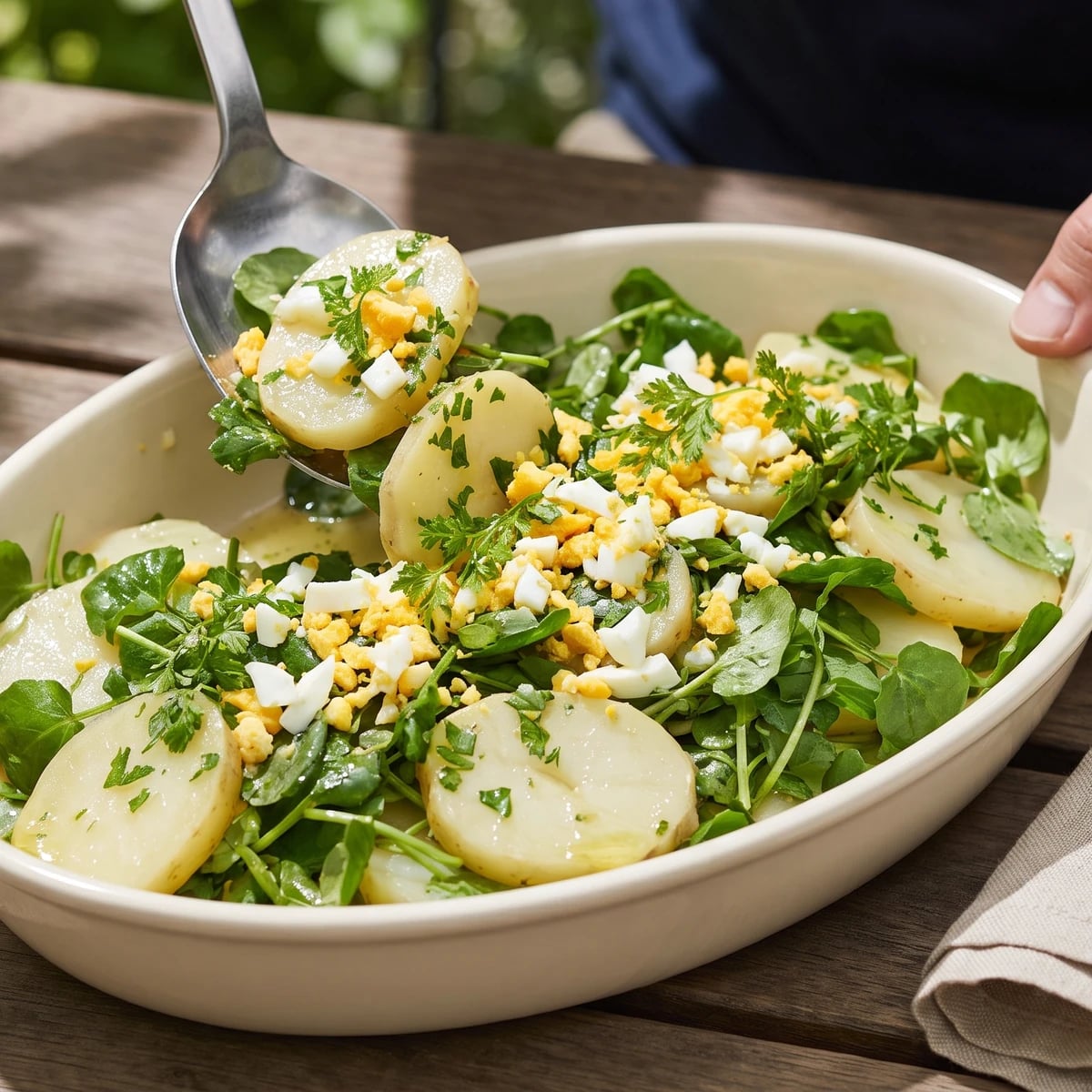
Equal parts potato salad and peppery watercress, folded together only at the last moment, then showered with parsley, chervil, and chopped egg: a quick Parisian salad that keeps its nerve.

Salads
French
Weeknight
Picnic
Quick Meal
15 min
Active Time
10 min cook30 min total
Yield4 servings

Salade Cressonnière (watercress and Parisian potato salad) teaches one clean principle: timing is part of seasoning. Peppery watercress and cool, dressed potatoes should meet only when the bowl is ready for the table. Bring the leaves in early and they collapse before the first fork arrives.

The original entry assumes a cold pantry with Salade Parisienne (No. 2017) already finished, eggs cooked, herbs picked, and several hands available at service. For four people, the honest home measure is two level cups of the prepared salad and two loosely filled cups of watercress. Equal volume, not equal weight, preserves the intended balance without burying the potatoes beneath a hedge. No saucier, perpetual stockpot, or salamander has work to do here. The extra bowls and last-minute hands are brigade scaffolding, so they go; the prepared component, equal-part measure, and final fold are the dish, so they stay. One cook, one stove, one evening.

The finished bowl should be pale and herb-flecked, with flashes of yolk gold and crisp green leaves running through every serving. Dry the watercress completely, then fold it in only after everything else is waiting. That final minute decides the salad.

Salade Cressonnière belongs to the Parisian cold-table repertoire, drawing its peppery green from watercress grown in spring-fed beds around Paris and neighboring Essonne. In classical French menu language, cressonnière identifies watercress as the defining garnish or partner rather than naming a vague regional style. The recipe also shows the cold pantry's modular practice: an established preparation could become another dish through proportion, contrast, and a carefully timed finish.

The technique, the tradition, and the story behind every dish.

Discover Culinary Explorer

Ingredients

prepared Salade Parisienne

Quantity

2 cups (500 ml / 400 g) Salade Parisienne (No. 2017)

chilled

watercress leaves

Quantity

2 loosely packed cups (500 ml / 60 g)

coarse stems removed

large eggs

Quantity

2

flat-leaf parsley

Quantity

2 tablespoons (30 ml / 8 g)

finely chopped

chervil

Quantity

2 tablespoons (30 ml / 4 g)

finely chopped

Equipment Needed

  • Small saucepan with lid
  • Salad spinner or clean kitchen towels
  • Broad mixing bowl
  • Flexible serving spoon

Instructions

  1. 1

    Cook the eggs

    Put the eggs in a small saucepan and cover them with cool water. Bring to a boil, cover, remove from the heat, and leave for 10 minutes. Cool them promptly in cold water, then peel and chop the whites and yolks together into small, irregular crumbs. They should remain distinct, not turn into paste.

  2. 2

    Revive the cress

    Pick the watercress leaves from any coarse stems, wash them in cold water, and dry them thoroughly in a salad spinner or between clean towels. Wet leaves dilute the prepared salad and slide away from its dressing. If the cress looks tired, plunge it into ice water for 5 minutes, then dry it well. Ça se rattrape: the cold water restores its crispness before dressing, but nothing restores it once it has wilted in the bowl.

    Measure the watercress after removing the coarse stems. Fill the cup loosely, without crushing the leaves, to preserve the source recipe's equal-volume proportion.
  3. 3

    Ready the base

    Place the prepared Salade Parisienne (No. 2017) in a broad mixing bowl. The referenced preparation is used as a finished component, exactly as the entry intends; its method remains with its own recipe. If it is refrigerator-stiff, leave it for 5 minutes so it can accept the leaves without crushing them. Do not add another dressing.

  4. 4

    Fold in cress

    Wait until everyone and everything else is ready. Add the equal volume of dry watercress to the Salade Parisienne (No. 2017), then lift and fold with a broad spoon just two or three times. You want the leaves distributed but still lively, with some remaining upright. If the salad must travel to a picnic, keep the two components separate and perform this fold after unpacking.

  5. 5

    Shower and serve

    Mix the chopped egg with the parsley and chervil, keeping the crumbs loose. Sprinkle the mixture generously over the salad rather than stirring it through, preserving the source entry's sequence and its green, gold, and white finish. Carry the bowl straight to the table. À table!

Chef Tips

  • Choose watercress with upright leaves and a clean peppery smell. Yellowed bunches belong in soup, where heat can use them kindly; this salad needs the living bite of fresh leaves.
  • Equal quantities means equal filled measures here, not equal weights. Watercress is mostly air and structure, so matching its weight to the potato salad would destroy the balance the entry sets down.
  • Resist lemon, vinaigrette, bacon, and extra mayonnaise. The prepared Salade Parisienne carries the seasoning and coherence; watercress, herbs, and egg are the complete transformation.
  • For a picnic, transport the watercress dry and wrapped separately. Fold it into the salad at the last possible moment, because the forty seconds of mixing are easy and the wilt is not.

Advance Preparation

  • Prepare Salade Parisienne (No. 2017) according to its own entry and keep it chilled. Measure the required portion shortly before assembling the salad.
  • The eggs may be boiled and peeled a day ahead. Keep them covered in the cold, then chop them shortly before serving so the yolks remain neat.
  • Wash and dry the watercress several hours ahead, then wrap it loosely in a dry towel and keep it cold. Do not combine it with the prepared salad until serving.

Frequently Asked Questions

Nutrition Information

1 serving (about 145g)

Calories
190 calories
Total Fat
10 g
Saturated Fat
2 g
Trans Fat
0 g
Unsaturated Fat
8 g
Cholesterol
95 mg
Sodium
310 mg
Total Carbohydrates
19 g
Dietary Fiber
2 g
Sugars
1 g
Protein
6 g

Note: Chef personas and recipes are created with AI assistance. Cook with care: follow safe food-handling practices, check doneness with a thermometer when needed, and adapt for allergies and your kitchen.

Where cooking meets culture.

Culinary guides, cultural storytelling, and the editorial depth that makes cooking meaningful.

Discover Culinary Explorer

More from Roasts and Salads - Salads

Browse the full collection