
Chef Juliette
Smelt (Éperlans)
Tiny éperlans, lightly floured and fried until their tails stand crisp, arrive in a generous heap on a napkin with fried parsley and grooved lemon, a weeknight lesson in heat and restraint.
A cooking platform built around craft, culture, and the stories behind what we eat.
Created by Chef Juliette
Based on No. 200, Chicken Forcemeat for Galantines, Pies and Terrines, from Le Guide Culinaire (1907) by Auguste Escoffier
Farce de volaille teaches the cold emulsion: chicken, pork, veal, fatback, eggs, and brandy kept icy, worked smooth, and sieved fine enough to bind a galantine, pâté, or terrine without greasiness.
Farce de volaille pour galantines, pâtés et terrines teaches the first law of every fine farce: cold is not housekeeping, it is structure. Keep the meat, fat, eggs, bowl, and blade cold enough that the fat stays suspended, and the finished slice will be smooth, tender, and richly seasoned. Let the mixture grow warm and the fat escapes. That is the one true thing to know before touching a pan.
This formula asks for no saucier, perpetual stockpot, or salamander. Its old burden was different: a large fowl with its fillets reserved, a chopping bench, a heavy mortar, a tamis, and enough hands to pound nearly six pounds of mixture without warming it. Here the book's formula is scaled to forty percent, with 8 ounces of chicken setting every other quantity. A chilled food processor replaces the mortar, while the ratios remain exact. One cook, one stove, one evening.
The chopping crew and stone mortar are scaffolding, so they may go. The proportion of lean meats to fresh fatback, the eggs added consecutively, the brandy poured last, and the final passage through the sieve are the dish itself, so they stay. Watch the farce while it emulsifies: it must become tacky and satin-fine without ever turning warm or oily.
Farce de volaille belongs to the shared craft of French charcutiers and classical kitchens, with the pâté shops and traiteurs of Paris giving galantines, raised pies, and decorated terrines a particularly public home. The formula traveled between the charcutier's mold, the grand kitchen's cold buffet, and the bourgeois dining table, serving as both filling and structural bond. Farce does not mean a loose stuffing here; it is a cold meat-and-fat emulsion, and the striking quantity of fresh fatback is what keeps a cooked, chilled slice tender rather than dry.
Quantity
about 1½ cups (8 oz / 227 g)
skinned, trimmed of sinew, and diced
Quantity
about ⅔ cup (3.2 oz / 91 g)
trimmed and diced
Quantity
about ⅔ cup (3.2 oz / 91 g)
trimmed and diced
Quantity
about 2½ cups (12 oz / 340 g)
diced
Quantity
2 (about 7 tablespoons / 100 g without shells)
thoroughly chilled
Quantity
4 teaspoons (0.8 oz / 23 g)
Quantity
3 tablespoons (45 ml / 43 g)
Quantity
up to ¾ cup (6.4 oz / 180 g)
diced and thoroughly chilled
Quantity
about ¾ to 1 cup (4 to 6 oz / 115 to 170 g)
finely chopped
| Ingredient | Quantity |
|---|---|
| raw boneless chicken meat, preferably thigh or mixed poultry trimmingsskinned, trimmed of sinew, and diced | about 1½ cups (8 oz / 227 g) |
| lean pork lointrimmed and diced | about ⅔ cup (3.2 oz / 91 g) |
| lean veal tenderloin or top roundtrimmed and diced | about ⅔ cup (3.2 oz / 91 g) |
| unsmoked, unsalted pork fatback, the home equivalent of fresh fat bacondiced | about 2½ cups (12 oz / 340 g) |
| large eggsthoroughly chilled | 2 (about 7 tablespoons / 100 g without shells) |
| fine spiced salt for charcuterie | 4 teaspoons (0.8 oz / 23 g) |
| brandy | 3 tablespoons (45 ml / 43 g) |
| raw foie gras trimmings (optional)diced and thoroughly chilled | up to ¾ cup (6.4 oz / 180 g) |
| fresh black truffle (optional)finely chopped | about ¾ to 1 cup (4 to 6 oz / 115 to 170 g) |
Trim the chicken, pork, veal, and fatback meticulously; sinew left now becomes a thread in the finished slice. Cut everything into 1-inch pieces and spread it on a chilled tray. If using foie gras, add its cold diced trimmings to the tray. Chill the meat, fat, processor bowl, blade, eggs, and brandy until the pieces are firm at their edges but not frozen solid, about 20 to 30 minutes. Cold is structure here: the fat must remain distinct long enough to form an emulsion instead of melting into grease.
Pulse the chicken, pork, veal, fatback, and optional foie gras in short bursts until finely chopped but not yet smooth. Work in two equal batches if the processor bowl is crowded, dividing every ingredient precisely; crowding makes the blade churn while the fat warms. The source permits chopping the meats together or separately, so use whichever keeps them coldest. If softened fat begins smearing the bowl, stop at once, spread the mixture on the chilled tray, and return it to the cold for 15 minutes. Ça se rattrape while the fat is still merely soft.
Combine the chopped meats and fat in the processor, add the spiced salt, and process until the mixture becomes fine, tacky, and cohesive enough to cling to the blade. Add the cold eggs one at a time, processing only until each disappears before adding the next. Scrape down the bowl, then pour in the brandy last and process just until absorbed. This order belongs to the farce and must stay. If the mixture turns oily or clear fat beads at the edges, stop, chill it firmly, then process one quarter until sticky and feed the remainder back into that cold base one spoonful at a time. A loose paste after the brandy is harmless; visible oil is the warning.
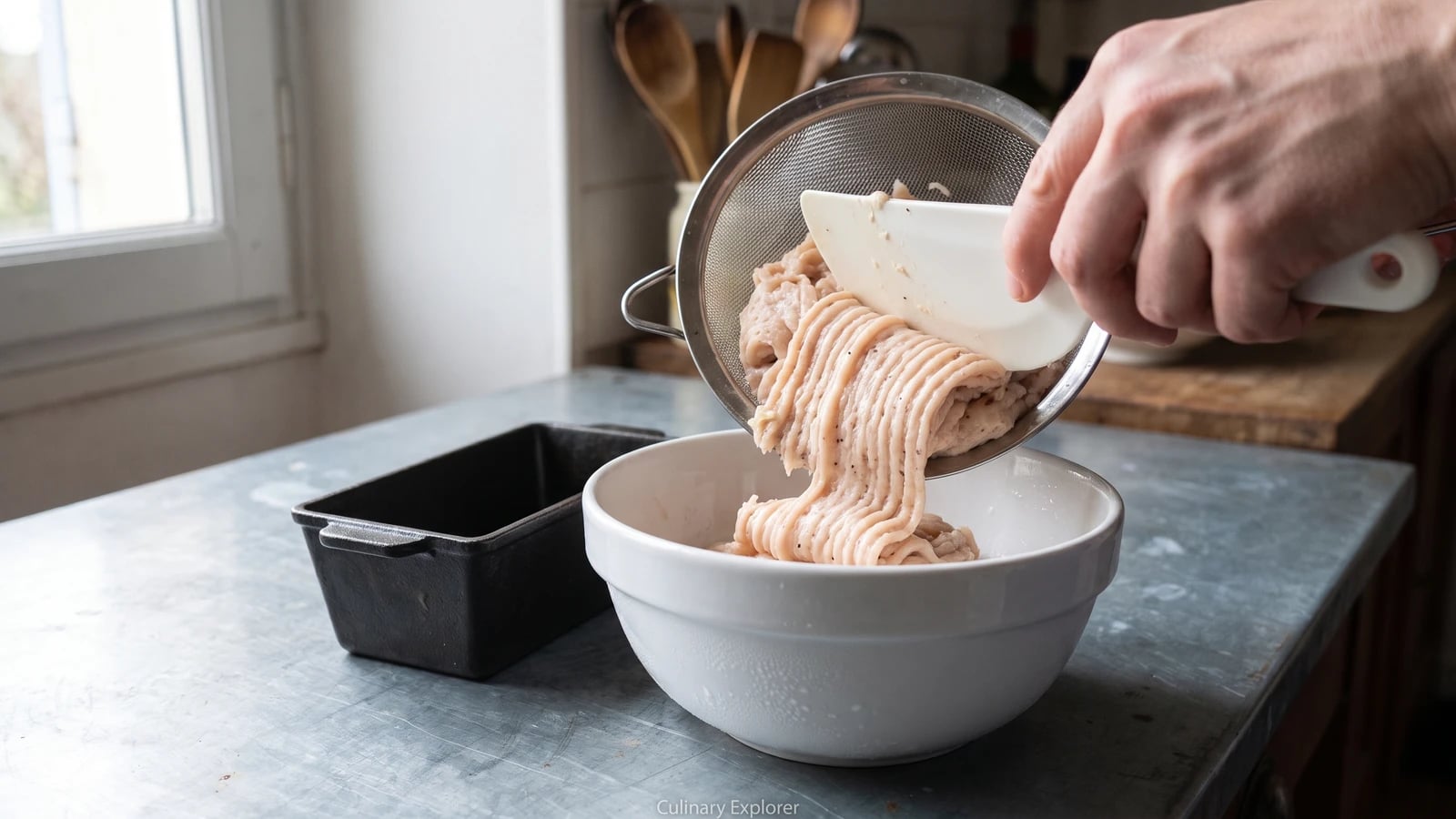
Set a fine-mesh tamis or sturdy sieve over a bowl nested in ice. Press the farce through in small portions with a flexible scraper, then scrape the smooth paste from the underside. Discard the sinew and coarse fibers left behind. The old chopping bench and stone mortar were brigade scaffolding, and the processor replaces them honestly; the sieving is not scaffolding. It gives a galantine or fine terrine its even, delicate slice. If the sieve clogs or the farce softens, clean the mesh and chill both paste and tools before continuing. Do not loosen it with water or cream.
Cook a teaspoon of farce as a thin patty in a small dry skillet until completely cooked through, about two minutes per side, then let it cool before tasting. Cold preparations mute seasoning, so judge the cooled sample. If it tastes flat, mix in additional spiced salt 1 gram at a time and test again; the source allows a small adjustment, not a free hand. If it is too salty, the only honest rescue is to prepare a small unseasoned portion in the same chicken, pork, veal, fatback, egg, and brandy ratios and blend in enough to restore balance. Breadcrumbs would change the farce rather than mend it.
If using truffle, fold it gently into the sieved farce now so the pieces remain visible. The source calls for 2 to 3 ounces per pound of farce, which means 4 to 6 ounces (115 to 170 g) for this unenriched batch; if foie gras has increased the final weight, recalculate the truffle at that same rate. Foie gras belongs in the initial emulsion and must never exceed one-fifth of the base farce by weight. Both additions are optional. The plain brandy-scented farce is complete without them.
Use the farce immediately to fill a galantine, pâté, or terrine, packing it firmly so no air pockets remain. If holding it, press food-safe wrap directly against the surface and refrigerate at or below 40°F (4°C) for no more than 24 hours. This is a raw component, not ready to eat; cook the filled preparation according to its own method until the center reaches at least 165°F (74°C), then chill promptly if it will be served cold. Once cooked and properly rested, À table!
1 serving (about 100g)
Culinary guides, cultural storytelling, and the editorial depth that makes cooking meaningful.
Discover Culinary ExplorerChef Juliette
Tiny éperlans, lightly floured and fried until their tails stand crisp, arrive in a generous heap on a napkin with fried parsley and grooved lemon, a weeknight lesson in heat and restraint.

Chef Juliette
Brandade de Morue turns salt cod, warm olive oil, and milk into a pale, silky emulsion: keep everything warm and add the oil slowly, then crown the generous dome with butter-fried bread.

Chef Juliette
Salt cod worked warm with cream, one patient spoonful at a time, until the rough flakes become a glossy Nîmes paste, domed generously and ringed with butter-fried croutons for the table.

Chef Juliette
Wine-poached char packed in its earthenware crock beneath butter gold: a make-ahead first course that turns careful cooling, thorough boning, and one unbroken seal into quiet abundance.