
Chef Juliette
John Dory (St. Pierre)
John Dory has the delicacy of sole and the firmness of turbot. A light flouring, a quick butter sauté, and nut-brown beurre noisette show exactly why looks never mattered.
A cooking platform built around craft, culture, and the stories behind what we eat.
Created by Chef Juliette
Based on No. 1950, Fillet of Beef, from Le Guide Culinaire (1907) by Auguste Escoffier
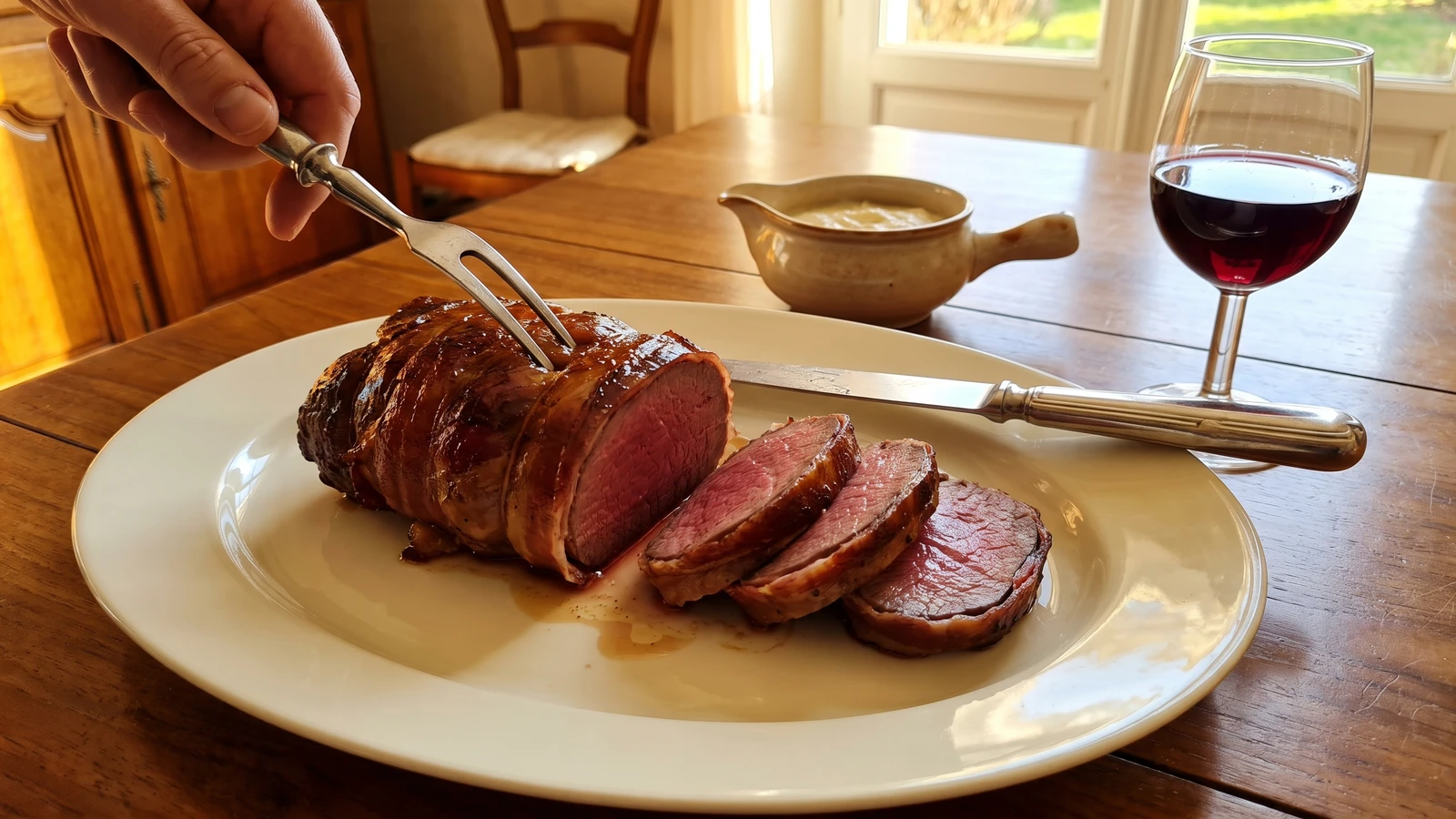
A whole filet de bœuf, protected with a bacon bard and roasted at fierce heat, proves the lesson of lean meat: guard the outside, trust the thermometer, and rest before carving the rosy centre.
Filet de Bœuf Rôti (roast fillet of beef) teaches one uncompromising thing: tenderness is not juiciness. The fillet has almost no internal fat, so once its two sinewy envelopes are stripped away, you must replace their protection before fierce heat touches the meat. A thin barde (fat wrapping) of unsmoked bacon or flattened beef fat does the work, guarding the exterior while the centre stays rosy.
The original kitchen assumed a larding needle, a roast cook watching the fire, and a saucier ready with Horse-radish or Albert Sauce (No. 119) or Horse-radish Sauce (No. 138). At home, larding strip by strip is brigade scaffolding you can discard. Overlapping slices of fat, butcher's string, a fierce oven, and an instant-read thermometer keep the intent intact, with either finished sauce made from its own entry and served apart. One cook, one stove, one evening.
The fierce heat and the resting time are not scaffolding. They are the dish. Pull the fillet below its final temperature, then give it twenty untouched minutes before carving; that rest is the one step that decides whether its juices stay in every slice or escape across the board.
Filet de bœuf rôti belongs to the classical French roast table, where tenderloin was prized for softness but understood to need larding or barding because its fine grain carries little fat. This entry's rosy centre, Yorkshire pudding, and horseradish accompaniments record the method's passage into English roast service, a French butchery and roasting technique meeting an English table. Removing the sinewy coverings was never permission to roast the meat bare; added fat replaced the protection that trimming had taken away.
Quantity
1 fillet, 2¼ lb (1 kg)
chain removed, with the two sinewy envelopes left for trimming
Quantity
10 to 12 thin slices, 8 oz (225 g)
for barding
Quantity
1 teaspoon (5 ml / 6 g)
Quantity
¾ teaspoon (3.75 ml / 1.5 g)
Quantity
½ cup (120 ml / about 120 g) Horse-radish or Albert Sauce (No. 119)
kept warm; choose one of the two referenced sauces
Quantity
½ cup (120 ml / about 120 g) Horse-radish Sauce (No. 138)
served very cold; choose one of the two referenced sauces
| Ingredient | Quantity |
|---|---|
| centre-cut whole beef fillet (tenderloin)chain removed, with the two sinewy envelopes left for trimming | 1 fillet, 2¼ lb (1 kg) |
| unsmoked streaky bacon or flattened beef fatfor barding | 10 to 12 thin slices, 8 oz (225 g) |
| fine sea salt | 1 teaspoon (5 ml / 6 g) |
| freshly ground black pepper | ¾ teaspoon (3.75 ml / 1.5 g) |
| finished Horse-radish or Albert Sauce (optional)kept warm; choose one of the two referenced sauces | ½ cup (120 ml / about 120 g) Horse-radish or Albert Sauce (No. 119) |
| finished Horse-radish Sauce (optional)served very cold; choose one of the two referenced sauces | ½ cup (120 ml / about 120 g) Horse-radish Sauce (No. 138) |
Keep the beef cold while you work. Slip a narrow, flexible knife beneath the first firm silver sheet, angle the blade slightly toward the sinew, and draw it along in short strokes. Remove the second envelope in the same manner, taking the tough membrane without shaving away the red meat beneath it. Do not chase every pale seam into the flesh; the two sinewy coverings must go, but unnecessary trimming only makes this lean joint drier.
Heat the oven to 450°F (230°C) with a rack in the middle. Dry the fillet thoroughly, then season it evenly with the salt and pepper. Lay the bacon or fat slices on the board with their edges slightly overlapping, set the fillet across them, and wrap the slices snugly around the meat. Tie with cotton butcher's string at 1½-inch (4 cm) intervals, tucking the narrow tail under itself if necessary to make the roast even. This barding replaces the protection lost during trimming; it is the intent of larding without the larding needle.
Set the barded fillet seam-side down on a rack in a shallow roasting tin. Roast at 450°F (230°C), beginning to check the centre after 18 minutes. Insert the thermometer from the side into the thickest part and remove the beef at 118 to 122°F (48 to 50°C); it should take roughly 22 to 30 minutes, but the thermometer decides. The fierce heat colours the fat covering before the lean centre dries. If one patch darkens too quickly, shield only that patch with a small piece of foil and continue roasting.
Transfer the fillet to a warm platter and cover it loosely with foil, leaving room for the exterior to remain dry. Rest it untouched for 20 minutes; the centre should rise to about 126 to 130°F (52 to 54°C) while the juices settle through the meat. Do not cut into it to check. If an early cut releases a flood of juice, stop. Ça se rattrape: place the cut faces together and rest the remaining roast for another 10 minutes before continuing.
While the beef rests, set the finished Horse-radish or Albert Sauce (No. 119) warm in a sauceboat, or set the finished Horse-radish Sauce (No. 138) very cold in a chilled bowl. These are alternatives, each a complete preparation from its own entry, and they remain apart from the meat until each guest takes some.
Snip away every piece of string without disturbing the barding. Carve the fillet across the grain into generous ¾-inch (2 cm) slices, keeping any crisp bacon or fat with the corresponding slice. Arrange the rosy pieces on the warm platter, spoon over any resting juices, and pass the chosen horseradish sauce separately. À table!
1 serving (about 230g)
Culinary guides, cultural storytelling, and the editorial depth that makes cooking meaningful.
Discover Culinary ExplorerChef Juliette
John Dory has the delicacy of sole and the firmness of turbot. A light flouring, a quick butter sauté, and nut-brown beurre noisette show exactly why looks never mattered.

Chef Juliette
Fresh haddock proves its delicacy in the meunière pan: a fine flour crust, moist pearly flakes, and beurre noisette sharpened with lemon and parsley, ready from one skillet in half an hour.

Chef Juliette
Éperlans à l’Anglaise turns small fish into a lesson in disciplined coating: boned smelts under a close, crisp crumb, pan-fried in clarified butter and finished with bright, half-melted maître d’hôtel butter.

Chef Juliette
Tiny smelts, shallot, mushrooms, white wine, gratin sauce, and fine bread raspings meet a fierce oven, where the fish must turn tender in the same breath the buttered crust bronzes.