
Chef Juliette
Smelt (Éperlans)
Tiny éperlans, lightly floured and fried until their tails stand crisp, arrive in a generous heap on a napkin with fried parsley and grooved lemon, a weeknight lesson in heat and restraint.
A cooking platform built around craft, culture, and the stories behind what we eat.
Created by Chef Juliette
Based on No. 1934, Sylphides d’Ortolans, from Le Guide Culinaire (1907) by Auguste Escoffier
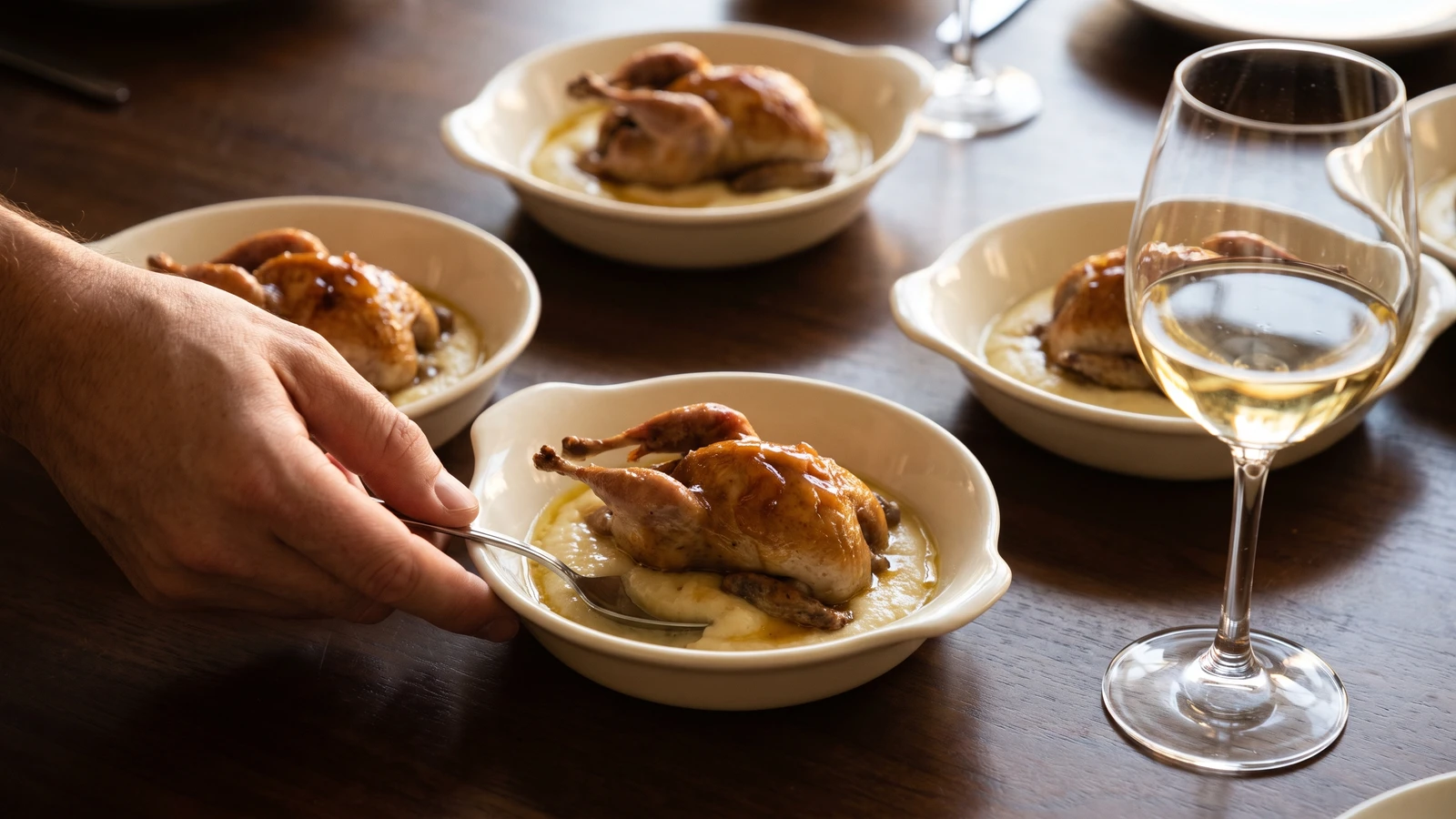
Four truffled mousseline cassolettes, gently poached and crowned with butter-seared quail, then glossed with beurre noisette, pale glaze, and pineapple juice, a precise grand-kitchen bite brought home.
Sylphides d’Ortolans (quail cassolettes with truffled mousseline) teach one exact discipline: mousseline stays delicate only when the meat, cream, bowl, and blade remain thoroughly cold. Warm forcemeat loses its emulsion and poaches grainy; cold forcemeat rises into a fine, tender cushion for the buttered bird.
The book’s kitchen assumed ortolans in the game larder, a saucier holding pale melted glaze, a stockpot never off the fire, and a dependable cool zone at the front of the oven. The salamander had no work here because the mousseline must poach without browning. Your kitchen gets legally farmed quail, rich chicken stock reduced to a spoonful, a bain-marie, and four shallow porcelain cassolettes. Ortolan is protected, so the bird changes because it must; the truffle, three-minute butter cook, beurre noisette, pale glaze, pineapple juice, and sequence remain. One cook, one stove, one evening.
Separate cooks, holding pans, and silver vessels are brigade scaffolding, and they can go. The cold emulsion, quiet poach, and timing the quail to meet the mousseline are the dish, and they stay. Before touching a pan, chill the meat, cream, egg white, processor bowl, and blade. That is the step that decides the Sylphides.
Ortolan bunting belongs to the table lore of Gascony and the Landes, while Sylphides d’Ortolans is a composed hot hors-d’œuvre from the Parisian grand-kitchen repertoire rather than a regional farmhouse dish. The bird is now protected in France and throughout the European Union, so its capture and trade are prohibited; farmed quail is the lawful home-kitchen translation, named honestly rather than passed off as the original. Pineapple juice is not a Provençal flourish here, but the small sweet-acid counterpoint the grand canon set against rich game, truffle, and butter.
Quantity
1 cup (240 ml / 240 g)
for the pale melted glaze
Quantity
8 ounces (225 g)
trimmed, diced, and very cold
Quantity
1 (about 2 tablespoons / 30 ml / 30 g)
very cold
Quantity
½ cup (120 ml / 120 g)
very cold
Quantity
2 teaspoons (10 ml / 10 g)
Quantity
1 teaspoon (5 ml / 5 g)
divided
Quantity
¼ teaspoon (1.25 ml / 0.5 g)
divided
Quantity
5 tablespoons plus 1 teaspoon (80 ml / 76 g)
divided
Quantity
4 (about 12 ounces / 340 g total)
skin on, butterflied and flattened to ⅜ inch (1 cm)
Quantity
1 tablespoon (15 ml / 15 g)
strained
| Ingredient | Quantity |
|---|---|
| rich unsalted chicken stock that gels when coldfor the pale melted glaze | 1 cup (240 ml / 240 g) |
| boneless farmed quail meattrimmed, diced, and very cold | 8 ounces (225 g) |
| large egg whitevery cold | 1 (about 2 tablespoons / 30 ml / 30 g) |
| heavy creamvery cold | ½ cup (120 ml / 120 g) |
| concentrated natural black-truffle juice (truffle essence) | 2 teaspoons (10 ml / 10 g) |
| fine sea saltdivided | 1 teaspoon (5 ml / 5 g) |
| finely ground white pepperdivided | ¼ teaspoon (1.25 ml / 0.5 g) |
| unsalted butterdivided | 5 tablespoons plus 1 teaspoon (80 ml / 76 g) |
| fully boned farmed quailskin on, butterflied and flattened to ⅜ inch (1 cm) | 4 (about 12 ounces / 340 g total) |
| unsweetened pineapple juicestrained | 1 tablespoon (15 ml / 15 g) |
Reserve 1 tablespoon of the chicken stock, then pour the remainder into a small wide saucepan. Simmer steadily until it reduces to 2 tablespoons, looks pale amber, and coats a cold spoon with a thin, sticky glaze, about 18 to 22 minutes. Do not drive it until dark, because this is a pale melted glaze, not a roasted meat reduction. If it tightens to a paste, loosen it with a little of the reserved stock; if it scorches and smells bitter, begin again.
Chill the food processor bowl and blade for 15 minutes. Add the cold quail meat, ¾ teaspoon of the salt, and ⅛ teaspoon of the white pepper, then process until the meat forms a smooth, sticky paste. Add the egg white and process only until absorbed. Reserve 1 tablespoon of cream, then add the rest in a thin stream with the machine running, stopping as soon as the mousseline turns smooth and satin-like. Pulse in the truffle essence and the reserved cream. Poach a teaspoonful in barely simmering water until fully cooked, then taste and adjust with a pinch of the remaining salt if needed.
Heat the oven to 300°F (150°C). Butter four shallow 8-ounce (240 ml) ovenproof cassolettes with 1 teaspoon of the butter. Divide the mousseline among them, filling each no more than halfway, and smooth the tops without pressing out their lightness. Set the cassolettes in a roasting pan and add hot water to reach halfway up their sides. Bake until the mousseline is softly set, remains pale, and reaches 165°F (74°C) at the centre, about 15 to 18 minutes. If the surface begins to colour, cover it loosely with foil and lower the oven slightly.
When the mousseline is nearly set, dry the flattened quail thoroughly and season them with the remaining salt and white pepper. Melt 2 tablespoons of butter in a broad skillet over medium-high heat. When the foam subsides, lay in the quail skin-side down and cook for 90 seconds, pressing the breasts gently against the pan. Turn and cook for 90 seconds more, basting with the foaming butter. For birds flattened to ⅜ inch (1 cm), the total is three minutes. Confirm that the thickest part reaches 165°F (74°C); if it does not, lower the heat and cook in 20-second turns until it does. Rest for 2 minutes.
Warm the pale melted glaze with the pineapple juice until fluid. Melt the remaining 3 tablespoons of butter in a clean small pan over medium heat. Let it foam, quiet, and turn beurre noisette, butter cooked to a hazelnut colour, with amber milk solids and a warm nutty aroma. Pull it from the heat before those solids turn black. Whisk in the warm glaze and pineapple mixture a little at a time; it should become glossy and lightly bound, with sweetness only at the finish.
Lift the cassolettes from the bain-marie and dry their bases. Set one quail into each, folding the legs inward so the bird rests neatly on the truffled mousseline. Spoon the warm beurre noisette, pale glaze, and pineapple finish over each bird, letting a little pool around the edges. Serve immediately while the mousseline is tender and the butter still gleams. À table!
1 serving (about 205g)
Culinary guides, cultural storytelling, and the editorial depth that makes cooking meaningful.
Discover Culinary ExplorerChef Juliette
Tiny éperlans, lightly floured and fried until their tails stand crisp, arrive in a generous heap on a napkin with fried parsley and grooved lemon, a weeknight lesson in heat and restraint.

Chef Juliette
Brandade de Morue turns salt cod, warm olive oil, and milk into a pale, silky emulsion: keep everything warm and add the oil slowly, then crown the generous dome with butter-fried bread.

Chef Juliette
Salt cod worked warm with cream, one patient spoonful at a time, until the rough flakes become a glossy Nîmes paste, domed generously and ringed with butter-fried croutons for the table.

Chef Juliette
Wine-poached char packed in its earthenware crock beneath butter gold: a make-ahead first course that turns careful cooling, thorough boning, and one unbroken seal into quiet abundance.