
Chef Juliette
Smelt (Éperlans)
Tiny éperlans, lightly floured and fried until their tails stand crisp, arrive in a generous heap on a napkin with fried parsley and grooved lemon, a weeknight lesson in heat and restraint.
A cooking platform built around craft, culture, and the stories behind what we eat.
Created by Chef Juliette
Based on No. 1912, Mandarines de Cailles, from Le Guide Culinaire (1907) by Auguste Escoffier
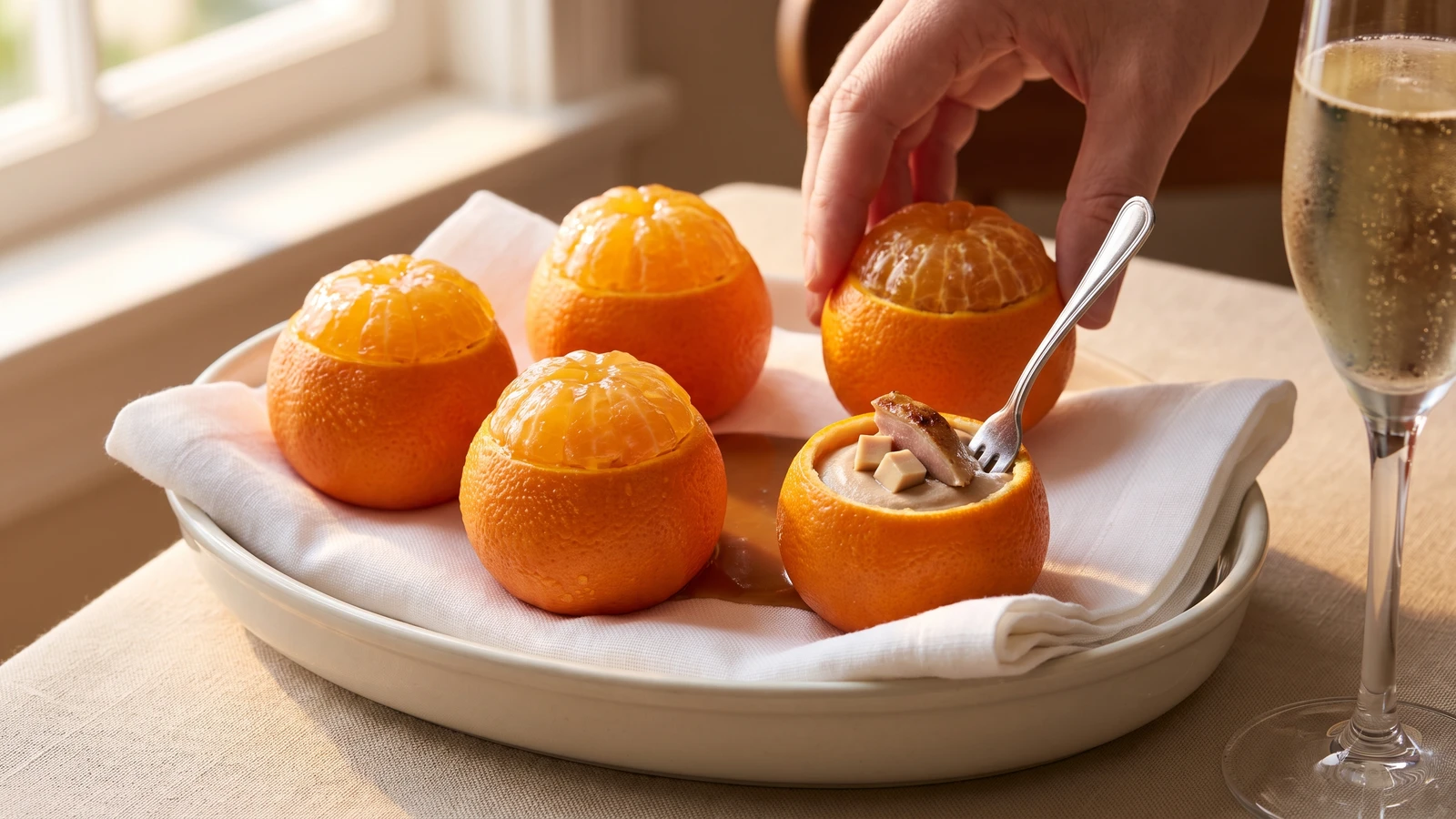
A cold classical conceit made workable at home: tangerine shells packed with quail Mousse and foie gras, crowned with roast fillet, then finished in glossy brown chaud-froid and clear aspic.
Mandarines de Cailles (tangerine shells filled with quail) teaches the discipline behind cold Mousses. Cooked meat, gelatin, and softly whipped cream must meet as one cool emulsion, or the filling turns grainy before it ever reaches the rind. The one true thing to know before touching a pan is simple: a warm Mousse will not hold, so cool the quail base fully, keep the cream cold, and work fast once they meet.
The brigade recipe assumed a saucier, a stockpot never off the fire, and larder hands to pound, sieve, mask, and glaze a whole service; the salamander used for so many grand finishes had no work in this cold dish. At home, four shells, a mini processor in place of the mortar, one concentrated quail fond, the refrigerator, and a pastry brush give the same intent. The brigade's volume and extra hands are scaffolding and can go. The cold Mousse, roasted fillet, sauce chaud-froid brune (a brown masking sauce that sets cold), skinned tangerine sections, and aspic glaze are the dish and must stay. One cook, one stove, one evening.
When it is right, each tangerine looks nearly whole until the fork finds silken quail Mousse, cool cubes of foie gras, and a roast fillet beneath savory brown glaze and bright fruit. Cool the purée before folding in the cream. That is the step that decides everything.
Mandarines de Cailles belongs to the Parisian grand-kitchen repertoire of cold hors-d'oeuvre and buffet service, where chaud-froid allowed cooked game to be masked, decorated, and held neatly in the cold. The name is literal rather than regional: the mandarin rind serves as mold and dish, while its raw-skinned sections are rebuilt over the quail so the finished piece reads again as fruit. Chaud-froid is not simply a warm sauce allowed to cool; here it is a gelatin-strengthened brown sauce designed to coat a chilled fillet and set to a clean gloss.
Quantity
4 (about 1¼ pounds / 570 g total)
scrubbed and dried
Quantity
4 (about 1¼ pounds / 570 g total)
patted dry
Quantity
½ cup (120 ml / 120 g)
very cold
Quantity
about ⅓ cup (80 ml / 70 g)
cut into ¼-inch dice and chilled
Quantity
1½ cups (360 ml / 360 g)
Quantity
½ cup (120 ml / 120 g)
Quantity
3 tablespoons (45 ml / 42 g)
divided
Quantity
2 tablespoons (30 ml / 16 g)
Quantity
1 teaspoon (5 ml / 3 g)
Quantity
2 tablespoons (30 ml / 30 g)
Quantity
1 teaspoon (5 ml / 3 g)
Quantity
2 tablespoons (30 ml / 30 g)
Quantity
½ teaspoon (2.5 ml / 1.5 g)
Quantity
1 tablespoon (15 ml / 15 g)
Quantity
1½ teaspoons (7.5 ml / 8 g)
divided
Quantity
¼ teaspoon (1 ml / 0.5 g)
divided
| Ingredient | Quantity |
|---|---|
| large, firm tangerinesscrubbed and dried | 4 (about 1¼ pounds / 570 g total) |
| whole quailpatted dry | 4 (about 1¼ pounds / 570 g total) |
| heavy creamvery cold | ½ cup (120 ml / 120 g) |
| cooked whole foie gras or firm foie gras terrinecut into ¼-inch dice and chilled | about ⅓ cup (80 ml / 70 g) |
| unsalted chicken stock for the quail fond | 1½ cups (360 ml / 360 g) |
| clear unsalted chicken stock for the aspic | ½ cup (120 ml / 120 g) |
| unsalted butterdivided | 3 tablespoons (45 ml / 42 g) |
| all-purpose flour | 2 tablespoons (30 ml / 16 g) |
| powdered gelatin for the quail Mousse | 1 teaspoon (5 ml / 3 g) |
| cold water for the Mousse gelatin | 2 tablespoons (30 ml / 30 g) |
| powdered gelatin for the brown chaud-froid | 1 teaspoon (5 ml / 3 g) |
| cold water for the chaud-froid gelatin | 2 tablespoons (30 ml / 30 g) |
| powdered gelatin for the clear aspic | ½ teaspoon (2.5 ml / 1.5 g) |
| cold water for the aspic gelatin | 1 tablespoon (15 ml / 15 g) |
| fine sea saltdivided | 1½ teaspoons (7.5 ml / 8 g) |
| ground white pepperdivided | ¼ teaspoon (1 ml / 0.5 g) |
Center a 1½-inch round cutter over each stem and press only hard enough to score an even circle. Finish the cut with a small sharp knife, lift away the cap, and ease out the sections with a grapefruit spoon without puncturing the rind. Set the empty shells upside down on a rack for at least 1 hour. Peel every scrap of white membrane from the sections while they are raw, keeping as many whole as possible, then cover and chill them. Drying the shells is not decoration: moisture left inside loosens the Mousse.
Heat the oven to 450°F (230°C). Rub the quail with 2 tablespoons (30 ml / 28 g) of the butter and season them with about half the salt and white pepper. Arrange them breast-side up in a small heavy roasting pan and roast for 12 to 15 minutes, until deeply golden and the thickest meat reaches 165°F (74°C). Rest for 10 minutes, preserving every browned drop in the pan, then cool the birds until they can be handled.
Lift the breasts from the quail, keeping four of the neatest fillets whole for the tops. Cover and chill those fillets immediately. Remove the skin, sinew, and any browned edges from the remaining breast and leg meat, then weigh out 5 ounces (about 1 cup / 140 g) for the Mousse. Break the carcasses into several pieces and keep them with the roasting pan. The fillet must remain recognizably roasted; the picked meat is the part that becomes silk.
Set the roasting pan over medium heat, add the broken carcasses, and let their edges brown for 4 to 5 minutes. Pour in the 1½ cups (360 ml / 360 g) of chicken stock and scrape the pan floor clean. Simmer uncovered for about 25 minutes, strain, then reduce the liquid to 1 cup (240 ml / 240 g). Measure 3 tablespoons (45 ml / 45 g) for the Mousse and ¾ cup (180 ml / 180 g) for the chaud-froid. This concentrated fond replaces the stockpot that once never left the fire.
Bloom the Mousse gelatin in its 2 tablespoons (30 ml / 30 g) of cold water for 5 minutes. Warm the 3 tablespoons (45 ml / 45 g) of quail fond, dissolve the gelatin in it, and process the mixture with the 5 ounces (140 g) of picked quail meat until completely smooth. Press the purée through a fine sieve, season with a little of the remaining salt and white pepper, then stir it over ice until cool but still fluid. Whip the cream to soft folds, reserving two spoonfuls, and fold the rest into the quail base in three additions. Fold in the cold foie gras dice last. A warm Mousse will not hold. If the base begins setting before the cream is incorporated, warm the underside of the bowl briefly over lukewarm water; if the finished Mousse feels loose, set it over ice for 2 minutes and fold in the reserved cream. Ça se rattrape.
Stand the dried tangerine shells in four small ramekins so they cannot roll. Spoon in the quail Mousse until each shell is three-quarters full, exactly as the original preparation directs, then smooth the surface without packing it down. Chill for 45 to 60 minutes, until the Mousse is firm enough to support a fillet. Do not fill to the rim; the roast fillet, chaud-froid, and fruit still need their place.
Bloom the chaud-froid gelatin in its 2 tablespoons (30 ml / 30 g) of cold water. Melt the remaining 1 tablespoon (15 ml / 14 g) of butter in a small saucepan, stir in the flour, and cook this roux until it reaches the brown of a hazelnut and smells toasted, not scorched. Whisk in the reserved ¾ cup (180 ml / 180 g) of quail fond a little at a time, then simmer for 5 minutes, until the sauce coats the back of a spoon. Remove it from the heat, dissolve in the bloomed gelatin, strain, and correct the seasoning. Cool the sauce over ice, stirring, until it remains fluid but leaves an opaque brown coat on the spoon. If it sets too far, loosen it over lukewarm water; if it runs thin, return it to the ice for a minute.
Bloom the aspic gelatin in its 1 tablespoon (15 ml / 15 g) of cold water. Warm the clear ½ cup (120 ml / 120 g) of chicken stock, dissolve the gelatin in it, strain, and cool it until lightly syrupy. Set one chilled roast quail fillet on each firm Mousse and mask the fillet completely with the brown chaud-froid. Chill for 10 minutes to set the coat. Arrange the membrane-free tangerine sections over each top in overlapping petals, covering the fillet, then brush them with the clear aspic. Chill for 10 minutes and apply a second fine coat. If either glaze sets in its bowl, warm it gently only until it flows again.
Refrigerate the finished Mandarines de Cailles for at least 2 hours, loosely covered so nothing touches the glaze. Line a low serving dish with a folded white linen napkin, which steadies the round shells and catches their cold condensation, then arrange the mandarines upright. Serve directly from the cold with small forks or spoons; the rind is the vessel, not part of the bite. À table!
1 serving (about 300g)
Culinary guides, cultural storytelling, and the editorial depth that makes cooking meaningful.
Discover Culinary ExplorerChef Juliette
Tiny éperlans, lightly floured and fried until their tails stand crisp, arrive in a generous heap on a napkin with fried parsley and grooved lemon, a weeknight lesson in heat and restraint.

Chef Juliette
Brandade de Morue turns salt cod, warm olive oil, and milk into a pale, silky emulsion: keep everything warm and add the oil slowly, then crown the generous dome with butter-fried bread.

Chef Juliette
Salt cod worked warm with cream, one patient spoonful at a time, until the rough flakes become a glossy Nîmes paste, domed generously and ringed with butter-fried croutons for the table.

Chef Juliette
Wine-poached char packed in its earthenware crock beneath butter gold: a make-ahead first course that turns careful cooling, thorough boning, and one unbroken seal into quiet abundance.