
Chef Juliette
Smelt (Éperlans)
Tiny éperlans, lightly floured and fried until their tails stand crisp, arrive in a generous heap on a napkin with fried parsley and grooved lemon, a weeknight lesson in heat and restraint.
A cooking platform built around craft, culture, and the stories behind what we eat.
Created by Chef Juliette
Based on No. 1909, Filets de cailles aux Pommes d’Or, from Le Guide Culinaire (1907) by Auguste Escoffier
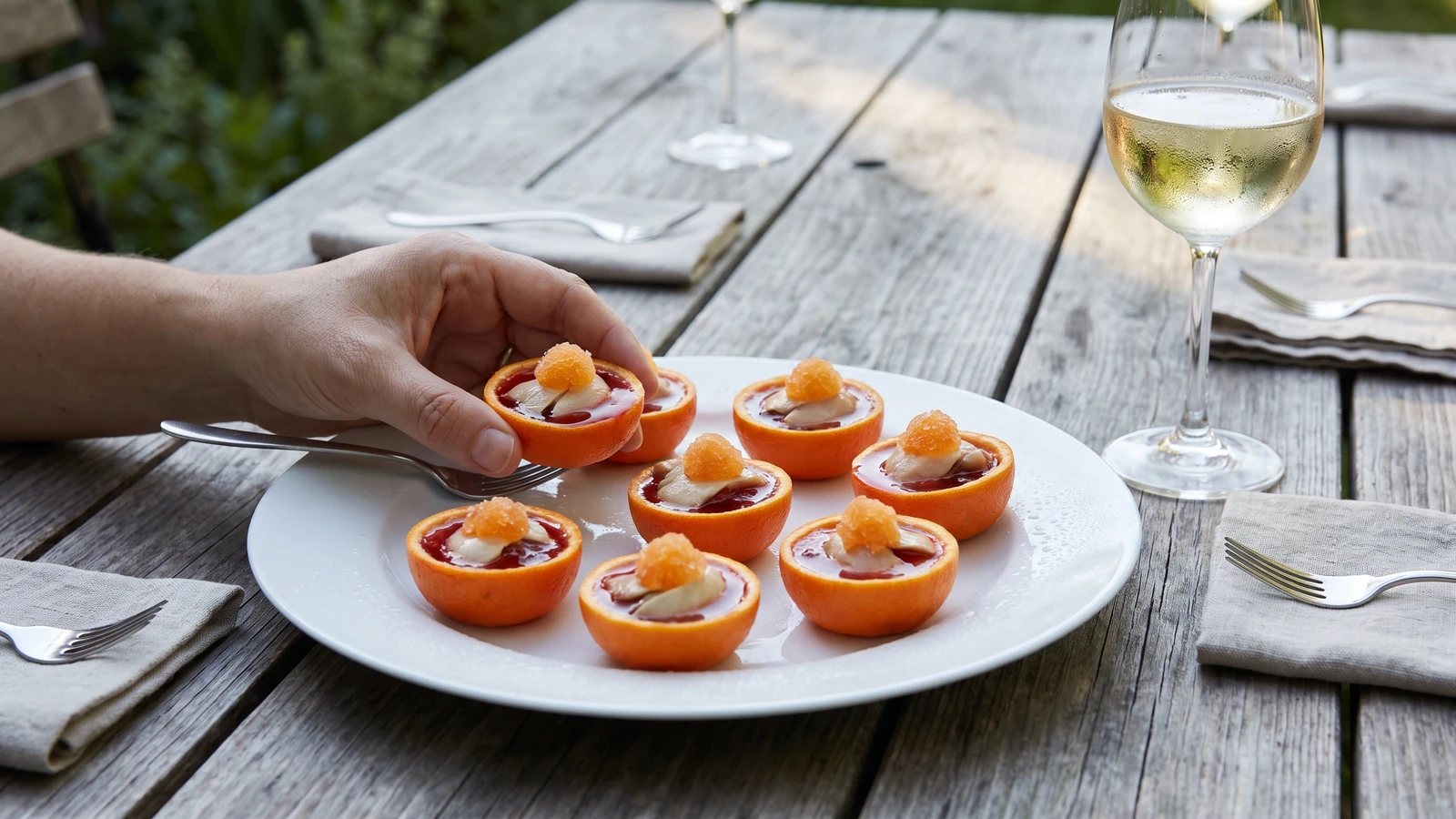
Tender quail suprêmes, ruby Port jelly, and tangerine granité meet inside bright citrus shells, a cold first course that teaches the discipline of setting one texture completely before adding the next.
Filets de cailles aux Pommes d’Or (quail suprêmes in golden citrus shells) teaches the discipline of cold assembly: each layer must be finished, cooled, and set before the next arrives. The Suprême, the breast fillet of the quail, stays tender because the bird is poached whole, cooled, and only then carved. Ruby Port jelly holds the pale meat inside the bright rind, while tangerine granité gives the last, icy flash.
The original entry assumed a garde-manger, the cold station, with clear jelly ready, a stockpot never off the fire, a freezer watched by another pair of hands, and enough birds for a banquet. At home, one small pan of clear stock replaces the standing pot, powdered gelatin replaces the prepared jelly supply, and a shallow metal tray replaces the ice machine. Clarifying gallons of aspic and shaping dozens of cases were brigade scaffolding, so they go; poaching before carving, setting the Port jelly, and piping the fruit granité at the last moment are the dish, so they stay. One cook, one stove, one evening.
Let the jelly become fully firm before the granité comes near it. If you pipe onto a soft set, the two run together and the careful contrast disappears. That clean division between garnet jelly and pale-orange ice is the step that decides the dish.
Filets de cailles aux Pommes d’Or belongs to the formal garde-manger table of French grande cuisine, where poached game birds were served cold under clear jelly and individual fruit cases turned them into composed hors d’oeuvres. Here Pommes d’Or means the golden orange or tangerine shells, not apples or potatoes, and the conceit is practical as well as decorative: the rind perfumes the quail while containing its Port jelly. The dish passed from banquet service to the home dinner table once prepared gelatin and a domestic freezer made its two cold preparations manageable in small quantities.
Quantity
4 (about 4½ oz / 125 g each)
Quantity
6 (about 1½ lb / 680 g total)
4 reserved for shells and all juiced
Quantity
6 cups (1.4 L / 1.4 kg)
divided
Quantity
1 teaspoon (5 ml / 6 g)
divided
Quantity
½ cup (120 ml / 118 g)
Quantity
2¼ teaspoons (11 ml / 7 g)
Quantity
3 tablespoons (45 ml / 38 g)
Quantity
2 tablespoons (30 ml / 30 g)
| Ingredient | Quantity |
|---|---|
| whole oven-ready quails | 4 (about 4½ oz / 125 g each) |
| small, thin-skinned tangerines4 reserved for shells and all juiced | 6 (about 1½ lb / 680 g total) |
| light, clear, unsalted chicken stockdivided | 6 cups (1.4 L / 1.4 kg) |
| fine saltdivided | 1 teaspoon (5 ml / 6 g) |
| ruby Port | ½ cup (120 ml / 118 g) |
| unflavored powdered gelatin | 2¼ teaspoons (11 ml / 7 g) |
| granulated sugar | 3 tablespoons (45 ml / 38 g) |
| water | 2 tablespoons (30 ml / 30 g) |
Choose the four most even tangerines for the cases and cut them across the equator. Ream them gently over a fine sieve, then lift out the membranes with a small spoon without cutting through the white pith; the rind must remain strong enough to hold the jelly. Set the eight shells in a muffin tin so they cannot rock. Juice the remaining fruit, strain it, and measure 1 cup (240 ml / 250 g), saving any extra. Warm the sugar and water just until the sugar dissolves, then cool and stir in the measured juice. Pour into a shallow metal pan and freeze, scraping firmly with a fork after 30 minutes and every 30 minutes thereafter, until the granité forms fine crystals that hold together when pressed, about 2½ to 3 hours. If it freezes into a hard block, let it stand for 5 minutes and rake it again. Ça se rattrape. Keep it frozen until service.
Reserve ¾ cup (180 ml / 180 g) of the chicken stock for the jelly. Put the remaining stock and ¾ teaspoon of the salt in a snug saucepan and bring it to a bare simmer, about 185°F (85°C). Lower in the whole quails and keep the liquid between 180°F and 185°F (82°C and 85°C), with only an occasional tremble at the surface. Begin checking after 10 minutes and remove each bird when the thickest part of its breast reaches 165°F (74°C), usually within 10 to 14 minutes. A boil would toughen the breasts, so lower the heat at once if the stock becomes lively. Drain the birds on a rack for 15 minutes, then refrigerate them until cold through, about 45 minutes. Cooling before carving is not brigade fussiness. Warm quail flesh is delicate and tears away from the breastbone instead of lifting cleanly.
Remove the skin from each cold quail. With the tip of a small flexible knife, follow one side of the breastbone, keeping the blade against the bone as you lift away the whole breast fillet. Repeat on the other side to produce eight Suprêmes. If one tears, fit the pieces together inside a shell with their smooth sides uppermost; the jelly will hold the seam and no one at the table need hear a confession. Set one Suprême, curved side up, inside each chilled tangerine shell. Return the filled shells to the refrigerator while you make the jelly. Reserve the cooked legs and carcasses for another meal.
Put ¼ cup (60 ml / 60 g) of the reserved cold stock in a small bowl, sprinkle the gelatin evenly over it, and leave it for 5 minutes to swell. Heat the remaining ½ cup (120 ml / 120 g) stock with the remaining ¼ teaspoon salt until just below a simmer. Remove it from the heat, add the swollen gelatin, and stir until perfectly clear, then stir in the ruby Port. Cool the jelly over a bowl of ice water, stirring gently, until it is cold and just beginning to coat the spoon but remains pourable. If it sets in the jug, don't force it into the shells. Stand the jug in warm water and stir until fluid again. Never boil the gelatin once it has been added, or its set may weaken.
Keep the tangerine shells upright in the muffin tin and pour the cold Port jelly around each Suprême, filling the rind nearly to its edge. Clear any surface bubbles with the corner of a paper towel. Refrigerate without moving the tray for at least 3 hours, until the jelly is firm enough to resist the light touch of a fingertip. Cover the tray only after the surface has set, so the wrapping cannot mark it.
Chill the serving platter. Rake the granité once more so its crystals are fine, then pack it into a cold piping bag fitted with a large open-star tip. Confirm that the Port jelly is fully firm before piping one modest ornament of granité onto each shell. If the granité is too hard to pipe, rest it for 3 to 5 minutes; if it becomes wet and loose, return it to the freezer for 10 minutes. If granité has already begun to bleed into jelly that was too soft, spoon it off, chill the shells until firm, and pipe them again with fresh granité. Ça se rattrape. Arrange two shells per person and serve immediately. For outdoor dining, carry the set shells and granité separately in a well-packed cooler, keeping both below 40°F (4°C), and pipe only when everyone is seated. À table!
1 serving (about 265g)
Culinary guides, cultural storytelling, and the editorial depth that makes cooking meaningful.
Discover Culinary ExplorerChef Juliette
Tiny éperlans, lightly floured and fried until their tails stand crisp, arrive in a generous heap on a napkin with fried parsley and grooved lemon, a weeknight lesson in heat and restraint.

Chef Juliette
Brandade de Morue turns salt cod, warm olive oil, and milk into a pale, silky emulsion: keep everything warm and add the oil slowly, then crown the generous dome with butter-fried bread.

Chef Juliette
Salt cod worked warm with cream, one patient spoonful at a time, until the rough flakes become a glossy Nîmes paste, domed generously and ringed with butter-fried croutons for the table.

Chef Juliette
Wine-poached char packed in its earthenware crock beneath butter gold: a make-ahead first course that turns careful cooling, thorough boning, and one unbroken seal into quiet abundance.