
Chef Juliette
John Dory (St. Pierre)
John Dory has the delicacy of sole and the firmness of turbot. A light flouring, a quick butter sauté, and nut-brown beurre noisette show exactly why looks never mattered.
A cooking platform built around craft, culture, and the stories behind what we eat.
Created by Chef Juliette
Based on No. 1862, Suprêmes de Faisan Gastronome, from Le Guide Culinaire (1907) by Auguste Escoffier
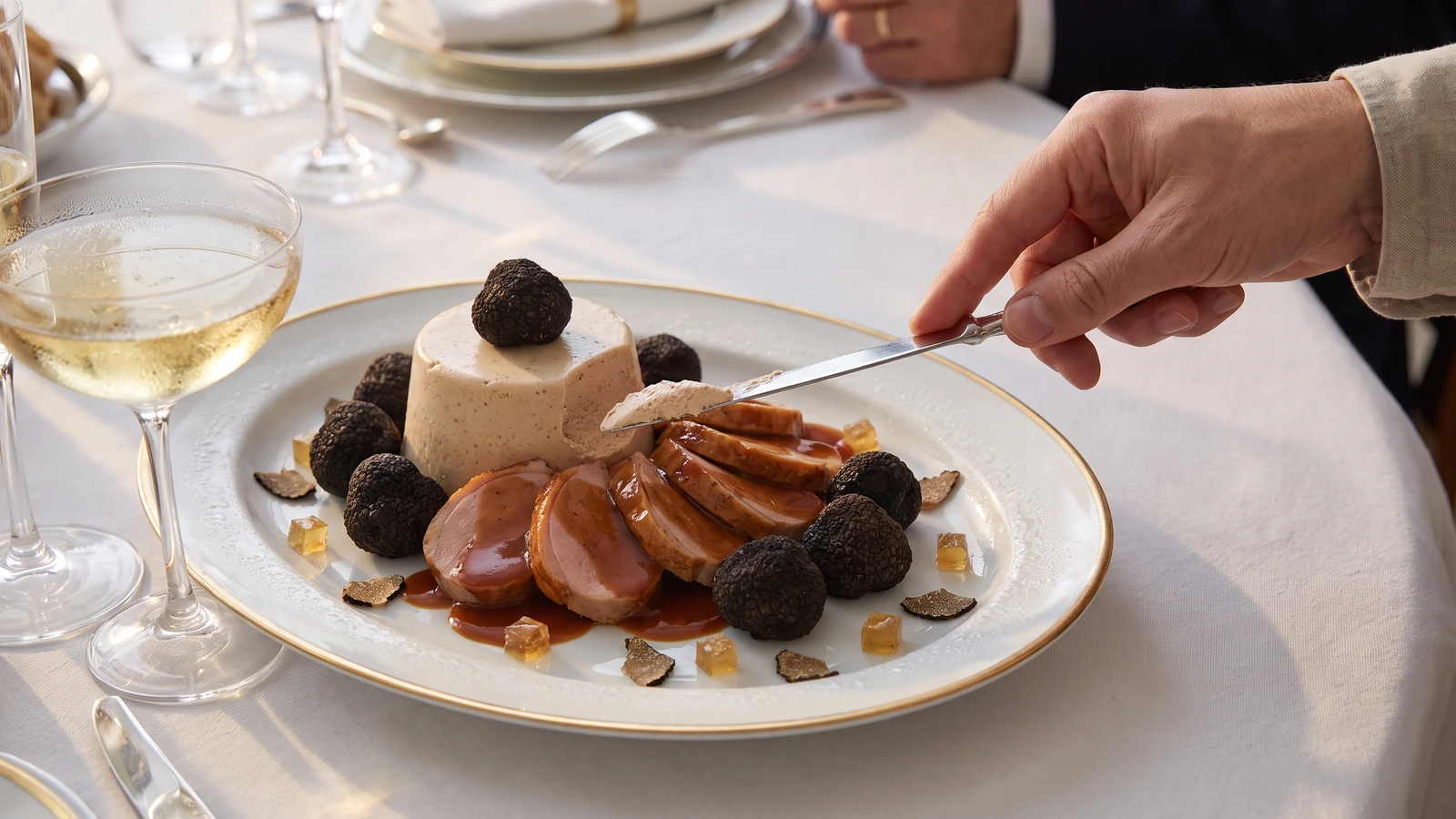
Suprêmes de Faisan Gastronome turns one pheasant into a cold architectural centerpiece: glossy chaud-froid breast slices, a precisely matched leg-meat mousse, Champagne-poached truffles, and aspic cut like little jewels.
Suprêmes de Faisan Gastronome (cold pheasant breasts with mousse, chaud-froid, and truffles) teaches one severe and useful principle: a cold composition succeeds by proportion before ornament. The glossy breast slices must rise exactly to the depth of the leg-meat mousse, so decide now that you will measure, not guess. When the heights agree, the slices lean naturally and the platter looks abundant rather than fussy.
The original assumed a saucier at your elbow, brown stock never off the fire, brigade quantities, a cupboard of parfait moulds, and a silver hatelet for the crowning truffle. At home, one pheasant, good prepared demi-glace, a 5-inch springform ring, and a short wooden cocktail pick perform the same honest work. The salamander has no job here, because this construction is served cold. One cook, one stove, one evening of work, then a proper rest in the cold.
Only the freehand decoration changes: neat diamonds cut from the truffle peelings replace a brigade's elaborate motifs, because more ornament adds hands, not flavor. The Poëling, Madeira, brown chaud-froid (a gelatin-set brown sauce served cold), leg-meat mousse, Champagne truffles, and aspic border are the dish and must stay. The measure that decides everything comes after coating: stand up one glazed slice, mark its exact height inside the mould, and fill the mousse to that line. No higher, no lower.
Suprêmes de Faisan Gastronome belongs to the Parisian grand-kitchen repertoire of cold game dishes prepared for formal suppers and buffet tables, where one bird supplied the sliced suprêmes, the mousse, and the foundation of the sauce. Chaud-froid describes food cooked hot and presented cold, not a sauce served at two temperatures; its glossy coating kept sliced meat succulent while giving the platter its composed finish. Gastronome is not a regional claim but a formal garnish built from game, truffles, Champagne, and aspic.
Quantity
½ cup (120 ml / 120 g), for Poëlings (No. 250)
Quantity
2 cups (475 ml / 450 g) Mousse de Volaille Froide (No. 1711)
made with the cooked pheasant leg meat and clean trimmings
Quantity
1½ cups (360 ml / 360 g)
Quantity
½ cup (120 ml / 120 g), from Poëlings (No. 250)
strained and degreased
Quantity
¼ cup (60 ml / 60 g)
Quantity
2 teaspoons (10 ml / 6 g)
Quantity
2 tablespoons (30 ml / 30 g)
Quantity
7 truffles, about 5 ounces (140 g)
brushed clean and peeled, peelings reserved
Quantity
1½ cups (360 ml / 355 g)
Quantity
2 cups (475 ml / 475 g)
for the aspic
Quantity
4 teaspoons (20 ml / 12 g)
Quantity
¼ cup (60 ml / 60 g)
Quantity
to taste
Quantity
to taste
| Ingredient | Quantity |
|---|---|
| whole young pheasantoven-ready | 1 bird, about 2½ pounds (1.1 kg), for Poëlings (No. 250) |
| Madeira for the pheasant | ½ cup (120 ml / 120 g), for Poëlings (No. 250) |
| Mousse de Volaille Froidemade with the cooked pheasant leg meat and clean trimmings | 2 cups (475 ml / 450 g) Mousse de Volaille Froide (No. 1711) |
| rich, unsalted brown veal demi-glace | 1½ cups (360 ml / 360 g) |
| reserved pheasant cooking liquidstrained and degreased | ½ cup (120 ml / 120 g), from Poëlings (No. 250) |
| Madeira for the brown chaud-froid | ¼ cup (60 ml / 60 g) |
| powdered gelatin for the brown chaud-froid | 2 teaspoons (10 ml / 6 g) |
| cold water for the brown chaud-froid gelatin | 2 tablespoons (30 ml / 30 g) |
| small whole fresh black trufflesbrushed clean and peeled, peelings reserved | 7 truffles, about 5 ounces (140 g) |
| brut Champagne | 1½ cups (360 ml / 355 g) |
| clear, unsalted poultry stockfor the aspic | 2 cups (475 ml / 475 g) |
| powdered gelatin for the aspic | 4 teaspoons (20 ml / 12 g) |
| cold water for the aspic gelatin | ¼ cup (60 ml / 60 g) |
| fine sea salt | to taste |
| finely ground black pepper | to taste |
Sprinkle the aspic gelatin over the cold water and leave it for 5 minutes, until every granule is swollen. Heat half the poultry stock to a bare simmer, remove it from the heat, and stir in the bloomed gelatin until completely dissolved. Add the remaining stock, season carefully, and strain into an 8-inch (20 cm) shallow metal pan to a depth of about ¼ inch (6 mm). Chill for at least 3 hours, until firm enough to cut into clean shapes without tearing.
Prepare the pheasant according to Poëlings (No. 250), using the measured Madeira during the final game-bird stage rather than flooding the pot at the beginning. The butter-basted bird must brown without becoming a braise. Cook until the thickest parts of the breast and thigh reach 165°F (74°C), then lift the bird onto a rack. Strain and reserve ½ cup of the cooking liquid from Poëlings (No. 250); chill it and remove every trace of set fat. Cool the pheasant promptly and refrigerate it within 2 hours, loosely covered at first, until completely cold.
Choose the finest truffle for the top and keep all seven whole after peeling. Reserve the clean peelings for decorating the pheasant slices. Place the truffles snugly in the smallest saucepan that holds them, add the Champagne, and cover with a round of parchment. Hold the liquid at the barest tremble for 10 minutes, never a hard boil, then let the truffles cool in the Champagne. Drain, cover, and chill them; reserve the scented Champagne for another sauce or stock.
Remove the legs and pull all their meat cleanly from the bones. Lift off the breast fillets, remove their skin, and save the leg meat and every clean breast trimming for the mousse. Slice each breast on a long diagonal into regular pieces about 3/16 inch (5 mm) thick, trimming their lower edges straight so they can stand. Aim for 14 to 16 slices. Keep them cold and covered while you make the coating.
Bloom the chaud-froid gelatin in its cold water for 5 minutes. Combine the demi-glace, the reserved cooking liquid from Poëlings (No. 250), and the Madeira in a small saucepan; simmer gently until reduced to 1½ cups (360 ml), skimming away any fat or froth. Remove from the heat, dissolve in the bloomed gelatin, season with salt and finely ground pepper, and pass the sauce through a fine sieve. Cool it over a bowl of ice, stirring often, until it reaches about 84°F (29°C) and becomes nappant, meaning it coats the back of a spoon in one smooth layer. If it sets in lumps, don't force it onto the meat. Ça se rattrape: warm the bowl briefly over barely warm water and stir until smooth; if it runs like broth, return it to the ice for another minute.
Set the chilled breast slices on a wire rack over a tray and spoon the brown chaud-froid over them, turning each slice so every surface receives a thin, even coat. Let the first layer set, then patch only the bare places; a heavy shell is clumsy under the teeth. Press one small diamond of reserved truffle peeling onto each slice while the coating is still tacky. If the first coat slides off, the sauce or meat is too warm: collect the sauce from the tray, chill both for 5 minutes, and begin again. Once set, stand up one coated slice and measure its exact height from the flat base to its crown.
Use the leg meat and breast trimmings to prepare the Mousse de Volaille Froide (No. 1711), keeping that referenced preparation whole rather than rebuilding it here. Line the base and sides of a 5-inch (13 cm) springform ring or parfait mould, then mark the measured height of the coated slices inside it. Pack in the mousse without leaving air pockets and level it precisely at that line. Cold Mousses are light set preparations, not pâtés, so press firmly enough to remove voids but don't crush the texture. If the mousse cannot fill the ring to the mark, use a smaller-diameter mould; the width may change, but the height must not. Chill for at least 6 hours, preferably overnight, until fully set.
Chill the serving platter, then turn the mousse out in its center. If the mould clings, wrap its outside with a warm towel for 5 seconds and lift straight up; don't tug at the mousse. Stand the coated pheasant slices upright around it, glazed faces outward, each leaning against the next in the same direction. Arrange six Champagne-poached truffles in a close crown around the slices. Set the finest truffle on top of the mousse with a short wooden cocktail pick in place of the old hatelet, an ornamental skewer. Keep the pick visible to the server and remove it before cutting.
Turn out the set aspic and cut it into 18 to 24 small diamonds, crescents, or triangles. These are aspic croûtons, shaped pieces of jelly rather than fried bread. Arrange them in a neat outer border around the platter and chill the completed dish for 20 minutes so every part settles together. Bring it out of the cold 15 minutes before serving, then cut through the mousse with a thin, sharp knife and give each guest pheasant, mousse, truffle, and aspic. À table!
1 serving (about 470g)
Culinary guides, cultural storytelling, and the editorial depth that makes cooking meaningful.
Discover Culinary ExplorerChef Juliette
John Dory has the delicacy of sole and the firmness of turbot. A light flouring, a quick butter sauté, and nut-brown beurre noisette show exactly why looks never mattered.

Chef Juliette
Fresh haddock proves its delicacy in the meunière pan: a fine flour crust, moist pearly flakes, and beurre noisette sharpened with lemon and parsley, ready from one skillet in half an hour.

Chef Juliette
Éperlans à l’Anglaise turns small fish into a lesson in disciplined coating: boned smelts under a close, crisp crumb, pan-fried in clarified butter and finished with bright, half-melted maître d’hôtel butter.

Chef Juliette
Tiny smelts, shallot, mushrooms, white wine, gratin sauce, and fine bread raspings meet a fierce oven, where the fish must turn tender in the same breath the buttered crust bronzes.