
Chef Juliette
John Dory (St. Pierre)
John Dory has the delicacy of sole and the firmness of turbot. A light flouring, a quick butter sauté, and nut-brown beurre noisette show exactly why looks never mattered.
A cooking platform built around craft, culture, and the stories behind what we eat.
Created by Chef Juliette
Based on No. 1711, Mousse de Volaille Froide, from Le Guide Culinaire (1907) by Auguste Escoffier
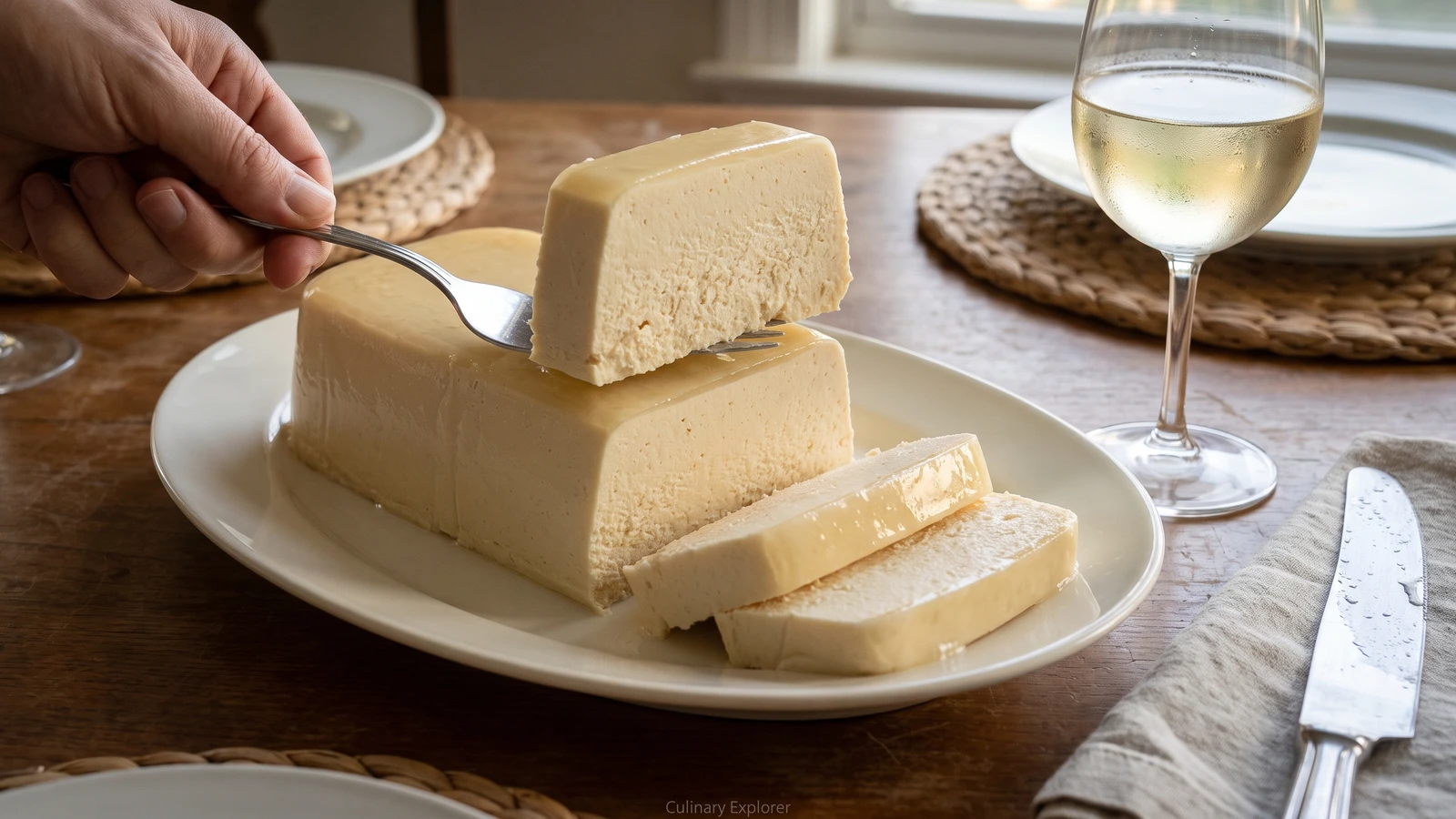
Mousse de volaille froide turns freshly roasted fowl, velouté, gelatin, and half-whipped cream into a cold, silken supper centerpiece, molded simply and made ahead without losing the clean flavor of the bird.
Mousse de Volaille Froide (cold poultry mousse) teaches that lightness is not the same as more air. The cream must be only half-whipped, thickened but unable to hold a peak; whip it firm and the chilled mousse turns dry and woolly. That is the one true thing to know before you touch a pan.
A poached fowl is permitted, but a freshly roasted one, scarcely cooled, gives the cleaner and more distinct flavor. The meat is worked with butter while still supple, bound with gelled velouté, passed through a sieve, and lightened with cream. The finished mousse should be close and silken, never spongy, with enough structure to hold a generous slice without feeling stiff on the tongue.
The original sends the cook to Préparation de la Mousse de Tomates (No. 814) for the governing proportions and assumes a saucier, pale velouté always ready, a tammy, large service molds, and plenty of cold space. Your equivalents are a finished quarter-cup of gelled chicken velouté from that linked formula, a food processor followed by a fine sieve, a four-cup mold, and the refrigerator. The large display and its decorative labor are brigade scaffolding and can go; the warm roast meat, butter, gelled velouté, sieve, and half-whipped cream are the dish and must stay. One cook, one stove, one evening.
Have the ice bath and mold ready before the base begins to cool. Fold in the cream when the chicken mixture is almost cold but still flexible, and stop whisking before that cream can hold a peak.
Mousse de volaille froide belongs to the classical Parisian cold-supper and buffet repertoire, not to one regional farmhouse larder, and was molded in enough quantity to serve several guests. Its structure is a savory bavarois (a gelled cream preparation without sugar): cooked poultry purée, velouté, gelatin, and cream, often finished with clear aspic or chaud-froid (a cold set sauce coating). The form passed from grand kitchens to bourgeois supper tables in smaller molds, while the preference for scarcely cooled roast fowl preserved a cleaner, more distinct flavor than poaching.
Quantity
1, about 3 lb (1.35 kg)
roasted, skinned, and boned; reserve 1 lb (450 g) of scarcely cooled meat
Quantity
1 tablespoon (15 ml / 14 g)
softened
Quantity
4 tablespoons (60 ml / 56 g)
melted and cooled until just warm
Quantity
2 teaspoons (10 ml / 12 g)
divided
Quantity
1/4 cup (60 ml / 60 g)
warm and fluid
Quantity
Up to 1 1/4 cups (300 ml / 300 g)
half-whipped; use a finished volume equal to half the sieved chicken base
Quantity
1 teaspoon (5 ml / 5 g)
Quantity
1/16 teaspoon (0.3 ml / 0.1 g)
Quantity
1/2 cup (120 ml / 120 g)
barely fluid, for glazing
Quantity
1 finished poultry application
for the alternate cold-fillet presentation
Quantity
1 finished poultry application
for an alternate mousse-and-fillet presentation
| Ingredient | Quantity |
|---|---|
| small roasting chickenroasted, skinned, and boned; reserve 1 lb (450 g) of scarcely cooled meat | 1, about 3 lb (1.35 kg) |
| unsalted butter for roastingsoftened | 1 tablespoon (15 ml / 14 g) |
| unsalted butter for the moussemelted and cooled until just warm | 4 tablespoons (60 ml / 56 g) |
| fine sea saltdivided | 2 teaspoons (10 ml / 12 g) |
| gelatine-thickened chicken velouté from the poultry application of Préparation de la Mousse de Tomates (No. 814)warm and fluid | 1/4 cup (60 ml / 60 g) |
| cold heavy creamhalf-whipped; use a finished volume equal to half the sieved chicken base | Up to 1 1/4 cups (300 ml / 300 g) |
| fresh lemon juice | 1 teaspoon (5 ml / 5 g) |
| cayenne pepper | 1/16 teaspoon (0.3 ml / 0.1 g) |
| clear poultry aspic (optional)barely fluid, for glazing | 1/2 cup (120 ml / 120 g) |
| Truites Saumonées Froides (No. 813) (optional)for the alternate cold-fillet presentation | 1 finished poultry application |
| Other Preparations of Trout after the same Recipe (No. 815) (optional)for an alternate mousse-and-fillet presentation | 1 finished poultry application |
Heat the oven to 425°F (220°C). Dry the chicken thoroughly, rub the skin with the softened butter, and season it with 1 1/2 teaspoons (9 g) of the salt. Roast until the skin is deeply golden, the breast reaches 165°F (74°C), and the thigh reaches at least 175°F (79°C), about 50 to 60 minutes. Let it rest for 15 minutes, no longer than needed to handle it comfortably; the mousse wants freshly roasted meat scarcely cooled, not yesterday's bird.
Remove every scrap of skin, bone, cartilage, and darkened clot while the chicken is still warm and supple. Weigh out 1 lb (450 g) of meat and tear it into small pieces, checking with your fingers as you go. Careful boning matters because the final sieve can refine fibers, but it cannot make a chip of bone disappear. Reserve any extra meat for another meal.
Set a 4-cup (1 L) mold nearby and rinse its interior with cold water. Have an ice bath ready. Warm the gelatine-thickened chicken velouté, the pale roux-bound poultry sauce supplied by the poultry application of Préparation de la Mousse de Tomates (No. 814), only until it flows freely. Do not boil it, because hard heat weakens gelatin and needlessly dulls a delicate sauce.
Put the 1 lb (450 g) of warm chicken and the 4 tablespoons (56 g) of melted butter in a food processor. Process until very fine, stopping twice to scrape the bowl, then add the 1/4 cup (60 ml) of gelled velouté from Préparation de la Mousse de Tomates (No. 814) and process again until smooth. This doubles the linked formula's half-pound proportions for a four-serving mold while keeping its ratio intact: chicken, butter, gelled velouté, then cream. Do not add the cream yet.
Press the warm chicken base through a fine-mesh sieve into a chilled bowl, working in small amounts with a firm flexible spatula. The processor replaces the old mortar, but the sieve stays; it removes the last dry fibers and gives the mousse its silken finish. If the base cools and becomes too stiff to pass, set its bowl briefly over warm water and stir until supple. Add no extra liquid. Set the sieved base over the ice bath and stir until almost cold, thickening slightly but still flexible.
Reserve 2 tablespoons of liquid cream, then whisk the rest only until it has body and the whisk leaves trails that disappear almost at once. It must not hold a peak. Measure the volume of the sieved chicken base and fold in half that volume of half-whipped cream, first one-third to loosen the base, then the remainder with broad, gentle turns. If the cream has gone too far and stands in points, stir in the reserved liquid cream until it relaxes. Ça se rattrape. Taste only now, then add the lemon juice, cayenne, and enough of the remaining salt to make the cold flavor clear but never sharp.
Spoon the mousse into the cold mold, pressing gently into the corners so no large air pockets remain. Tap the mold once against a folded towel, smooth the top, and cover it closely. Refrigerate for at least 4 hours, preferably overnight, until fully set at the center. If the mixture begins setting in the bowl before the mold is filled, place it over barely warm water and fold slowly just until it moves again, then mold it at once. Do not freeze it.
Dip the mold in warm water for 5 to 8 seconds, dry its outside, and invert it onto a chilled platter. If it clings, wrap the mold briefly in a warm damp towel; more soaking will melt the surface. For the book's sober finish, brush the set mousse with two or three very thin coats of barely fluid poultry aspic, chilling each coat until set before adding the next.
Let the mousse stand outside the refrigerator for 10 minutes, then cut generous slices with a thin knife dipped in hot water and wiped dry between cuts. For the book's alternate fillet service, reach for Truites Saumonées Froides (No. 813) or Other Preparations of Trout after the same Recipe (No. 815) as separate finished poultry applications; neither is folded into this four-serving mold. Serve the mousse cool, not icy. À table!
1 serving (about 270g)
Culinary guides, cultural storytelling, and the editorial depth that makes cooking meaningful.
Discover Culinary ExplorerChef Juliette
John Dory has the delicacy of sole and the firmness of turbot. A light flouring, a quick butter sauté, and nut-brown beurre noisette show exactly why looks never mattered.

Chef Juliette
Fresh haddock proves its delicacy in the meunière pan: a fine flour crust, moist pearly flakes, and beurre noisette sharpened with lemon and parsley, ready from one skillet in half an hour.

Chef Juliette
Éperlans à l’Anglaise turns small fish into a lesson in disciplined coating: boned smelts under a close, crisp crumb, pan-fried in clarified butter and finished with bright, half-melted maître d’hôtel butter.

Chef Juliette
Tiny smelts, shallot, mushrooms, white wine, gratin sauce, and fine bread raspings meet a fierce oven, where the fish must turn tender in the same breath the buttered crust bronzes.