
Chef Juliette
Selle de Chevreuil et Cuissot
Selle de Chevreuil et Cuissot teaches the discipline of game: strip every tendon, skip marinade for a young, well-hung joint, roast in butter, and stop before leanness turns to dryness.
A cooking platform built around craft, culture, and the stories behind what we eat.
Created by Chef Juliette
Based on No. 1829, Faisan à la Mode d’Alcantara, from Le Guide Culinaire (1907) by Auguste Escoffier
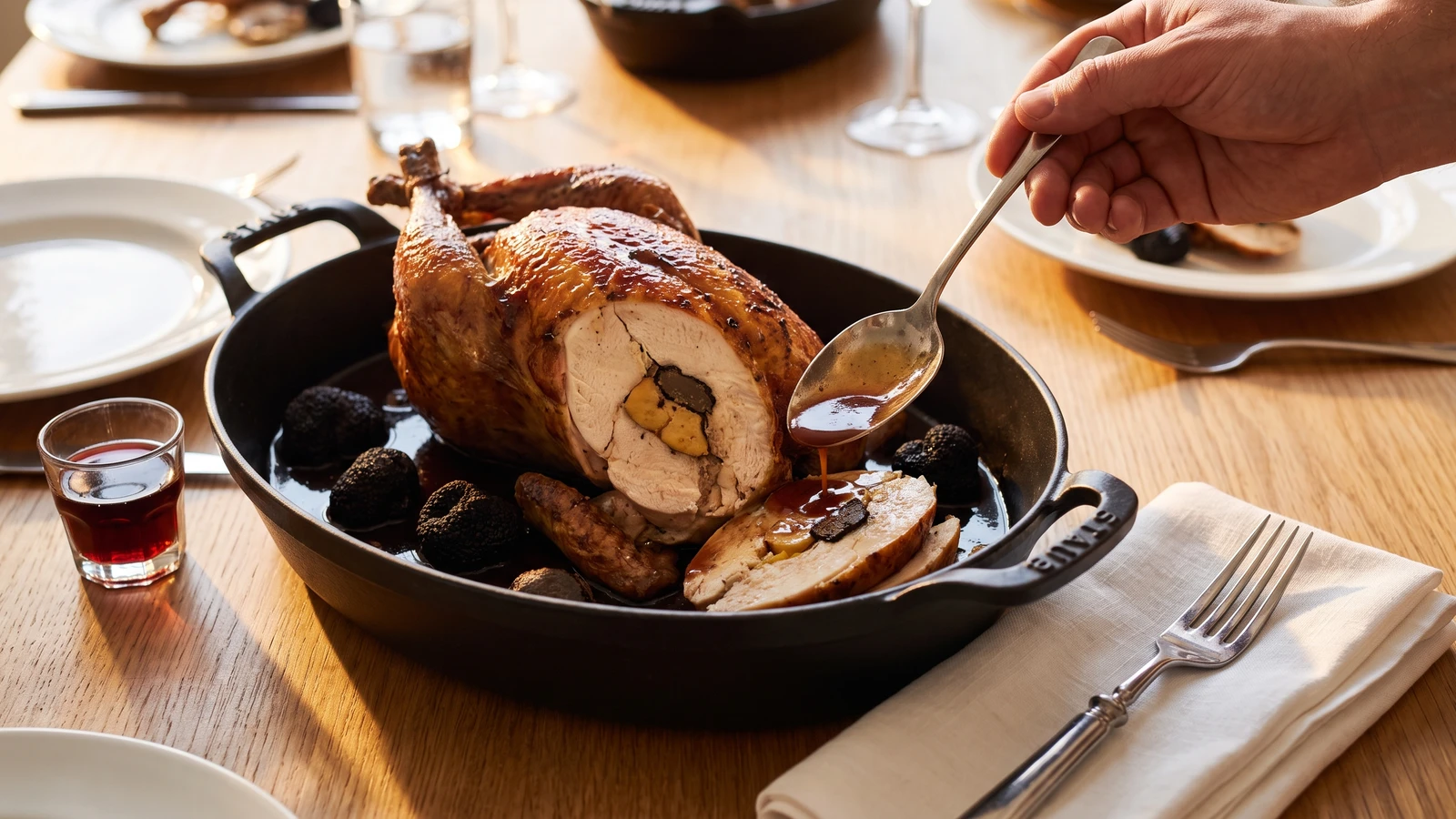
Faisan à la Mode d’Alcantara protects lean pheasant with foie gras, perfumes it with port and black truffle, then finishes the bird en casserole in a glossy, wine-dark sauce made for a celebration.
Faisan à la Mode d’Alcantara (pheasant with foie gras, truffles, and port) teaches the discipline behind luxurious game cookery: richness must protect a lean bird, not smother it. The pheasant spends three days beneath port, its boned breast filled with foie gras and port-cooked truffle, then it cooks en casserole so the meat stays succulent while the wine becomes a dark, glossy reduction.
The grand recipe assumed a saucier on staff, a stock never off the fire, game glaze waiting, and enough truffles to count by the dozen. It mentions the spit, then wisely rejects it because lean pheasant dries there. At home, a snug food-safe bag replaces the marinating vat, a lidded oval casserole replaces the spit and terrine, prepared game glaze replaces the resident stockpot, and foil beneath the lid replaces a flour-paste seal. It needed no salamander, and neither do you. Those old pieces of equipment are scaffolding; the three-day port bath, partial boning, foie gras filling, and extravagant truffle finish are the dish and must stay.
One cook, one stove, one evening of active cooking, after the marinade has done its quiet work. The step that decides the result is temperature: stop the first roast while the stuffing is still below its final mark, then let the sealed truffle finish carry it precisely to 165°F (74°C).
Faisan à la Mode d’Alcantara enters the French classical canon from the convent table of Alcántara in Extremadura, not from a French province. The received French account says a commissariat officer rescued a monastic recipe from papers being torn into cartridges during the Portuguese campaign, then carried it to the Duchess of Abrantès and into grand-kitchen circulation. The revealing correction is that the convent recipe was for partridge; pheasant, the casserole finish, and the à la Souvaroff treatment belong to its French adaptation.
Quantity
1 bird, about 3 to 3½ pounds (1.4 to 1.6 kg)
drawn through the neck if possible
Quantity
1½ teaspoons (7.5 ml / 9 g)
divided
Quantity
¾ teaspoon (3.75 ml / 2 g)
divided
Quantity
1¼ cups (300 ml / 225 g)
trimmed and cut into ¾-inch cubes
Quantity
2 medium, about ⅓ cup (80 ml / 50 g)
quartered
Quantity
1 bottle (3⅛ cups / 750 ml / 750 g)
divided
Quantity
1 cup (240 ml / 250 g) Cooked Marinade for Venison (No. 168)
prepared separately and completely chilled
Quantity
1 home-scaled Poëlings (No. 250) preparation for 1 pheasant
use in its en casserole form
Quantity
12 medium, about 2 cups (480 ml / 300 g)
cleaned or drained if preserved
Quantity
½ cup (120 ml / 130 g)
Quantity
3 tablespoons (45 ml / 42 g)
cold and cubed
| Ingredient | Quantity |
|---|---|
| oven-ready farmed pheasantdrawn through the neck if possible | 1 bird, about 3 to 3½ pounds (1.4 to 1.6 kg) |
| fine saltdivided | 1½ teaspoons (7.5 ml / 9 g) |
| freshly ground black pepperdivided | ¾ teaspoon (3.75 ml / 2 g) |
| raw duck foie grastrimmed and cut into ¾-inch cubes | 1¼ cups (300 ml / 225 g) |
| black truffles for the stuffingquartered | 2 medium, about ⅓ cup (80 ml / 50 g) |
| ruby Portdivided | 1 bottle (3⅛ cups / 750 ml / 750 g) |
| Cooked Marinade for Venisonprepared separately and completely chilled | 1 cup (240 ml / 250 g) Cooked Marinade for Venison (No. 168) |
| Poëlingsuse in its en casserole form | 1 home-scaled Poëlings (No. 250) preparation for 1 pheasant |
| black truffles for finishingcleaned or drained if preserved | 12 medium, about 2 cups (480 ml / 300 g) |
| prepared game glaze | ½ cup (120 ml / 130 g) |
| unsalted buttercold and cubed | 3 tablespoons (45 ml / 42 g) |
Work through the neck opening so the breast skin remains whole. Remove the wishbone, then use short strokes of a boning knife to free the breast flesh from the inner face of the ribs and breastbone. Snip the breast cage free at its joints and lift it out, leaving the leg and wing bones in place. You are making a pocket, not flattening the bird. If the skin is nicked, close the tear with a small skewer and kitchen twine. Ça se rattrape.
Put the quartered stuffing truffles and ½ cup (120 ml) of the Port in a small saucepan. Simmer gently until the Port reduces to about ¼ cup (60 ml) and the truffles smell deep and earthy, about 5 minutes. Cool completely, then fold the truffles and their syrup through the cold foie gras with ½ teaspoon of the salt and ¼ teaspoon of the pepper. Keep the cubes distinct. If the foie gras softens or begins to look oily, stop and chill the filling for 15 minutes before continuing.
Pack the foie gras and truffle filling loosely into the boned breast cavity. Close the neck opening with skewers and twine, then truss the legs against the body without squeezing the filling out. Combine the remaining Port with the completely chilled Cooked Marinade for Venison (No. 168). Place the pheasant and marinade in a snug food-safe bag, press out the air, seal, and set it on a rimmed tray in a refrigerator held between 32 and 38°F (0 and 3°C). Marinate for 72 hours, turning the bag morning and evening so the bird remains covered. Alcohol is flavor, not a room-temperature safety system.
Lift the pheasant from the marinade and strain every drop of liquid into a saucepan. Keep it cold until reduction. Pat the bird thoroughly dry, inside every fold and around every joint, then leave it uncovered in the refrigerator for 30 minutes. Season the exterior with the remaining salt and pepper. A wet pheasant cannot brown, and browning is the foundation beneath all this foie gras and truffle. Heat the oven to 350°F (175°C).
Use the home-scaled Poëlings (No. 250) preparation in its en casserole form, the butter-roasting treatment specified for a bird cooked without added liquid. Heat its butter in a heavy oval casserole over medium heat, then color the pheasant on every side until the skin is an even hazelnut bronze, about 8 minutes. Turn it carefully with two wooden spoons so the skin stays intact. Do not moisten the casserole at this stage. Liquid would turn the poëling into a braise and wash away the clean flavor of the game.
Set the pheasant breast up, cover the casserole, and roast for 30 minutes. Baste it with the butter in the casserole, uncover, and continue roasting for 15 to 25 minutes, until the center of the foie gras stuffing reaches 154°F (68°C). The sealed finish will carry it to its safe final temperature. If the breast is already deeply colored while the center remains cool, shield only the breast with buttered foil and keep cooking. More heat is not the answer; protection is.
While the pheasant roasts, bring the reserved port mixture containing Cooked Marinade for Venison (No. 168) to a full rolling boil for 5 minutes before tasting it, because it has held raw game. Skim away any grey foam, then reduce briskly to about 1 cup (240 ml). Add the game glaze and simmer until the sauce coats the back of a spoon in a clear, wine-dark layer. Take it off the heat and whisk in the cold butter a few cubes at a time. If the reduction becomes sticky, loosen it with a tablespoon of boiling water; if the butter beads on the surface, whisk in a teaspoon of cold water away from the heat. Ça se rattrape.
Lift the pheasant briefly from its casserole and pour off the excess cooking fat, leaving the browned fond untouched. Add the port sauce and scrape the casserole floor gently to dissolve that fond. Arrange the 12 whole truffles in the sauce and set the pheasant directly over them. For the à la Souvaroff finish, meaning a sealed terrine finish, press a sheet of heavy foil over the casserole before replacing the lid. This replaces the original flour-paste seal without losing its purpose. Return the casserole to the oven for 10 minutes, or until the center of the stuffing reaches 165°F (74°C).
Rest the pheasant under its lid for 10 minutes. Remove the trussing, take off the legs, and carve the breasts crosswise so each slice carries pheasant, foie gras, and truffle together. Arrange the meat on a warm platter or return it to the casserole, giving each diner three whole truffles. Warm the sauce gently if necessary, but never boil it after the butter has gone in. Spoon it generously over the carved bird. À table!
1 serving (about 355g)
Culinary guides, cultural storytelling, and the editorial depth that makes cooking meaningful.
Discover Culinary ExplorerChef Juliette
Selle de Chevreuil et Cuissot teaches the discipline of game: strip every tendon, skip marinade for a young, well-hung joint, roast in butter, and stop before leanness turns to dryness.

Chef Juliette
A three-day marinade perfumes this lean saddle, but the roast lives or dies by its rosy center; the tray fond, cream, meat glaze, and one juniper berry make the sauce.

Chef Juliette
A butter-poêled venison saddle, carved rosy and flanked by unsweetened pears scented with cinnamon and lemon, with clear game jus and redcurrant jelly at the table.

Chef Juliette
Verjuice perfumes rather than pickles this saddle, while a thermometer protects its rosy centre. Poivrade and red-currant jelly meet in strict equality, with semi-candied cherries folded through for the generous game table.