
Chef Juliette
John Dory (St. Pierre)
John Dory has the delicacy of sole and the firmness of turbot. A light flouring, a quick butter sauté, and nut-brown beurre noisette show exactly why looks never mattered.
A cooking platform built around craft, culture, and the stories behind what we eat.
Created by Chef Juliette
Based on No. 1822, Lièvre en Daube, from Le Guide Culinaire (1907) by Auguste Escoffier
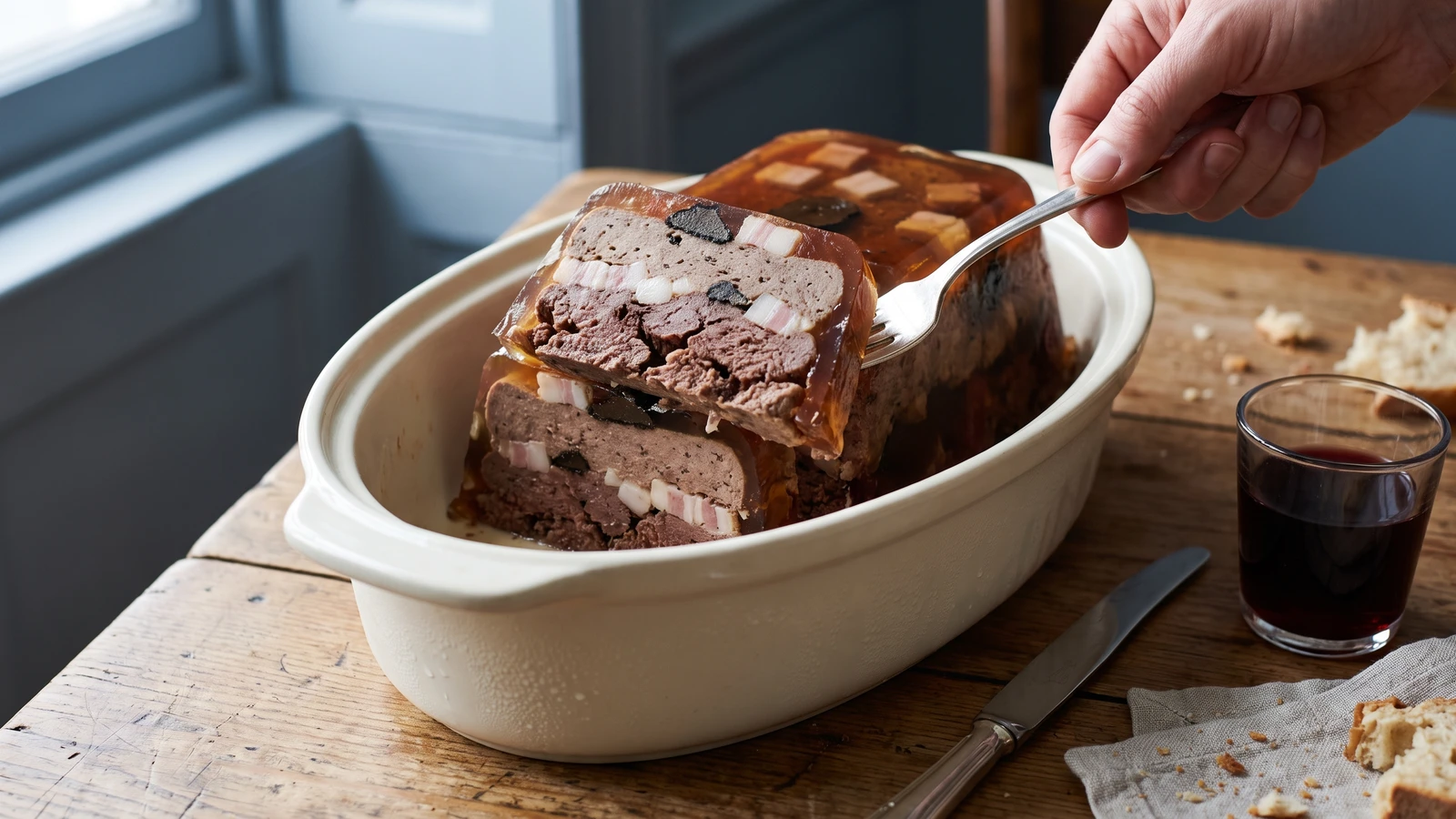
A whole hare reconstructed around two truffled forcemeats, braised gently under bacon and set cold in wine-dark jelly: a demanding but orderly lesson in temperature, texture, and the discipline of a clean slice.
Lièvre en daube (boned hare stuffed with two forcemeats, braised in a terrine, and set in jelly) teaches the discipline behind every fine cold preparation: the slice is built before the oven ever warms. The one true thing to know is this: the forcemeat must remain cold. Cold fat stays distinct, binds to the hare, and cuts cleanly; warm fat smears, leaks, and leaves a crumbly center.
The source assumed a game butcher who could bone a head-on hare through the back, a cook at the sieve, a saucier with red-wine fumet ready, and savory jelly from a stockpot that never went cold. At home, ask the butcher to make the difficult back opening, use a chilled processor and sturdy fine sieve for the old pounding, make the fumet from the reserved bones in one saucepan, and reinforce the strained cooking liquor with measured gelatin. The enormous pots of marinade and jelly were brigade scaffolding, so they become one cup and one terrine; the back boning, equal weights of hare and fat bacon, two forcemeats, bacon wrapping, uncovered start, three-hour covered cook, and two-hour cold set are the dish and stay.
This version is scaled around one small hare for four, with the shoulder-and-leg meat and fat bacon held at equal weights, and the added fat bacon and truffle kept at the source's eight-to-five ratio. One cook, one stove, one evening. Keep the bowl over ice while you mix, and if the forcemeat begins to shine, stop and chill it before continuing.
Daube belongs most strongly to Provence and the lower Rhône, where the word names long, covered cooking in wine in a deep earthenware daubière. Lièvre en daube carried game from the hunt into that slow-cooking practice, but this classical kitchen form transformed the stew into a boned, stuffed terrine served cold under jelly. The animal-at-rest shape is not merely display: preserving the belly skin creates a natural casing for the two forcemeats and allows the cooked hare to cut as one composed slice.
Quantity
1, 3½ to 4 lb / 1.6 to 1.8 kg
Head attached, opened and boned through the back with the belly skin intact; shoulder and leg meat, liver, and bones reserved
Quantity
1 cup (240 ml / 240 g) Cooked Marinade for Venison (No. 168)
Prepared and fully chilled
Quantity
½ cup (120 ml / 113 g)
Divided
Quantity
1 tablespoon (15 ml / 18 g)
Divided
Quantity
1½ teaspoons (7.5 ml / 3 g)
Divided
Quantity
1 tablespoon (15 ml / 14 g)
Quantity
1 bottle (3⅛ cups / 750 ml / 740 g)
Quantity
3 cups (720 ml / 720 g)
Quantity
About 1½ cups diced (12 oz / 340 g)
Chilled; use exactly the same weight as the trimmed shoulder and leg meat
Quantity
1
Quantity
½ teaspoon (2.5 ml / 0.5 g)
Quantity
½ teaspoon (2.5 ml / 1 g)
Quantity
¾ cup (180 ml / 170 g) Gratins (No. 268)
Made with the reserved hare liver, fat bacon, and truffle parings; chilled
Quantity
½ cup diced (4 oz / 113 g)
Chilled
Quantity
½ cup diced (2½ oz / 71 g)
Preserved truffles well drained
Quantity
20 to 24 slices (1 lb / 450 g)
For wrapping and lining
Quantity
2 envelopes (4½ teaspoons / 22.5 ml / 14 g)
Quantity
¼ cup (60 ml / 60 g)
For blooming the gelatin
Quantity
1 teaspoon (5 ml / 3 g)
For rescuing a weak jelly
| Ingredient | Quantity |
|---|---|
| small fresh hareHead attached, opened and boned through the back with the belly skin intact; shoulder and leg meat, liver, and bones reserved | 1, 3½ to 4 lb / 1.6 to 1.8 kg |
| Cooked Marinade for Venison (No. 168)Prepared and fully chilled | 1 cup (240 ml / 240 g) Cooked Marinade for Venison (No. 168) |
| French brandyDivided | ½ cup (120 ml / 113 g) |
| fine saltDivided | 1 tablespoon (15 ml / 18 g) |
| freshly ground black pepperDivided | 1½ teaspoons (7.5 ml / 3 g) |
| unsalted butter | 1 tablespoon (15 ml / 14 g) |
| dry red wine | 1 bottle (3⅛ cups / 750 ml / 740 g) |
| cold water | 3 cups (720 ml / 720 g) |
| lightly salted fat bacon or unsmoked fatbackChilled; use exactly the same weight as the trimmed shoulder and leg meat | About 1½ cups diced (12 oz / 340 g) |
| large egg | 1 |
| dried wild thyme | ½ teaspoon (2.5 ml / 0.5 g) |
| quatre-épices | ½ teaspoon (2.5 ml / 1 g) |
| Gratins (No. 268), prepared as hare-liver gratin forcemeatMade with the reserved hare liver, fat bacon, and truffle parings; chilled | ¾ cup (180 ml / 170 g) Gratins (No. 268) |
| lightly salted fat bacon or unsmoked fatbackChilled | ½ cup diced (4 oz / 113 g) |
| fresh or preserved black trufflesPreserved truffles well drained | ½ cup diced (2½ oz / 71 g) |
| thin unsmoked streaky baconFor wrapping and lining | 20 to 24 slices (1 lb / 450 g) |
| powdered gelatin | 2 envelopes (4½ teaspoons / 22.5 ml / 14 g) |
| ice-cold waterFor blooming the gelatin | ¼ cup (60 ml / 60 g) |
| additional powdered gelatin (optional)For rescuing a weak jelly | 1 teaspoon (5 ml / 3 g) |
Lay the hare belly-down and inspect the back opening. The ribs and spine should be removed without piercing the belly skin, while the saddle meat remains attached inside its natural casing. Trim the shoulder and leg meat from their bones and chill it immediately. Season the hare inside and out with 2 teaspoons of the salt and 1 teaspoon of the pepper, then place it in a snug nonreactive dish with the Cooked Marinade for Venison (No. 168) and 2 tablespoons of the brandy. Cover, chill for 1 hour, and turn once. Reserve 2 tablespoons of the brandy-scented marinade for the forcemeat, where it will cook fully, then discard the rest.
While the hare marinates, prepare the fumet, the concentrated game essence that replaces the brigade stockpot. Melt the butter in a heavy saucepan over medium-high heat and brown the reserved bones thoroughly, turning them until their surfaces are deep bronze and the pan floor carries a dark fond. Pour in the red wine gradually, scraping up every brown deposit, then reduce it by about one-third. Add the cold water and hold at a bare simmer for 45 minutes. Strain and reduce or dilute with hot water as needed to make 4 cups. Reserve 1 cup separately for the jelly and keep the remaining fumet hot. If part of the fond burns black, leave that patch behind rather than scraping bitterness into the liquid.
Weigh the chilled shoulder and leg meat, then weigh out exactly the same amount of chilled fat bacon or fatback. The equality matters; it is the source recipe's governing ratio. Chill the processor blade or grinder parts for 15 minutes, then grind or pulse the meat and fat with the egg, wild thyme, quatre-épices, reserved marinade, remaining salt, and remaining pepper until cohesive and tacky. Rub this forcemeat through a sturdy fine-mesh sieve, pressing firmly with a scraper. Fold in the prepared hare-liver component from Gratins (No. 268), followed by the diced fat bacon and truffles. Fry a teaspoonful until fully cooked and taste for seasoning. If the mixture becomes glossy, greasy, or warm, stop. Ça se rattrape: spread it in a shallow bowl, chill it for 20 minutes, then continue with the bowl set over ice.
Drain the hare and dry it thoroughly inside and out. Spread the forcemeat evenly along the belly and saddle, pressing it into the shoulder and leg spaces before mounding the remainder through the center. Pack firmly enough to exclude air pockets, but do not stretch the skin. Draw the back opening together and sew it closed with butcher's twine in close, even stitches. Fold the limbs into a resting position and tie the head back against the body, restoring the hare's compact natural outline. If the skin tears, place a bacon slice across the weak spot and secure it with a cross-tie; the bacon becomes an honest patch and protects the filling.
Heat the oven to 400°F (200°C). Line a 4-quart oval terrine crosswise with half the streaky bacon, leaving enough overhang to fold inward. Wrap the reconstructed hare with the remaining slices and settle it snugly into the terrine, sewn side down. Fold over the lining bacon and pour the remaining brandy around the hare. Set the uncovered terrine on a rimmed baking sheet and cook for 30 minutes. This uncovered beginning supplies the browning, so there is no need to imitate a salamander under a home broiler.
Reduce the oven to 300°F (150°C). Pour about 3 cups of the hot fumet around the hare, bringing the liquid roughly two-thirds of the way up its sides without washing over the browned bacon. Cover the terrine and cook gently for 3 hours. The liquid should barely tremble, never boil hard, and the center of the forcemeat must reach at least 160°F (71°C). If the liquid bubbles aggressively, lower the oven to 275°F (135°C); if the level falls below halfway, add a little hot water. Continue beyond 3 hours in 15-minute intervals if the center has not reached temperature.
Leave the covered terrine to half-cool for 30 minutes, no longer. Lift the hare carefully onto a tray with two broad spatulas, then pour the cooking liquor through a fine-mesh sieve lined with damp cheesecloth. Remove the bacon wrapping without tearing the skin, skim the clear fat from the strained liquor, and return the hare to the wiped terrine. Leave the sewing and shaping ties in place until the jelly has set.
Bloom the gelatin in the ice-cold water for 5 minutes. Measure the strained cooking liquor and add enough reserved fumet to make 3 cups; if there is more, reduce it gently to that amount. Warm the liquid without boiling, dissolve the bloomed gelatin in it, and taste for salt. Chill a spoonful on a cold saucer for 5 minutes. It should form a tender jelly that holds when tilted. If it remains liquid, bloom the optional extra gelatin in a tablespoon of cold cooking liquor and whisk it into the warm mixture. Pour the savory jelly around the hare, working slowly so it fills every space in the terrine.
Set the terrine in a shallow bath of ice water for 20 minutes, then cover and refrigerate for at least 2 hours; overnight gives the cleanest slices. Remove every visible thread and shaping tie before carving. Cut the hare crosswise with a thin knife dipped in hot water and wiped dry between cuts, keeping the amber-red jelly with each slice. The forcemeat should be close and smooth, with distinct cubes of fat bacon and black truffle held inside. À table!
1 serving (about 620g)
Culinary guides, cultural storytelling, and the editorial depth that makes cooking meaningful.
Discover Culinary ExplorerChef Juliette
John Dory has the delicacy of sole and the firmness of turbot. A light flouring, a quick butter sauté, and nut-brown beurre noisette show exactly why looks never mattered.

Chef Juliette
Fresh haddock proves its delicacy in the meunière pan: a fine flour crust, moist pearly flakes, and beurre noisette sharpened with lemon and parsley, ready from one skillet in half an hour.

Chef Juliette
Éperlans à l’Anglaise turns small fish into a lesson in disciplined coating: boned smelts under a close, crisp crumb, pan-fried in clarified butter and finished with bright, half-melted maître d’hôtel butter.

Chef Juliette
Tiny smelts, shallot, mushrooms, white wine, gratin sauce, and fine bread raspings meet a fierce oven, where the fish must turn tender in the same breath the buttered crust bronzes.