
Chef Juliette
John Dory (St. Pierre)
John Dory has the delicacy of sole and the firmness of turbot. A light flouring, a quick butter sauté, and nut-brown beurre noisette show exactly why looks never mattered.
A cooking platform built around craft, culture, and the stories behind what we eat.
Created by Chef Juliette
Based on No. 1793, Selle de Chevreuil à la Baden-Baden, from Le Guide Culinaire (1907) by Auguste Escoffier
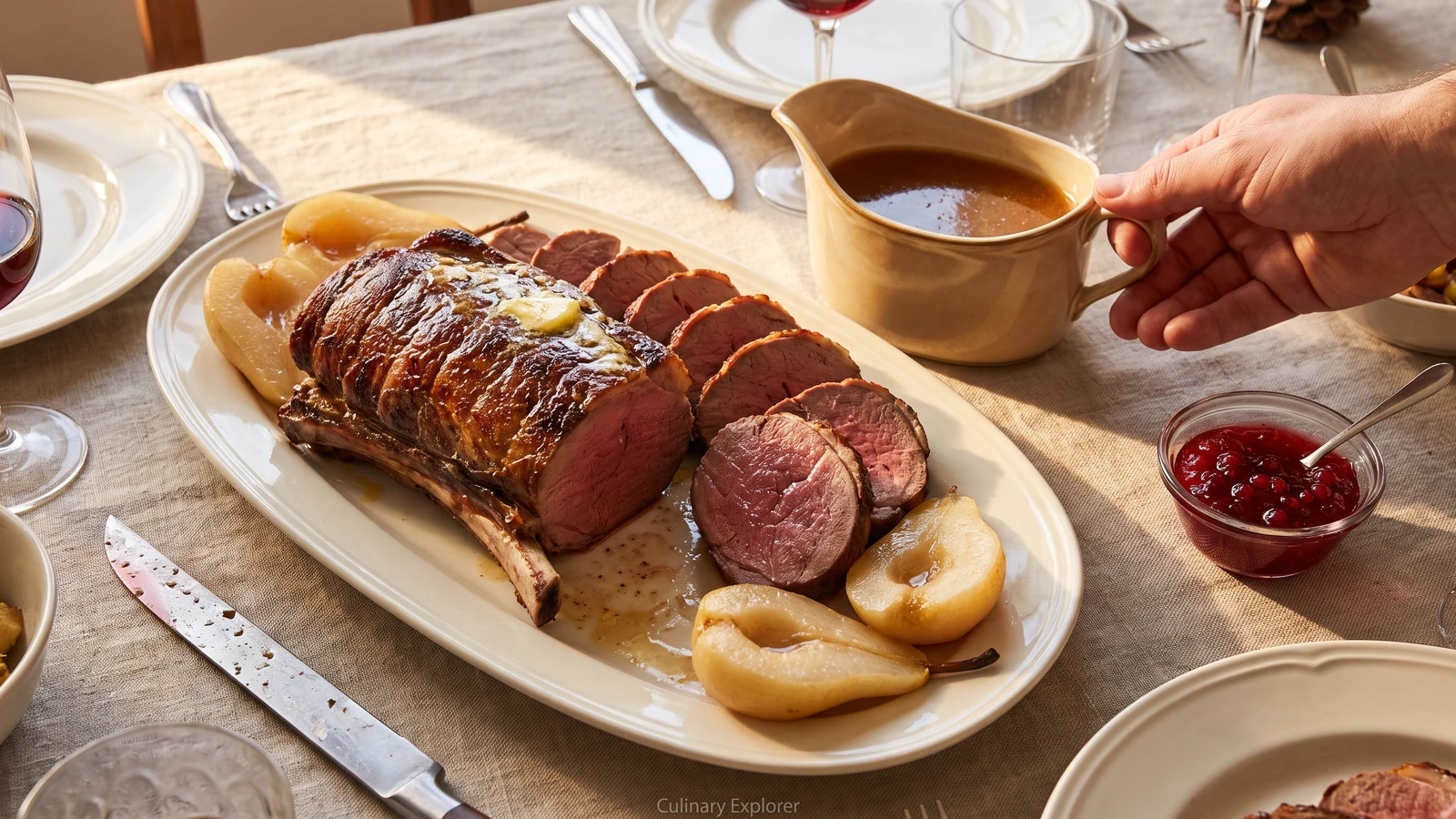
A butter-poêled venison saddle, carved rosy and flanked by unsweetened pears scented with cinnamon and lemon, with clear game jus and redcurrant jelly at the table.
Selle de Chevreuil à la Baden-Baden (saddle of venison with unsugared spiced pears) teaches the discipline that game demands: moisture is the enemy of colour. The saddle comes from an aromatic marinade carrying all the seasoning it needs, but before it meets the butter, its surface must be dried until it feels almost tacky. Leave it wet and it will grey rather than bronze, however splendid the venison.
The original assumed a five-quart preparation of marinade, a deep poêling pan, a saucier at the elbow, and game stock never off the fire. Here, a small saddle for four needs only one quart of the finished marinade, a snug covered roasting pan, a fine sieve, and a gravy separator. The cloth straining and service holding were brigade scaffolding, so they go. The Cooked Marinade for Venison, butter-rich poëling, ten-minute extraction of the roasting vegetables, unsugared pears, arrowroot finish, and separate redcurrant jelly are the dish itself, so they stay. One cook, one stove, one evening.
The finished saddle should arrive rosy beneath a burnished surface, with tender pear halves at either end and a clear, lightly thickened jus gleaming in its sauceboat. Dry the joint thoroughly before cooking. That is the one step you cannot negotiate, and the one that gives everything after it a chance to be magnificent.
Baden-Baden stands in Baden on the edge of Germany’s Black Forest, where venison, orchard fruit, and tart redcurrants belong naturally to the local table. French grand kitchens drew the spa city into their garnish vocabulary, pairing saddle of game with unsweetened cinnamon-and-lemon pears rather than disguising the meat beneath a sweet sauce. The name marks a French classical interpretation of Baden’s larder, not a claim that the dish belongs to a French region.
Quantity
1 saddle, 3½ to 4 lb (1.6 to 1.8 kg)
trimmed of silverskin
Quantity
1 cup (240 ml / about 120 g)
reserved before the marinade touches the raw meat
Quantity
1 teaspoon (5 ml / 5 g)
Quantity
1 teaspoon (5 ml / 2 g)
Quantity
6 tablespoons (90 ml / 85 g)
melted
Quantity
4 pears, about 1¼ lb (570 g)
peeled, halved, and cored
Quantity
3 cups (720 ml / 720 g)
Quantity
1
Quantity
4 wide strips from 1 lemon
cut without the white pith
Quantity
¾ cup (180 ml / about 180 g)
Quantity
2 teaspoons (10 ml / 6 g)
Quantity
1 tablespoon (15 ml / 15 g)
Quantity
⅓ cup (80 ml / about 100 g)
| Ingredient | Quantity |
|---|---|
| small bone-in saddle of venisontrimmed of silverskin | 1 saddle, 3½ to 4 lb (1.6 to 1.8 kg) |
| Cooked Marinade for Venison (No. 168)completely cold | 4 cups (960 ml / about 960 g) |
| strained vegetables from the Cooked Marinade for Venison (No. 168)reserved before the marinade touches the raw meat | 1 cup (240 ml / about 120 g) |
| Poëlings (No. 250), referenced butter-cooking methodfollowed for the saddle | 1 application |
| fine sea salt | 1 teaspoon (5 ml / 5 g) |
| freshly ground black pepper | 1 teaspoon (5 ml / 2 g) |
| unsalted buttermelted | 6 tablespoons (90 ml / 85 g) |
| small firm pearspeeled, halved, and cored | 4 pears, about 1¼ lb (570 g) |
| water | 3 cups (720 ml / 720 g) |
| cinnamon stick | 1 |
| lemon rindcut without the white pith | 4 wide strips from 1 lemon |
| well-seasoned game stock | ¾ cup (180 ml / about 180 g) |
| arrowroot | 2 teaspoons (10 ml / 6 g) |
| cold water | 1 tablespoon (15 ml / 15 g) |
| redcurrant jelly | ⅓ cup (80 ml / about 100 g) |
Set the saddle in a close-fitting nonreactive container and pour over the completely cold Cooked Marinade for Venison (No. 168). Cover and refrigerate for 12 hours, turning the joint two or three times so every surface spends time in the liquid. Keep the reserved vegetables from the Cooked Marinade for Venison (No. 168) chilled separately; they must have been removed before the marinade touched the raw venison.
Lift the saddle from the marinade and discard the used liquid. Blot the joint with several changes of clean kitchen paper, pressing into every hollow around the backbone, then set it uncovered on a rack in the refrigerator for 45 to 60 minutes. The surface is ready when it feels dry and slightly tacky. If beads of moisture return, blot again and wait another 15 minutes. Ça se rattrape, but only before the meat meets the butter.
Put the pear halves in a snug saucepan with the water, cinnamon stick, and lemon rind. Bring just to a simmer, cover with a small lid or parchment round, and cook gently for 15 to 25 minutes, turning once, until a knife enters cleanly but the fruit still holds its shape. There is no sugar here. The pears should soften the game’s richness, not turn the plate into dessert. Remove the pan from the heat and leave the pears in their liquid.
Heat the oven to 350°F (175°C). Spread the reserved vegetables from the Cooked Marinade for Venison (No. 168) across the bottom of a snug, deep roasting pan. Season the dry saddle with the salt and pepper, set it bone-side down on the vegetables, and pour over 4 tablespoons (60 ml / 57 g) of the melted butter. Cover tightly with a lid or buttered parchment and foil. This is Poëlings (No. 250), covered butter-roasting: add no stock or other liquid now, because moisture would turn the poëling into a braise.
Cook the covered saddle for 20 minutes. Uncover it, baste thoroughly with the butter in the pan, add the remaining 2 tablespoons (30 ml / 28 g) melted butter, and raise the oven to 425°F (220°C). Continue uncovered, basting every 7 to 8 minutes, until the surface is deeply bronzed and the thickest part of the loin reaches 130°F (54°C), usually another 15 to 25 minutes. It should rest to about 135°F (57°C). If the saddle remains pale, spoon away any watery liquid, blot the exposed surface carefully, brush it with hot butter, and give it another few minutes in the hot oven. Ça se rattrape.
Transfer the saddle to a warm long platter and tent it loosely with foil for 15 minutes. Keep every vegetable, browned speck, and drop of butter in the roasting pan. Resting lets the heat settle through the loin and keeps the juices in the meat when you carve; cut immediately and those juices belong to the board instead.
Set the roasting pan over gentle heat, or scrape its entire contents into a saucepan if the pan is not stovetop-safe. Pour in the game stock and simmer for exactly 10 minutes, scraping up the fond and keeping the stock in contact with both vegetables and butter. Do not remove the fat first. It carries the roasted aromas into the stock during this extraction. Strain through a fine sieve, pressing lightly, then remove the fat with a gravy separator or shallow spoon.
Return the clear stock to a clean small saucepan. Mix the arrowroot with the cold water until perfectly smooth, then whisk it into the simmering stock a little at a time, holding back the final spoonful until you see the texture. Cook for only 30 to 60 seconds, until the jus lightly coats a spoon while remaining clear and fluid. Arrowroot turns gluey if overcooked. If it tightens too far, whisk in hot water a teaspoon at a time; if it remains thin, add the reserved slurry. Ça se rattrape.
Warm the pears gently in their cooking liquid, then drain them well. Run a sharp knife along each side of the saddle’s backbone, lift off the loins, and cut them across the grain into generous slices. Return the slices to the platter in their original lines, with the bone between them, and arrange the unsugared pear halves at either end. Pour the game jus into a warm sauceboat and place the redcurrant jelly in a small bowl, serving both separately as the source directs. Never apologize at your own table. À table!
1 serving (about 400g)
Culinary guides, cultural storytelling, and the editorial depth that makes cooking meaningful.
Discover Culinary ExplorerChef Juliette
John Dory has the delicacy of sole and the firmness of turbot. A light flouring, a quick butter sauté, and nut-brown beurre noisette show exactly why looks never mattered.

Chef Juliette
Fresh haddock proves its delicacy in the meunière pan: a fine flour crust, moist pearly flakes, and beurre noisette sharpened with lemon and parsley, ready from one skillet in half an hour.

Chef Juliette
Éperlans à l’Anglaise turns small fish into a lesson in disciplined coating: boned smelts under a close, crisp crumb, pan-fried in clarified butter and finished with bright, half-melted maître d’hôtel butter.

Chef Juliette
Tiny smelts, shallot, mushrooms, white wine, gratin sauce, and fine bread raspings meet a fierce oven, where the fish must turn tender in the same breath the buttered crust bronzes.